
What fruit flies can teach us about the human brain
By Adrian Ephraim
Dopamine. It’s the brain’s in-house drug of choice; a neurotransmitter that deals in feelings of pleasure and reward, sending messages that translate into warm and fuzzy emotions.
For millennials, it’s that feeling they get when they discover a new notification or a mention on Instagram. That feeling derived from instant gratification, or when they get 100 Likes for random pieces of content. For older folk, it’s the feeling they get when stumbling upon a song they haven’t heard in a decade or speaking to a friend they haven’t seen in a lifetime. It’s that sensation you get when eating a chocolate, going on a morning hike or getting a full night’s sleep. It’s that winning feeling that is the curtain raiser to a rush of adrenaline.
Dopamine is the “feel-good” chemical in our brain that has, in fact, driven our evolution as a species and inspired us to seek new frontiers, break limits to our bodies, discover new forms of arousal and pleasure, and learn new skills. It has also inspired countless music hits, all sharing the same title. Dopamine.
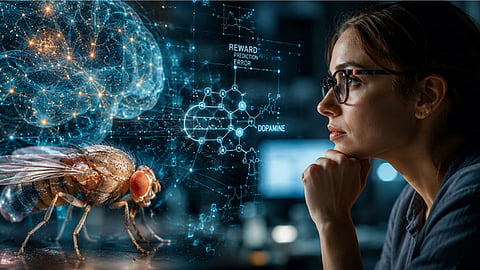
Now, informatics experts at the University of Sussex believe they have found a model that links similarities between dopamine signals in the human brain, and that of fruit flies which (beyond sounding like a cruel joke) show similarities in the way mammals and insects learn.
The Sussex team has developed a new computational model that reveals the link between human and insect learning. What this means is that they’ve discovered that dopamine neurons in the area of the fruit fly’s brain, called the mushroom body, like dopamine neurons in human brains, can trigger learning through the promise of a “reward” and a “feel-good” factor, using the reward prediction error (RPE) hypothesis.
Drugs that are abused boost dopamine function. This increase enhances the “rewarding” effects of the drug, like euphoria, relaxation, and a perception of greater creativity and intelligence.
The RPE hypothesis has been a game changer in neuroscience research and an influential hypothesis in understanding the link between learning in mammals. To explain, dopamine neurons send a signal that looks at three possible errors in predicting the reward: that the reward was BETTER than expected (a positive error); EXACTLY as expected (no error); or LESS than expected (a negative error).
That’s not to say that we will see trained fruit flies in the circus at any point or be subjected to talented fruit flies on TikTok. No, the research is far more significant than that. The University’s computational model opens up new possibilities for scientists to study neural mechanisms of learning, and researchers are hopeful this will lead to a better understanding of depression and addiction – two of the biggest killers in society at present.
Dr James Fellow, a research fellow at the University of Sussex, told the Science Daily: “Establishing a bridge between insect and mammal studies on learning may open up the possibility of exploiting the powerful genetic tools available for performing experiments in insects, and the smaller scale of their brains, to make sense of brain function and disease in mammals, including humans.”
The RPE hypothesis in mammals has also been applied to decision-making and assessing mental illnesses like depression and addiction. But up until now scientists have been unable to study learning in insects in the same way.
The computational model from the University of Sussex changes all of that, showing how the major features of a fruit fly’s mushroom body anatomy and physiology can instil learning according to the RPE hypothesis.
The model mimics the mushroom body of the fruit fly, and how the dopamine neurons promote learning and influence the decisions a fruit fly makes when it is rewarded for certain choices.
Dr Bennett explains, “While other models of the mushroom body have been created, to the best of our knowledge no other model until now has included connections between dopamine neurons and another set of neurons that predict and drive behaviour towards rewards.”
So why is this computational model so important, and why is it so relevant to those who couldn’t care less about the fruit fly?
Thomas Nowotny, Professor of Informatics at the University of Sussex, says, “The model brings together learning theory and experimental knowledge in a way that allows us to think systematically about how fly brains actually work. The results show how learning in simple flies might be more similar to how we learn than previously thought.”
But there is another reason, that will put a smile on the faces of those vehemently opposed to using animals for scientific experiments. The day this stops is still very far away, but if this model is able to prove that flies also use prediction errors to make decisions, it could change the face of scientific research forever. It could put an end to the use of animals for research and allow scientists to rather use simple insects like the fly to study the mechanisms of learning. The lab rat and monkeys in cages may even disappear altogether in the future.
Sign up for your early morning brew of the BizNews Insider to keep you up to speed with the content that matters. Register here.
Support South Africa’s bastion of independent journalism, offering balanced insights on investments, business, and the political economy, by joining BizNews Premium. Register here.
If you prefer WhatsApp for updates, sign up to the BizNews channel here.
