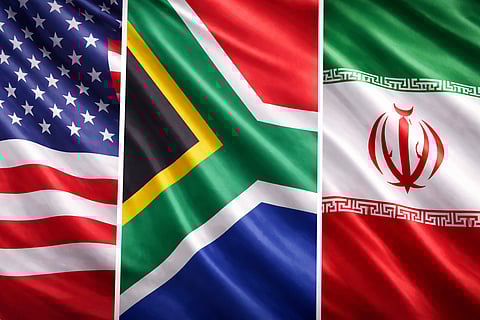
This article was first published by The Common Sense..Key topics:US pressure on Iran tests South Africa’s long-standing pro-Tehran stanceSimonstown naval drills expose strain in SA–US diplomatic relationsPretoria faces choice: silence, incoherence, or open alignment with Iran.Sign up for your early morning brew of the BizNews Insider to keep you up to speed with the content that matters. The newsletter will land in your inbox at 5:30am weekdays. Register here.Support South Africa’s bastion of independent journalism, offering balanced insights on investments, business, and the political economy, by joining BizNews Premium. Register here.If you prefer WhatsApp for updates, sign up to the BizNews channel here..By Reine Opperman.For South Africa the American naval armada sailing towards Iran marks an important test that will be broadly read as indicative of whether the country’s foreign policy is open to reform under pressure..As President Donald Trump dispatches a formidable United States (US) naval armada toward Iranian waters, the geopolitical reverberations are being felt far beyond the Persian Gulf. The president has issued an ultimatum to Tehran: negotiate a comprehensive nuclear agreement or face consequences.This escalation unfolds against a backdrop of domestic turmoil within Iran, where the regime has unleashed what observers describe as its most brutal suppression of civilian dissent in years.South Africa’s reaction to this confrontation between Washington and Tehran is important to watch closely as historically Pretoria has been a staunch ally and diplomatic shield of the Iranians. For the better part of a decade whenever Iran has been placed under American pressure South Africa has raced to its defence. Should Pretoria this time choose to not run diplomatic interference for the Iranians, that might signal that the relationship between Pretoria and Tehran may be changing.However, should South Africa continue its old pattern of blind diplomatic support for the Iranians, the read will be that the South Africans are immune to pressure with the risk of further diplomatic fallout between South Africa and the US.This would reduce the possibility of South Africa and the US successfully negotiating an investment and trade treaty and would also raise the possibility of sanctions against senior South African government officials.The Simonstown debacleThe timing of this American naval deployment carries particular significance for South Africa, occurring mere days after Pretoria concluded what many international observers have characterised as a farcical set of joint naval exercises with Iran at Simonstown.False news reports in the South African legacy media contended that President Cyril Ramaphosa was both ignorant of the Iranian naval participation and also ordered the Iranians expelled from Simonstown. The messages communicated by the Simonstown organisers were very much more obtuse than that and designed to create the charade of concern at the Iranian presence while ensuring that the presence continued.Washington's warningAmerica's public condemnation of the naval exercises was definitive. Senator Jim Risch accused the African National Congress (ANC)-led government of hiding behind claims of non-alignment while conducting military drills with US adversaries, arguing that Pretoria's actions signalled open hostility toward Washington..Read more:.South Africa’s defiance deepens US rift: Diplomats expelled, ties fray over Israel stance.The US Embassy in South Africa echoed this stance, saying it was "concerned and alarmed" by reports that Iranian participation went ahead, describing Iran as a destabilising state sponsor of terrorism and calling it "unconscionable" for South Africa to host Iranian security forces while they violently repressed peaceful protesters at home.The fact that the South Africans were willing to introduce a charade at all did cause some analysts to wonder whether at a certain level American pressure was causing them to reconsider their blind support for Iran. Hence why the South African response to the latest American armada is being watched so very carefully to be seen if there are any deeper signs of a deeper foreign policy shift.Iran's collapsing networkSouth Africa finds itself positioned on the periphery of an expanding pressure campaign that the US is applying against Tehran and its network of proxies and allies. As Iran's strategic leverage continues to erode, Pretoria's menu of viable pro-Iranian policy options shrinks correspondingly.What is unfolding is the systematic dismantling of Iran's layers of influence architecture. The first consists of regional proxy forces: Hamas, Hezbollah, and the Houthis. Recent years have seen these capabilities systematically degraded: Hamas weakened, Hezbollah constrained, Syrian supply routes disrupted, and Houthi effectiveness diminished. The result is a collapse of Iran's ability to use proxy threats as bargaining tools.The second layer comprises offshore facilitators like Venezuela and Cuba. Venezuela offered energy cooperation and a Western Hemisphere foothold that reduced friction for financial transactions and coordination. Cuba provides diplomatic alignment and technical cooperation that helps maintain regime resilience. These nodes function as relay points that keep Iran's network stitched together, providing redundancy that allows the system to absorb pressure without collapsing. With former Venezuelan President Nicolás Maduro under arrest in the US, and Cuba on its knees, these nodes are greatly undermined.South Africa's historical diplomatic alignment with Tehran, expressed through voting patterns, legal positioning, and foreign policy rhetoric, has provided Iran with political and reputational cover rather than material support. It is for this reason that South African officials may encounter mounting pressure from American counterparts to clarify and recalibrate their Iranian relationship. To some analysts South Africa is starting to resemble the last man standing in the once-expansive Iranian influence network.Three paths forwardAs the American armada sails toward Iranian shores, South Africa confronts a moment of decision regarding the ally it so hastily distanced itself from days earlier. Three pathways emerge.Option one: Continued incoherenceThe first option represents the continuation of South Africa's recent pattern: aggressive rhetorical support for Iran coupled with tactical retreat when genuine confrontation becomes imminent. This approach would see Pretoria maintaining its traditional voting patterns in international forums, defending Iran against resolutions at the United Nations, and sustaining diplomatic solidarity in public statements. Meanwhile, practical cooperation would be quietly curtailed whenever American scrutiny intensifies or consequences appear likely.The Simonstown charade demonstrated the dysfunction this creates, with military and civilian leadership apparently working at cross purposes. Sustained incoherence would institutionalise such chaos, making South Africa an increasingly unreliable actor whose positions and commitments cannot be taken seriously by anyone.Option two: SilenceThe second option represents a fundamental departure from a decade of established foreign policy: doing nothing. In practical terms, this would mean South Africa refrains from its traditional role as Iran's diplomatic defender, abstains from votes where it previously supported Tehran, issues no statements of solidarity, and allows the American pressure campaign to proceed without South African commentary.This silence would constitute a profoundly important and positive signal.Option three: Total commitmentThe third option represents the most dramatic: South Africa could double down, publicly challenging the American armada, condemning what it characterises as imperial aggression, and offering Iran explicit solidarity. There would be no ambiguity, no deniability, no room for the kind of tactical retreats that have characterised recent policy.Perhaps South Africa would apply the same escalatory playbook to the US that it has deployed against Israel. Against Israel, Pretoria has pursued a genocide case in the International Court of Justice and recently declared Israel’s top diplomat in South Africa persona non grata.Notably, South Africa has already tested American patience through the raid on an Afrikaner asylum processing centre run by American officials in Johannesburg late last year, during which South African authorities detained those officials. If this pattern continues, Washington could face similar legal, diplomatic, and administrative provocations, transforming rhetorical anti-imperialism into concrete confrontation..Read more:.Katzenellenbogen: As Iran’s Mullahs teeter, confused Pretoria becomes hypocritical.The immediate consequences of this approach would likely begin with targeted sanctions on South African government officials: travel bans, asset freezes, and financial restrictions on individuals deemed responsible for supporting Iranian sanctions evasion.While broader secondary sanctions on South African banks and companies would lurk on a more distant horizon, the diplomatic fallout would do nothing to help its struggling economy.A defining momentThe South African response to the latest American pressure on Iran is therefore a very useful indicator of the country’s longer-term foreign policy trajectory and will surely be closely watched by analysts and governments around the world..This article was first published by The Common Sense and is republished with permission