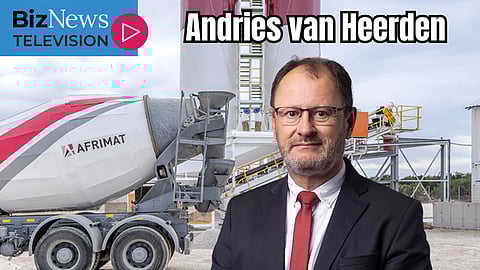
Afrimat CEO Andries van Heerden joins Alec Hogg to unpack the group’s worst results in decades, driven by a perfect storm of collapsing iron ore prices and early Lafarge losses. He remains bullish on the cement acquisition, touts a new ultra-low carbon product, and outlines progress on Transnet’s rail recovery and Afrimat’s rare earth ambitions. Van Heerden shares cautious optimism on SA’s infrastructure outlook under a new political era. .Sign up for your early morning brew of the BizNews Insider to keep you up to speed with the content that matters. The newsletter will land in your inbox at 5:30am weekdays. Register here.Support South Africa’s bastion of independent journalism, offering balanced insights on investments, business, and the political economy, by joining BizNews Premium. Register here.If you prefer WhatsApp for updates, sign up to the BizNews channel here..Watch here:.Listen here:.BizNews Reporter.For more than a decade, Afrimat CEO Andries van Heerden has been accustomed to acclaim when presenting the company’s financials. But this year’s results - tell a very different story. In an interview with BizNews, Van Heerden was candid about what he called the most difficult year the company has ever faced, attributing the setback to a confluence of challenging events, but maintaining confidence in a rebound.At the heart of Afrimat’s decline in earnings - headline earnings per share dropped from 567c to 72c - was what Van Heerden described as a “perfect storm.” A sharp decline in iron ore prices, both domestically and globally, was compounded by the company’s acquisition of the distressed Lafarge cement business.“Lafarge and the iron ore price together account for about 85% of the reduction in profit,” Van Heerden explained. “We’ve always acquired distressed businesses, turned them around, and reaped the rewards. This time, the timing was unfortunate.”The cement business was rudderless for over a year due to a prolonged approval process before Afrimat took the reins in May 2023. During this period, operational neglect set in. Van Heerden described the takeover as akin to inheriting a “very sick patient,” but insists early signs of recovery are emerging. The cement operations are already regaining profitability, market share is improving, and a new ultra-low carbon cement product has been launched.Accounting complexities further clouded perceptions, with the expected ‘bargain purchase’ benefit of Lafarge reversed as the company opted for a more conservative and realistic valuation. “We’ve never tried to paint a false picture. I’d rather the balance sheet reflect reality,” Van Heerden said.Despite the difficulties, Afrimat’s core aggregates and industrial minerals business remains solid. The traditional operations continue to perform well, and Van Heerden sees infrastructure renewal in South Africa as a long-term growth driver. He highlighted rising demand from road builders and utility-scale projects as early signs of a recovery in the construction sector. “We hit bottom in 2022 or 2023. The trend is slowly picking up,” he noted.However, systemic constraints persist. Afrimat, like many others in the mining sector, remains hamstrung by Transnet’s underperformance. The company was unable to utilise 16.5% of its 870,000 tonne rail allocation last year, though this was an improvement from the previous year’s 20% shortfall.Van Heerden praised Transnet’s current management for engaging with the industry and progressing slowly but surely. Afrimat is also involved in a public-private partnership initiative to help fix the rail system - though details remain under wraps due to NDAs.Meanwhile, Afrimat’s rare earths venture - still in early development - is a strategic long game. The company acquired the project four years ago, anticipating the West’s eventual push to diversify away from China’s dominance. “It’s not moving as fast as we thought, but over a five-year horizon, we believe it will pay off,” he said.South Africa, while not yet a major player in rare earths, has promising sources, including Afrimat’s asset. “Rare earths aren’t actually that rare, but quality and accessibility matter,” Van Heerden noted.As for the national picture, Van Heerden remains cautiously optimistic. He sees potential in the Government of National Unity and believes increased infrastructure spending could revitalise the economy. “We’re a resilient country. Those of us who stay are builders,” he said.With Lafarge stabilising, new products in the pipeline, and diversification efforts underway, Van Heerden remains confident. “Turnarounds take time. But by this time next year, I truly believe we’ll be smiling again.”