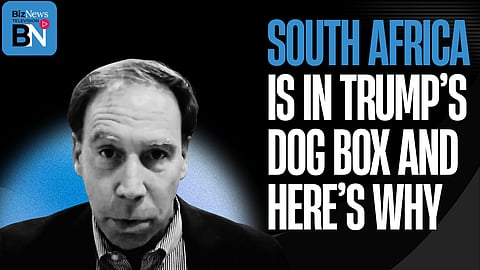
South African-born Wall Street veteran Anthony Ginsberg, founder of GinsGlobal, unpacks what Trump’s new trade team really thinks of South Africa, BRICS, and AGOA. From behind-closed-doors insights at the YPO Summit in Los Angeles, Ginsberg tells Alec Hogg why SA’s missing ambassador, misunderstood BEE policies, and Washington’s anti-China pivot could make or break our next US trade deal. A front-row view of Trump-era commercial diplomacy—where business, politics, and power collide..Sign up for your early morning brew of the BizNews Insider to keep you up to speed with the content that matters. The newsletter will land in your inbox at 5:30am weekdays. Register here.Support South Africa’s bastion of independent journalism, offering balanced insights on investments, business, and the political economy, by joining BizNews Premium. Register here.If you prefer WhatsApp for updates, sign up to the BizNews channel here..Watch here.Listen here.BizNews Reporter.Anthony Ginsberg has never been one to mince his words. Speaking to Alec Hogg after moderating a high-powered YPO panel in Los Angeles with Trump’s former trade ambassador, the South African-born Wall Street veteran says it plainly: “The BRICS - including China, India, and South Africa - are in the dog box right now.”Ginsberg, founder of GinsGlobal and based in California for nearly three decades, says Pretoria faces an uphill battle to renew the AGOA trade deal under a Trump administration that is fixated on tariffs and “commercial diplomacy.” “South Africa is trying its best, but trade has become political,” he explains. “The Americans see BRICS countries as too close to China, and right now, that’s a problem.”At the YPO summit, Ginsberg shared the stage with Trump’s first-term US trade representative, the foreign minister of El Salvador, and a leading geopolitical strategist. What he heard behind closed doors offers rare insight into Washington’s thinking. “There’s a groundswell among American voters, not just elites, who want tariffs. They believe China has taken advantage of the system. The WTO is seen as broken and unfair to the US. Unfortunately, AGOA — which has benefited South Africa — falls into that same basket,” he says.That voter anger, he explains, is deeply tied to America’s internal inequality. “It’s the revenge of the working class,” he says. “Trump was voted in by people who feel left behind. The wealthy top ten percent have seen their portfolios soar, but the lower half of America has been struggling. They want protection. They see tariffs as fairness, not punishment.”When Alec Hogg asks if this is politics or real economics, Ginsberg doesn’t hesitate. “It’s real,” he says. “Americans live and breathe their investments. They manage their own pensions, their 401(k)s. Every day they feel the impact of trade and deficits. And Trump’s base wants action.”He points out that the US is running record deficits not just with China, but also Japan and the EU. “So people ask, why go after smaller economies like South Africa? The answer is simple — the US wants to close every loophole. If you don’t go after everyone, China will just reship its goods through third parties.”He gives a telling example: “BYD, the Chinese electric vehicle giant, was planning the world’s biggest EV plant just south of San Diego in Mexico. The Americans shut it down. It’s all part of this push to protect the US middle class.”For South Africa, this shifting terrain is tricky. Trump’s allies, Ginsberg says, want deals with pragmatism and speed — not ideology. “The UK did it right,” he notes. “They were on the ground, had an ambassador, had Peter Mandelson brokering a 10% reciprocal trade tariff. They got it done in weeks. South Africa, by contrast, hasn’t had an ambassador in Washington for almost a year. It’s embarrassing. There’s no one senior there to engage the Americans.”That absence, he says, is costing the country. “It’s hard to negotiate from 10,000 miles away,” Ginsberg laments. “If you don’t have someone at the table, you’re forgotten. The White House has ADD — they’re onto the next deal before you’ve finished your sentence.”He says Pretoria must urgently separate politics from trade. “America sees BEE through its own lens. They call it DEI — diversity, equity, inclusion — and Trump’s people campaigned on scrapping it. They think it’s just affirmative action for the elite. Someone needs to explain that BEE is different, that it can work for both sides,” he says. “The same goes for expropriation. Offer market-related payouts, calm investor fears, and you can move forward.”Despite the “dog box” status, Ginsberg insists all is not lost. “There’s tremendous goodwill toward South Africa,” he says. “Americans love our country. They travel there, they buy our fruit, our cars. We’ve got 650 American companies already operating in South Africa. The foundations for trade are strong.”He adds that South Africa’s surplus with the US — meaning we export more to them than they export to us — is both a strength and a risk. “It’s good news because it shows success,” he says, “but it also makes us a target. The Americans want balance, and they’ll use tariffs to get it.”On Trump’s wider economic policy, Ginsberg is clear: “He’s got the stock market on his side. The Dow just hit a record high. Inflation is steady, oil is contained, and Wall Street is booming. Goldman Sachs just hired more managing directors than ever. These are business people running government now. They want deals, not speeches.”That business-first mindset could open doors for South Africa — if we act quickly. “Send an envoy, send an ambassador, start talking,” Ginsberg urges. “If you’re not at the table, you’re on the menu. Trump’s team speaks the language of business. They’re not anti-South Africa, they’re just pro-deal.”He warns that failing to engage could have bigger consequences than tariffs alone. “Two sanctions bills are making their way through Congress, modeled on the Magnitsky Act. They target individuals named in the Zondo Commission. Without a presence in Washington, there’s no one to defend our case. It’s like going to court without a lawyer.”Asked what he would tell South Africa’s president and trade minister, Ginsberg doesn’t pause. “Get representation in Washington. Hire a high-level ambassador. Focus on trade, not politics. And explain that South Africa is a friend, not a threat. That’s how you keep your seat at the table.”As the interview wraps, Hogg notes the irony — that while local politicians spin stories about “misguided genocide claims,” the real danger lies in silence. Ginsberg agrees. “Exactly. The genocide thing doesn’t come up here. It’s a distraction. What matters is trade, investment, and perception. And right now, we’re losing that battle simply because we’re not present.”The message is blunt, but it lands with weight. South Africa’s trade future in a Trump-led world depends not on ideology, but on engagement. “The deals are there to be done,” Ginsberg concludes. “But you’ve got to buy the lottery ticket first.”