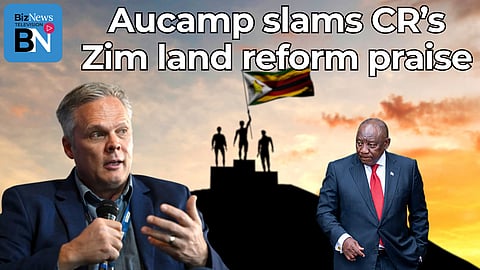
President Cyril Ramaphosa has been slammed for describing Zimbabwe’s land confiscation process as “essential” and “ambitious”. In his reaction, Willie Aucamp, the Democratic Alliance’s National Spokesperson, said Zimbabwe was “destroyed by the ideology and the implementation of their land grabs. And for our president to now go and praise the land reform efforts that Zimbabwe instituted in early 2000s is unacceptable…you're getting into a position where you are very afraid of what the real ideological ideas behind the Expropriation Act is…if you've got a president standing on an international stage like the one that he was on over the weekend, praising them for an absolute catastrophe of land reform implementation, it is going to deter investors away from our country and it's going to harm our economy - and it should not be allowed.” Aucamp stresses that the DA is “totally in favour” of redistribution of land, providing it takes places within the bounds of the Constitution. Meanwhile, Aucamp feels conficent that his party’s court case against the Expropriation Act will succeed..Sign up for your early morning brew of the BizNews Insider to keep you up to speed with the content that matters. The newsletter will land in your inbox at 5:30am weekdays. Register here.Support South Africa’s bastion of independent journalism, offering balanced insights on investments, business, and the political economy, by joining BizNews Premium. Register here.If you prefer WhatsApp for updates, sign up to the BizNews channel here..Watch here.Listen here.Edited transcript of the interview.Chris Steyn (00:02.357)Is President Cyril Ramaphosa ramping up the expropriation agenda of the African National Congress. We speak Willie Aucamp, the Democratic Alliance national spokesperson. Welcome, Vili.Willie Aucamp (00:17.368)Good afternoon Chris and thanks for having me.Chris Steyn (00:20.087)You're welcome. Please recap for us the President’s latest utterance.Willie Aucamp (00:25.4)Well, we know that the president visited Zimbabwe over the weekend. During an address to the Zimbabweans there, where President Manangagwa from Zimbabwe was also present, President Ramaphosa said that the land reform and the measures that they took in Zimbabwe in the early 2000s was necessary. Now, I think if you look at what happened in Zimbabwe, it is exactly an example of how not to do land reform. Years later, we are seeing the effects of the land grabs that took place in Zimbabwe. And for our president, seeing the background in our country and where we are now to praise Zimbabwe for how they did land reform is just unacceptable. It should not happen.Chris Steyn (01:19.769)Well, if we look at how it worked out for Zimbabwe 25 years down the line, they now have to compensate farmers whose land was seized.Willie Aucamp (01:30.12)Well, apart from the fact that they now do have to compensate those farmers, what we saw in Zimbabwe over the last 25 years was a total decay of the economy. The economy collapsed. The exchange rates with the Zimbabwean dollar, I mean, they don't use it anymore. There was famine. There was people that literally went hungry to bed on a daily basis. They did not have food. Where Zimbabwe was referred to as one of the food baskets of Africa. And now, over the last 25 years, we saw what happened with that country. It was destroyed by the ideology and the implementation of their land grabs. And for our president to now go and praise the land reform efforts that Zimbabwe instituted in early 2000s is unacceptable. We must also see that in the background of where we are in this country. The Expropriation Act has been passed. The DA, my party, is taking that to court. But if you then hear utterances like this of our president, you're getting into a position where you are very afraid of what the real ideological ideas behind the Expropriation Act is. People can stand on a stage and tell you many times that, don't want to do A, B, and C with this act. But if your president goes to another country and justifies and praises them for how they've done it and…those praises are directed at something that we as property owners in this country fear because we know what our neighbours went through, then it's very upsetting, Chris, - and it should not be praised, it should be used as an example of exactly not how to do land reform.Chris Steyn (03:20.195)What is driving the president to be so defiant in the face of international and national uproar over this issue?Willie Aucamp (03:28.407)Chris, I wish I had the answer to that. What I can just think is that the president is fighting for the survival of himself and his supporters in the ANC. There is a fight for the soul of the ANC. Let us have no two things about that. And I think that President Ramaphosa over many years have showed us that he can play the long game, but he can also play the pleasing game. And instead of doing what is in the interest of the country, is doing what's in the interest of his party. And not only his party, of his faction of the party.We must, as public representatives, never ask what is in the interest of our party. We must ask what is in the interest of this country. And it is high time that President Ramaphosa act in the interest of this country. And it is not in the interest of South Africa that land reform take place in the way that Zimbabwe has done that. We must have security of property rights. We must attract investment into this country. We must not deter investments away. Now, if you've got a president standing on an international stage like the one that he was on over the weekend, praising them for an absolute catastrophe of land reform implementation, it is going to deter investors away from our country and it's going to harm our economy and it should not be allowed.Chris Steyn (04:54.211)Meanwhile, please reiterate your party's position, the Democratic Alliance’s, position on land reform.Willie Aucamp (05:01.633)The Democratic Alliance is totally in favour of redistribution of land. We don't have any problem with that. But it must take place within the bounds of the Constitution. I just left a meeting where we had discussions with this, with agricultural organisations, AgriSA, SAI, AFASA, and we are all in agreement that land redistribution must take place within the framework of the Constitution, especially Section 25 of the Constitution.There must be a monetary value that is fair. It must be determined by courts and not by officials. And those are some of the reasons that the Democratic Alliance is opposed to that. And you all know that the DA referred this to the court. We were the first party that lodged a court case against the Expropriation Act. That case is based on procedural irregularities that was done when the act was passed. And we are quite sure that we will succeed with our court case. But again, we as the DA joined the Government of National Unity. And when we said that we joined it, we said that we've got two main aims. One, that we must grow the economy, and two, that we must create jobs. And proper land reform with security of property rights are standing as a pillar of economical growth and of job creation. Without that, without security of property rights, you will never grow your economy. And that is what we as the DA and a lot of organisations out there say is that security of property rights must be adhered to, it must be respected, as it is stated in our constitution.Chris Steyn (06:50.966)Can you tell us when next we can expect a development in the legal battle to get this act nullified in its current form?Willie Aucamp (07:00.833)Well, as I said, Chris, the DA took this to court and we are now in that process. We hope that we will get an indication of where things are going, but court processes are sometimes tedious. The Democratic Alliance is hopeful and we believe firmly that we will succeed. Just to go into the technical issues of this, when an act is passed, it goes through the National Assembly. When the National Assembly votes in favour thereof, it must go through the NationalCouncil of Provinces. And the National Council of Provinces obviously represent each one of the nine provinces. So those provinces must get mandates from the provincial legislatures which are then presented to the NCOP. And the Act is clear, those legislature votes must take place in a sitting of those legislatures. So each one of the nine provincial legislatures should have had a sitting where it was discussed and voted on so that a mandate can then be given to the NCOP. Now, in only two of the nine provinces, there were sittings. In five of them, there were no sittings. I think it was the Northwest that did not even give a mandate. The Western Cape obviously gave a mandate opposing this. So there was a huge fall in how this was steamrolled through the NCOP, and the NCOP was used as a rubber stamp, and they thought that we will not pick that up, we will look away.It did not happen, the Act is clear and I'm quite sure that the court will give us, will agree with us that this process was flawed and then it should be referred back to the National Assembly. The whole process must start afresh and that is what we are hoping for.Chris Steyn (08:48.493)Thank you. That was Democratic Alliance National Spokesperson, Willie Aucamp, speaking to BizNews. I'm Chris Steyn. Thank you, Willie.Willie Aucamp (08:56.642)Thank you very much for the opportunity, Chris.