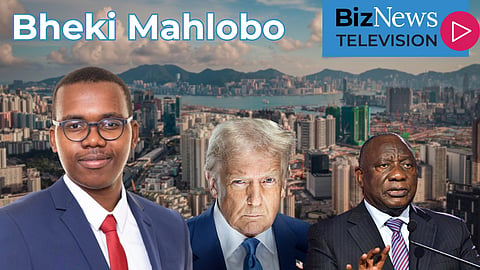
Evidence-based insights into the latest Trump Tariffs from California-based Bheki Mahlobo, economist and partner at Frans Cronjé Private Clients. His conclusion: South Africa is a mountain of missed opportunities, the result of own goals scored through poor decisions. He spoke to BizNews editor Alec Hogg..Sign up for your early morning brew of the BizNews Insider to keep you up to speed with the content that matters. The newsletter will land in your inbox at 5:30am weekdays. Register here.Support South Africa’s bastion of independent journalism, offering balanced insights on investments, business, and the political economy, by joining BizNews Premium. Register here.If you prefer WhatsApp for updates, sign up to the BizNews channel here.The auditorium doors will open for BNIC#2 on 10 September 2025 in Hermanus. For more information and tickets, click here..Watch here.Listen here.BizNews Reporter .In a compelling interview with Alec Hogg, economist Bheki Mahlobo, a partner at Frans Crojné Private Clients and a board member of the Social Research Foundation, offered sobering insights into South Africa's current economic challenges and policy missteps - particularly in light of the United States’ decision to increase tariffs on South African goods.Overnight, former US President Donald Trump announced an additional 10% tariff on South African imports, raising total tariffs to 40%. This decision directly impacts key exports such as platinum group metals (PGMs), vehicles and vehicle parts, and iron and steel, altogether representing around 8.4% of South Africa's total exports.Mahlobo acknowledged the significant blow this could deal to the economy but noted that other global markets might absorb the shortfall. However, he stressed that the deeper issue lies in South Africa’s inability to align itself with policies that attract international investment, particularly from traditional allies like the United States.He cited America’s successful relationship with India as a missed opportunity for South Africa. India has managed to secure over 60% of its foreign direct investment (FDI) from the US by maintaining a neutral foreign policy stance and sensible trade frameworks. In contrast, Mahlobo argued, South Africa's confrontational diplomatic posture, especially in international forums like BRICS, has isolated it from potential allies and investors.Key among US grievances are South Africa’s empowerment policies, which American investors perceive as a form of tax on entry. Additionally, the Expropriation Bill, allowing for property seizure below market value, has significantly damaged investor confidence. Finally, South Africa’s close alignment with Iran, a nation seen as a national security threat by the US and its allies, further erodes trust.Mahlobo highlighted how these policy choices translate into real-world consequences. Fixed investment as a proportion of GDP sits at a stagnant 15%, far below the 25% benchmark typical in comparable emerging markets. This underperformance keeps economic growth mired below 1% annually and contributes to persistent high unemployment, particularly among the youth, where the rate hovers around a staggering 72%.Despite the bleak outlook, Mahlobo remains hopeful. He believes that if the government addresses energy issues, revises empowerment policies, and restores market-value compensation for expropriated land, South Africa could significantly boost both investment and GDP growth. By merely returning to the economic trajectory it followed from 1994 to 2015, the country could have halved its unemployment rate and added over four million jobs by now.Alec Hogg voiced a common frustration: South Africa sits on vast natural and logistical resources, including untapped oil and gas potential along its coast, which remains undeveloped compared to Namibia's rapidly growing energy sector. Mahlobo agreed, adding that the US is shifting focus to invest in more cooperative African nations such as Namibia and Angola, leaving South Africa behind despite its strategic geographic importance.As the interview drew to a close, Hogg posed a critical question: “How long must South Africans endure this stagnation?” Mahlobo estimated it could take two decades to repair the damage, assuming immediate and sustained reform. South Africa, he stressed, must stop “scoring own goals” and begin leveraging its assets for long-term growth.In the meantime, Mahlobo observed that the private sector is stepping in to fill the void. From private electricity generation to alternative logistics and security solutions, industry players are adapting to a failing public sector. Yet, he emphasised, true prosperity will remain elusive until policy begins to serve the broader public interest, especially those who cannot afford to opt out of South Africa’s dysfunction.Ultimately, the message was clear: South Africa's future hinges on political will, sensible diplomacy, and inclusive economic reform. The time for excuses has passed.