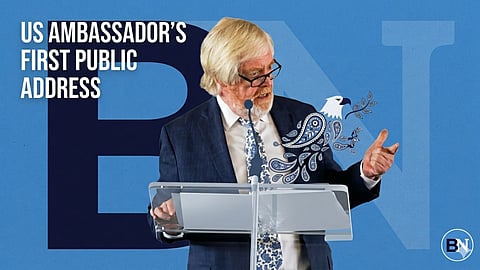
In his first public address since arriving in South Africa, new US Ambassador Brent Bozell delivered a candid keynote that mixed optimism about the country’s economic potential with sharp warnings about the direction of bilateral relations. Speaking to the BizNews Conference audience and later in a short Q&A with Alec Hogg, Bozell praised South Africa’s entrepreneurial depth, financial sophistication and strategic importance to Washington, while arguing that policy uncertainty, BEE-related ownership requirements, expropriation fears, rural safety concerns and Pretoria’s alignment with adversaries such as Iran are undermining investor confidence. He pointed to major recent US investments by Visa, Google, Microsoft and Amazon as proof of America’s long-term commitment, but stressed that stronger ties will depend on reciprocity, clearer rules and a more level playing field. His core message: the US still sees South Africa as a potentially important partner, but patience is wearing thin and the moment calls for candour, reform and renewed non-alignment..Sign up for your early morning brew of the BizNews Insider to keep you up to speed with the content that matters. The newsletter will land in your inbox at 5:30am weekdays. Register here.Support South Africa’s bastion of independent journalism, offering balanced insights on investments, business, and the political economy, by joining BizNews Premium. Register here.If you prefer WhatsApp for updates, sign up to the BizNews channel here..Watch here.Listen here.Read the full transcript of Bozell's address belowThank you, Alec, and thank you to the BizNews community for the warm invitation and for convening such an extraordinary gathering of leaders, investors and engaged citizens. It is an honour to join you here in Hermanus so early in my tenure as the United States Ambassador to the Republic of South Africa.Though I have only recently arrived, I have already begun to experience the richness and complexity of this remarkable country. I have travelled beyond Pretoria to Johannesburg and Durban, Cape Town, and now Hermanus. I have met with government officials, business leaders and local communities. I visited the Apartheid Museum and the District Six Museum. A word about those: those are not mere tourist stops. They are places that remind you that South Africa’s history is lived memory, sacrifice, struggle, resilience and unfinished work.At the same time, I have been struck by something equally powerful: the dynamism of this country, its entrepreneurs, its innovators, its young people, its deep reservoir of talent, ambition and confidence. South Africa is a nation of immense potential, immense complexity and immense importance, not only on this continent, but around the globe.In the weeks and months ahead, I look forward to engaging with a wide range of South Africans in government, in civil society and in the business community. Many of these voices are here in this room today. Listening will be essential, but so will clarity. Let me speak plainly about the moment we are in and some of the challenges I see in our bilateral relationship.The United States values its partnership with South Africa. This country is Africa’s largest economy and is the largest US trade and investment partner in sub-Saharan Africa. More than 500 US companies operate here, employing over 250,000 South Africans and contributing meaningfully to economic growth. That is real partnership.But partnership must be rooted in reciprocity. President Trump has been clear about our concerns. These concerns are not merely rhetorical. They involve the business environment, rural safety, the Expropriation Act and South Africa’s growing engagement with some of America’s greatest adversaries. These issues shape investor confidence. They shape strategic trust, and they shape the trajectory of our bilateral relationship.When businesses believe their property rights may be uncertain, when policy frameworks create unpredictability instead of clarity, and when strategic alignments appear to drift toward regimes that do not share our democratic values, common ground becomes harder to sustain.Honest partners must be able to say this out loud. President Trump’s America First policy means I am here to advance the security, prosperity and values of the American people. That is my duty. But America First does not mean America alone. It means where cooperation advances our interests and benefits our partners, we pursue it energetically. This is where I see the real opportunity.Let me highlight what is already working. This year alone has been filled with milestones that demonstrate the depth and momentum of the US-South African commercial relationship. Visa launched its first-ever data centre in Johannesburg, a R1 billion investment over the next three years. That is not symbolic. That is infrastructure. That is a long-term commitment to strengthening South Africa’s digital payments ecosystem and positioning this country as a leader in financial innovation.Google Cloud has opened its first African cloud region in Johannesburg as part of a major investment in Africa and South Africa’s digital transformation. That means advanced cloud services, AI capabilities and machine learning tools are now available to South African enterprises, enabling them to compete globally.Microsoft is investing an additional R5 billion by 2027 to expand cloud and AI infrastructure here, building on more than R16 billion already invested. And Microsoft is helping to skill one million South Africans, ensuring that local talent is positioned for the digital economy of the future.Amazon is another great American tech company that is not only expanding its presence in South Africa with thousands of jobs and new facilities, but also providing much-needed skills at training centres like the AWS Skills Center in Cape Town, the first international facility of its kind outside of the United States of America.These are not isolated announcements. They are proof that American companies bring capital, high standards, cutting-edge technology, workforce development and long-term commitment. This is what commercial diplomacy looks like in action. And this is precisely the kind of partnership we want to expand.A healthy economic relationship, however, is never one-sided. The strongest partnerships are built on investment and opportunity flowing in both directions. Just as American companies are investing in South Africa’s growth and innovation, we are eager for South African businesses and entrepreneurs to explore opportunities in the United States.That is why I am pleased to announce the SelectUSA Investment Accelerator, a new initiative designed to streamline access to US markets for major investors. I encourage any interested business leaders to contact my team for more information and to discuss the ways we can support you in your investment journey. Keep an eye on our embassy website as well. We will have more information on this programme online in a few days.Initiatives like this strengthen the foundation of the US-South African commercial relationship by expanding opportunity on both sides of the Atlantic. But sustaining and expanding that partnership requires the right conditions: predictability, the rule of law and a level playing field for businesses willing to invest for the long term.I recognise that South Africa’s history demands serious attention to inequality and redress. The injustice of apartheid cannot be dismissed or minimised. But the question is not whether historical injustice matters. Of course it does. The real question is whether current policies are achieving their intended outcome.Programmes such as Broad-Based Black Economic Empowerment are designed to expand opportunity and correct historical injustice. Those are important goals. But when those policies are structured in ways that introduce challenges to ownership, create complex compliance requirements, or are clouded in charges of corruption, investors begin to reassess risk.Foreign investors, including the more than 500 American companies operating in South Africa, make long-term decisions based on stability and predictability. They compare markets around the world and allocate capital where the rules are clear and consistent. When the policy environment becomes uncertain, investment slows. Expansion plans are reconsidered. In some cases, companies choose to deploy their capital elsewhere.And when that happens, the costs are borne not by the investors, but by the workers and the communities. Fewer factories are built. Fewer small businesses are integrated into supply chains. Fewer young South Africans gain access to the skills and jobs that large-scale investment can create.If policies create uncertainty around property rights or impose regulatory burdens that discourage expansion, the result is not empowerment. It is stagnation. And stagnation ultimately harms the very communities these reforms are meant to uplift. Inclusive growth requires both opportunity and investment confidence. The most successful economies find ways to pursue redress while also creating an environment where capital, innovation and entrepreneurship are encouraged to grow.I would suggest that the responsibility to craft these solutions does not rest solely with policymakers. It rests with business leaders as well. Those of you in this room have influence. You shape narratives, you advise governments, you structure deals, you innovate. The future of this economy will not be decided by rhetoric. It will be decided by whether South Africa creates an environment that welcomes investment and rewards risk-taking.The United States stands ready to be a partner in that work. We believe the US-South Africa relationship has great untapped potential, but unlocking it requires alignment on fundamentals. If South Africa seeks improved access to US markets and deeper economic integration, we will need to see serious proposals that reflect reciprocity and fairness. Fair trade must work in both directions.I have spent much of my public life navigating disagreements. When I led an international commission to help secure free and fair elections in Nicaragua, I worked alongside leaders with whom I disagreed profoundly on most issues. Yet we found common ground in service of a greater good. That experience taught me that principle, fairness and cooperative engagement are not contradictions, but complements.I bring the same mindset to this role. We may not agree on everything with the government of South Africa. We may continue to have serious differences regarding international legal proceedings, strategic relationships or elements of domestic policy. But there are areas where progress should be straightforward: protecting rural communities from violence, condemning rhetoric that incites hatred and glorifies violence, ensuring expropriation policies include fair and clear compensation standards, expanding digital and critical minerals cooperation, and ending mandatory surrender of ownership or control of corporate decision-making as a cost of doing business.These are practical, treatable and beneficial issues for both Americans and South Africans. I am an optimist. If I were not, I would not have accepted this assignment. South Africa has an opportunity to demonstrate that addressing historical injustice and fostering a world-class investment climate are not competing goals, but mutually reinforcing ones.By working constructively with policymakers to craft solutions that expand opportunity and encourage entrepreneurship, the business community can help build an economy that attracts investment, creates jobs and delivers lasting prosperity for South Africans.If these conditions are in place, I believe South Africa can unlock an extraordinary level of economic dynamism. South Africa has the talent, the infrastructure, the financial sophistication and the entrepreneurial energy to be an even greater engine of growth for this continent.In partnership with my country, my focus will be clear: to advance policies that benefit the American people, to expand commercial diplomacy, to deepen fair and reciprocal trade, and to engage South Africa candidly, respectfully, but candidly, about areas of disagreement. If we can align our shared interests around growth, opportunity and security, then both our nations will prosper. That is the partnership I hope to build.We are proud of the 500 companies that are here, but we are not satisfied. Why not 1,000? We are pleased that we have created jobs for 250,000 South Africans. But we are not done. Why not double that number as well? That is how Americans think. Nothing is beyond the pale for us. We want partners who also dream great dreams. And that is South Africa’s signature.Let us do all in our power to make our relationship prosper and thrive. Thank you very much.