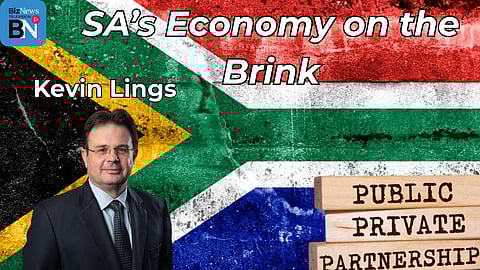
Stanlib’s chief economist Kevin Lings warns that South Africa has run out of options: ballooning government debt, crippled SOEs, and shaky politics mean the state can no longer drive growth. The only path left? Public-private partnerships to unlock business confidence, leverage strong corporate balance sheets, and revive infrastructure. With retail spending up, inflation low, and markets flying, Lings says the spark is there — but without urgent reform, the flame won’t catch.Sign up for your early morning brew of the BizNews Insider to keep you up to speed with the content that matters. The newsletter will land in your inbox at 5:30am weekdays. Register here.Support South Africa’s bastion of independent journalism, offering balanced insights on investments, business, and the political economy, by joining BizNews Premium. Register here.If you prefer WhatsApp for updates, sign up to the BizNews channel here..Watch here.Listen here.BizNews Reporter.Business confidence is one of those strange, almost intangible forces that shape an economy. You cannot touch it or measure it directly, yet it decides whether companies hire or fire, whether investments are unlocked or withheld, and whether a country grows or stagnates. For South Africa, confidence has been in short supply for nearly two decades.Stanlib’s chief economist Kevin Lings believes we are now at a crossroads. He told BizNews that although there are some encouraging signs, the government’s own balance sheet is broken, state-owned enterprises are on life support, and the only remaining route to growth lies in public-private partnerships. In his words, South Africa is “out of options”.A flicker of good newsDespite the constant drumbeat of negative headlines around politics and governance, there are some sparks in the economy. Retail sales are holding up surprisingly well. Inflation is low at around 3 to 3.5 percent. Salaries, at least in some sectors, are increasing above inflation, giving households a little more spending power. The Reserve Bank’s interest rate cut added momentum, and equity markets have delivered strong gains this year, with South African stocks up more than 20 percent in dollar terms.This cocktail has fed into consumer activity and given businesses a marginal lift. Retailers, for example, are reporting that customers are slightly more buoyant, and even credit flows are loosening. But Lings is quick to warn that these are marginal improvements. They have not yet sparked the kind of deep confidence needed for businesses to expand aggressively or hire at scale.Rates on hold, targets in focusThe South African Reserve Bank’s recent 50 basis point cut offered short-term relief, but Lings doubts there is more on the horizon. The Bank is fixated on anchoring inflation around 3 percent and wants that commitment endorsed by National Treasury. Given inflation is forecast to drift higher towards 4 percent later this year, the easier path for the central bank is simply to keep rates steady.Only if the economy falls off a cliff will the Bank consider cutting further. Until then, rates are likely to stay on hold while policymakers watch inflation carefully.Why the private sector must step upThe real challenge, Lings argues, lies in unlocking private sector balance sheets. The government is broke. Debt levels have ballooned from 26 percent of GDP during Trevor Manuel’s tenure as finance minister to around 76 percent today. That increase has stripped the state of any ability to use its balance sheet for large-scale infrastructure projects.State-owned enterprises like Eskom, Transnet, and Prasa are crippled by mismanagement and credit downgrades. They cannot raise financing on their own names without government guarantees. In short, the days of government-driven infrastructure expansion are over.This leaves the private sector. Unlike the state, South African corporates are sitting on relatively healthy balance sheets. Debt levels are low, cash buffers exist, and the potential to invest is there. But businesses are not going to “wake up one morning” and suddenly decide to deploy capital. No matter how low interest rates go, without the necessary confidence, companies will not expand.The only way forwardAccording to Lings, the only proven way to unlock this capital is through public-private partnerships. Government must deregulate industries, set clear rules, and create an enabling environment. The energy sector is a case in point. After the state deregulated, businesses poured billions into solar projects, installing more than 15,000 megawatts of capacity.The same formula could work in rail, ports, and other infrastructure. Pension funds are already showing interest. Trustees want to invest portions of South Africans’ retirement savings into long-term infrastructure, but only if projects are viable and properly managed. If government and business can create these conditions, investment will follow.Lings insists there is no ideological debate to be had. This is not about left or right, state versus market. It is about necessity. With debt spiralling and state enterprises crippled, partnerships are no longer optional, they are the only option.A race against timeThe urgency is clear. As elections draw nearer, political uncertainty is likely to grow. That alone dampens confidence. But if visible progress is made on infrastructure and private sector partnerships are rolled out decisively, confidence could turn. And with that turn, the broader corporate sector might finally unlock its own balance sheets.For now, the flickers of good news are not enough. South Africa is in a holding pattern. Confidence is slightly better, markets are up, but real momentum has not yet taken hold. The spark exists, but unless government embraces private capital, the fire may never catch.Lings’ final message is blunt. “We are now at the point where we’re out of options except for public-private partnerships”. The ball is firmly in government’s court.