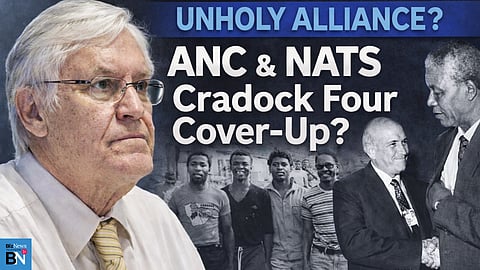
The inquest into the Apartheid-era killings of the Cradock Four reopens next month. In this interview with Chris Steyn, retired judge Chris Nicholson, who wrote Permanent Removal: Who killed the Cradock Four, speaks about the sinister reasons why State Security Council members ordered the killings have escaped justice. “I think the senior leadership of the ANC, as with the senior leadership of the Nats, came together and had an unholy pact in terms of which they said, we'll let the rats and mice be prosecuted, but we'll steer clear. So part of that unholy pact - and there are letters to that effect - shows that they were to be left alone. The hierarchy, the senior members of the ANC and the senior members of the Nat government were not to be touched.” Nicholson now remains hopeful, albeit sceptical, that the findings of the reopened inquest and outcomes of the current Truth and Reconciliation (TRC) Case Inquiry would bring the necessary justice. “…the sad thing to me is that it'll be another commission that will make findings with recommendations. And then will the politicians carry out the recommendations? That always seems to be the problem.”.Sign up for your early morning brew of the BizNews Insider to keep you up to speed with the content that matters. The newsletter will land in your inbox at 5:30am weekdays. Register here.Support South Africa’s bastion of independent journalism, offering balanced insights on investments, business, and the political economy, by joining BizNews Premium. Register here.If you prefer WhatsApp for updates, sign up to the BizNews channel here. .Watch here:.Listen here:.Edited transcript of the interview.Chris Steyn (00:02.319)The inquest into the killings of the Cradock Four reopens next month. I speak to retired judge Chris Nicholson, who wrote Permanent Removal: Who killed the Cradock Four. Welcome, Chris. Chris (00:18.882)Thank you for having me on your show. Chris Steyn (00:21.787)Please remind our viewers who they were and how they were killed. Chris (00:29.499)The Cradock Four were four activists in the Cradock area and they were agitating for reform against Apartheid during the early 80s, 1980s, and they were later targeted for permanent removal as the title of my book suggests. Chris Steyn (00:55.813)And who targeted them specifically. Chris (01:00.578)Well, it's quite a long story in the sense that they were agitating for reform, firstly with educational matters, then township rentals and matters such as that. And gradually, their activism resulted in demonstrations, boycotts, you know, consumer boycotts, school boycotts, the kids didn't go to school…and they were agitating for an overthrow really of the Apartheid educational system as well as other social conditions in the townships. Chris Steyn (01:39.429)So what order did that result in that led to their killings? Chris (01:46.67)It's quite a long story in the sense that their activities became known to the State Security Council, which was a sinister body that lay behind government in the mid-80s. And I was able to find various minutes, secret minutes from the State Security Council through my friend John Daniel, who was part of the Truth and Reconciliation Commission. Quite ironically, although quite a lot of these minutes had to be destroyed after reading. I think some of those bureaucrats were, I don't know, systematic and they then instead of deleting or destroying these minutes, they filed them away. So the Truth and Reconciliation Commission was able to find them and my friend John Daniels then supplied them to me. Now these minutes then traced the difficulties the State Security Council was having from 1983 onwards. And they indicated that there were these school teachers in the Cradock area and it was time they were removed. So use is made in these minutes of these euphemisms that one finds people tend to use because they, I think, find it difficult to face the notion of planning killings or murders. So these euphemisms persist in those minutes. And the early minutes from 1983 suggest that persons from the Security Branch should go down to Cradock to find out how it's possible to kill them without causing problems, either with witnesses who might see what's happening and report it, or that there would be other problems. They sent a man down… and a man… who went and visited Cradock and worked out that the township, Black Township… Chris (04:11.179)…was not a suitable place for them to be killed, but rather sometime when they were traveling between Cradock and Port Elizabeth. So they reported back to Craig Williamson and various members of the State Security Council that the best opportunity would be when they were traveling between Port Elizabeth and Cradock. And in the end, that's actually what happened. So, these minutes continued and finally the State Security Council decided in early June 1985 that it was time for them to be killed. The State Security Council sent a cable or whatever they called them to the Port Elizabeth Army and Security Police asking them to identify what would be the repercussions if they were killed. And on the 7th of June 1985, the Port Elizabeth Joint Management Council sent a message to the State Security Council asking for permission to permanently remove the Cradock Four. So that was the euphemism I've mentioned already that was used - and 20 days later, that's on the 27th of June 1985, their car was stopped on a trip from Port Elizabeth to Cradock and they were then murdered that night. Chris Steyn (05:56.955)They were not just murdered, they were tortured. Chris (06:00.972)Yes, I mean, some of the injuries are horrific. Some had 27 stab wounds, and they were bludgeoned. One who had a wedding ring on his finger, the finger was cut off. So they were tortured, and then their bodies were burned to try and prevent recognition. They were scattered around the Port Elizabeth area….and gradually the bodies were found… And then, you know, investigations began. Chris Steyn (06:54.523)Chris, who should have been in the dock for their killings decades ago already? Chris (07:01.557)You know, what happened was one of the people…in Port Elizabeth who actually sent that signal to Pretoria. He wondered if in the new South Africa, he wouldn't perhaps need some protection. So that signal that called, that asked permission to permanently remove the Cradock Four in a very sort of romantic…He went and buried it in the garden, you know, five paces from this tree and three paces from that. And come the new South Africa…then thought he could ingratiate himself on the new South Africa by producing that signal and giving it to Bantu Holomisa. I'm sure you're aware of him. So it was then published in the New Nation and an inquest took place. So...At that first, at the second inquest that was in front of Judge Zietzman, he found that the police and the army had acted together to carry out the killings. And I was part of the Legal Resources Center and our lawyers, including the late Arthur Chaskelson…acted for the families of the Cradock Four, and later George Bezos, I'm sure you will know about him, he acted for them at the TRC. So gradually, once I found the minutes from the State Security Council, it became obvious that permission was sought from that body and permission was obviously granted. So, P.W. Botha, F.W. de Klerk, and all the senior bureaucrats who sat on the State Security Council, gave permission then for the Cradock Four to be killed. So in law, it's not only the person who carried out those vicious stabbings, it's also the people who gave the orders. Often in law, fact, invariably people who give orders for killings are viewed much more seriously than the people who carried them out. So all the people on the State Security Council and those that helped… Chris (09:23.834)…are liable and that's what the latest Cradock Four inquest is trying to discover. Who's alive now? You know Chris, in law if you're an accomplice, if you give someone a motor car to go and kill someone, if you provide the weapon, if you help with the planning, you become known as an accomplice and you're equally liable with the people who actually did the stabbings in the case. What I was hoping over the years was that the NPA would actually take up cudgels and prosecute the people who actually gave the orders for their killing. But the NPA sadly has been seriously compromised over the years. And you and your viewers may be aware of the Kampepe Commission, which is now investigating how President Mbeki and Zuma politically interfered with prosecutions so that the killers of the Cradock Four were not prosecuted even after the new South Africa in 1994. So the NPA was actively prevented from carrying on the prosecutions. Chris Steyn (10:45.263)Just why do the politicians of the post-Apartheid government protect the criminals from the Apartheid government?.Read more:.The NdB Sunday Show: Ret.) Col Chris Wyatt - Cyril "Stalingrad Presidency", Steenhuisen’s "missed mission" - and refugee drama.Chris (10:54.812)It's quite a complicated story, but I believe that the Right-wing elements are suggesting that the ANC were also liable for human rights violations during the Apartheid struggle and that what's sauce for the goose must be sauce for the gander. So if the Apartheid operatives must be dragged before courts, they were suggesting also that the ANC leadership who ordered killings in South Africa should also be charged. And I mean, that totally makes sense because the pact was you go before the Truth and Reconciliation Commission and you, you know, bear your bosom and confess your sins. And so long as your acts were for a bona fide, a genuine political motive, you would be exonerated. You know, you would be given amnesty, but... I think the senior leadership of the ANC, as with the senior leadership of the Nats, came together and had an unholy pact in terms of which they said, we'll let the rats and mice be prosecuted, but we'll steer clear. So part of that unholy pact, and there are letters to that effect, shows that they were to be left alone. The hierarchy, the senior members of the ANC and the senior members of the NAT government were not to be touched. And that, of course, was a total abrogation of what the TRC Act said. Chris (12:41.062)…you’ve got to apply, you know, and tell the truth and if it's a political motive you will be amnestied. Chris Steyn (12:48.379)Chris, if somebody said to you there is a secret unit in this government that cleans up the messes, and that's a euphemism, of the old government, would you seriously consider that as a possibility or would you think that's a conspiracy theory? Chris (13:04.271)No, I think, you know, I'm sure there would be a unit somewhere. And I don't know under what, you know, auspices it falls, but I think it makes sense that the people who committed these atrocities on both sides would want not to be called to account. So then, you know, I don't actually, I haven't researched that in particular, but I'm pretty sure there must be units who are active even as we speak and trying to cover up and make sure that these criminals aren't brought to book. Chris Steyn (13:43.173)What finding do you expect from this last inquest after a 40 year struggle for justice? Chris (13:52.251)Chris, you know, I think in the end, this new commission will, you know, I've seen the papers and they're brilliant application papers. Howard Varney is actually a friend of mine and they are incredibly detailed papers and they point to the political interference and the perpetrators. You know, quite a lot of the perpetrators have died, but I think the sad thing to me is that it'll be another commission that will make findings with recommendations. And then will the politicians carry out the recommendations? That always seems to be the problem. We've seen the Zondo Commission. We've seen all these commissions make these devastating findings and recommendations. And then nothing ever happens. So I think the cynical might observe that the way to make a problem go away is to hold a commission and then ignore the recommendations and then what happens after that. So I think in the end there's got to be political will and I don't know where the political will will ever come from because one would have thought the ANC had suffered enough under the old Apartheid regime to have a fierce determination to prosecute these people. But evidently, I don't know…the alternatives were too ghastly. If the senior leadership of the ANC were charged as well, it would mean other people who weren't involved would take over the leadership of the ANC. So I suppose they found that a consequence too ghastly to contemplate. Chris Steyn (15:41.445)So are you saying, regardless of what the inquest finding is or what the TRC case inquiry recommends, that there may still not be justice? Chris (15:52.59)You know, I'm a hopeful person. I’d like to be optimistic and I like to think maybe we can turn a corner now and finally get these poor people justice. I don't know if you heard …Kalata giving his appalling testimony about how he's waited all these years for some justice. You know, in the old days there was a social contract in terms of which we put aside an eye for an eye and a tooth for a tooth, you know, where we didn't go and revenge the killing of, my brother by killing somebody in the family that killed them. And we decided that we'd have the social contract in terms of which, you know, the police would investigate and then the prosecutors would prosecute and then justice would, you know, would reign in the country. And somehow...It seems as though we've departed from that social contract that was argued by philosophers from Hobbes and Locke and all those that this was the way society was supposed to now be governed. He contemplated the law of nature, was nasty, brutish, and short, where we all took revenge. So we were supposed to have risen above that, and we were now embracing the new social contract where without fear or favor, the NPA followed up these murders, but it just never took place. But I'm just hoping we can turn the corner now and reinvigorate the National Prosecuting Authority and bring these people to book. So I remain ever optimistic. Chris Steyn (17:32.603)Chris, you've spent so much time with the family, share with our viewers the indescribable, if you can, indescribable trauma. Chris (17:43.405)…that the families have been through. You know, when I was part of the Legal Resources Centre and when I found out nobody was writing a book, the facts were so fascinating. I interviewed the families, you know, for long periods of time. I read every newspaper article about what they felt or said, and there just seemed to be a deep-seated anguish and hurt that, you know, the new South Africa, which was supposed to be now the saviour for Africans who had been oppressed for so long. And the disappointment was even greater than I could ever imagine. It was like a deep-seated horror that their own countrymen had deserted them. I think it's a desertion in a sense. They felt totally deserted that the Struggle, uou know, that they had fought so bravely for and given up their husband's time and they were strugglers as themselves, the wives, and made so many sacrifices. And now, the new South Africa, there was to be no justice for them. So it's like a tragedy on sort of Greek proportions. Chris Steyn (19:06.171)Chris, are you going to update your book after the commission makes its recommendations and after the inquest finding? Chris (19:16.472)Certainly if new facts do emerge, Chris, I think the important part is that, look, I don't want to suggest my book is the be all and end all, but I think the facts have really been uncovered. We know what took place. We know why it took place. It's obvious if you send a signal to a body asking for permission to kill people and 20 days later, they are killed, you know that that request was acceded to. But if the inquest reveals fresh facts, then I'd be very happy to update the book because it's been a very good seller. I'm chuffed to say it was nominated for the Alan Paton Prize. It sounds like boasting. He was my cousin, actually, my mother, my grandmother and his mother were sisters, so I don't know if that makes us second cousins, but I sometimes tell people that there's some Paton blood in my veins, though people say it's become diluted, though I try to deny that fact. Now I feel there is, if new facts emerge, I would very much like to relate them and update the book. And if there's a market for it, that would be very pleasing for me. Chris Steyn (20:43.727)Great. Well, I'm looking forward to that, Chris. That was retired Judge Chris Nicholson speaking to BizNews about the Cradock Four…a 40-year wait for justice. I'm Chris Steyn for BizNews. Thank you, Chris. Chris (21:00.823)Thank you, Chris.