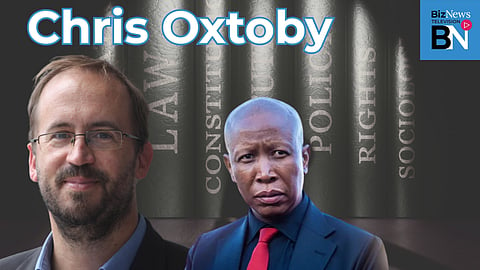
A series of adverse legal findings has put both Julius Malema’s seat in Parliament and his position on the Judicial Services Commission (JSC) in jeopardy. Should he be served a severe sentence for his firearm offences, he will be disqualified from being a member of the National Assembly. Meanwhile, Chris Oxtoby of Freedom Under Law, tells Chris Steyn why the Economic Freedom Fighters (EFF) leader’s position on the JSC has become “untenable”. He stresses that Parliament now has enough grounds to act. He further gives the inside story of two days of JSC hearings - from which Malema was absent in order to attend the Ad Hoc Committee hearings. Oxtoby says despite there being some “credible” candidates to fill a Supreme Court of Appeal vacancy, none were able to get enough votes. He describes Freedom Under Law's ongoing litigation with the JSC over its voting process, and questions “whether the process that we don't see after the interviews, the deliberations and the voting behind closed doors, whether that is properly fit for purpose if it's not being able to deliver us candidates…”.Sign up for your early morning brew of the BizNews Insider to keep you up to speed with the content that matters. The newsletter will land in your inbox at 5:30am weekdays. Register here.Support South Africa’s bastion of independent journalism, offering balanced insights on investments, business, and the political economy, by joining BizNews Premium. Register here.If you prefer WhatsApp for updates, sign up to the BizNews channel here..Watch here.Listen here.Edited transcript of the interview.Chris Steyn (00:01.679)There was a time when Economic Freedom Fighters Commander in Chief Julius Malema and his party seemed unstoppable. But the future of both are in the balance now. We speak to Chris Oxtoby of Freedom Under Law. Welcome, Chris.Chris Oxtoby (00:20.376)Thank you very much, nice to be here.Chris Steyn (00:23.503)Following Mr. Malema's conviction, criminal conviction, for firearm offenses and that hate speech ruling against him, how do you see his political future changing?Chris Oxtoby (00:36.782)So it will be a bit of a case of wait and see, certainly as far as the criminal conviction is concerned. Of course, there's a provision of the Constitution which people remember back to last year when former President Zuma was disqualified from standing for Parliament because of this provision, which means essentially that if you are convicted of an offence with a sentence above a certain threshold, I think it's 12 months without imposition of a fine, from memory, then you are disqualified from being a member of the National Assembly. So were the sentence to reach that level, obviously you wouldn't be able to sit as a member of Parliament. That is something that we will simply have wait and see. The sentencing has been postponed until January of next year. Whether it has an impact if he's not in fact convicted to that level of severity, I think it remains to be seen.I mean, I think we've seen a long history in this country of people have been able to take legal troubles, shall we say, and use them as a vehicle for, you know, politics of grievance or of martyrdom. And it may, you know, maybe that it has this kind of effect. Then there may, it may perhaps be that other issues such as the, you know, the MK party eating into EFF membership of the Floyd Shivambo Party, it may be that those have a more significant impact in the long run. But I think, to turn to the issue that Freedom Under Law and other civil society organisations have particularly had a difficulty with following this conviction, and as you say, also the proceeding hate speech finding against him, relates to his membership of the Judicial Service Commission. Now, this is something which Mr. Malema has been a…Chris Oxtoby (02:40.686)Excuse me. Mr. Malema has been a member of the JSC for over 10 years. And it's something that he's, I think, used very skillfully as a way of building profile, as a way of being noticed and...a way of sort of coming across, I think, in different ways to different people. In some ways, he's able to showcase his firebrand nature on that commission. In some ways, he's, I think, been quite impressive to audiences seeing how he can actually be a very skillful questioner and has asked some very skillful and effective questions.Of course, on the other hand, he's also asked some questions that have been extremely problematic. If anyone remembers a round of Constitutional Court interviews in 2012, which actually had to be be rerun after they were legally challenged. And some of the questions that he'd asked in that round of interviews had been central to that to that issue. So I think his role on the JSC has been quite significant. Ithink those the interviews of prospective judges that the JSC conducts attract quite a lot of attention. They're live streamed. I think people are increasingly aware that that is an important and significant issue and he's been a very prominent voice on that. Now the difficulty that these legal issues raise is that, well, let's say that there's two aspects. The first is that he and the EFF have indicated that they do intend to appeal both decisions. That obviously raises a potential conflict of interest if he's going to be sitting on the body that is constitutionally responsible for selecting judges. If he is then sitting on the interviews and the selection process over judges who may even possibly end up hearing cases that relate to those legal challenges he has, that obviously raises a serious conflict of interest question. There's then the question of his very suitability to be on the body at all.Chris Oxtoby (04:49.152)And in that regard, we have to remember there was a judgment by the Western Cape High Court last year concerning former Judge Hlophe and his attempt to always … membership of the JSC, which the court set aside and saying that, amongst other things, the Constitution implicitly has a fit and proper requirement to be a member of the JSC. Now, in that case, former Judge Hlophe, your removal as a judge and the circumstances around that, his subsequent statements about the judiciary, about that process were all considered factors that made him a not fit and proper person to sit on the JSC. The significance of that here is that in addition to the very fact of the hate speech finding, criminal conviction and of course also to recall a few years before that there was a finding by Parliament's Ethics Committee that Mr. Malema abused his position on the JSC for personal gain. The High Court upheld that finding. So you have all of those legal woes. You then also have remarks that were made in the immediate aftermath of the criminal conviction with the EFF statement associated elements of the judiciary with a broader racist conspiracy. And there was, I think, quite clear insinuation that there was racism on the part of the magistrate.Those are are comments that you know ourselves and other civil society organisations just regard as completely unfunded. They're presented without evidence, without substantiation. They're completely inappropriate for someone in that position to make about the judiciary.Chris Oxtoby (06:37.6)If they're then going to be sitting on the body, as I say, that plays a central role in appointing judges. So both of those factors, the conduct as evidenced in the court cases and the recent statements, as well as the conflict of interest aspects, we say all of that makes his position on the JSC untenable.Now, of course, I to go back to your original question, I don't think that's that's a fatal problem for all their political prospects. But I think I think I think it does do do some harm, as I said, not least because it has been quite a high profile forum for him to to showcase himself.Chris Steyn (07:16.229)Now, does the National Assembly have enough grounds to act against him now, or would they have to wait for his appeals to be heard?Chris Oxtoby (07:26.998)Well, I think on the basis of the the Hlophe judgment, which makes it clear that the National Assembly does have to consider whether or not someone that it designates to the JSC is fit and proper for that role, that that position has been clearly established by the courts. Even if the appeal were to succeed and even if the argument were to be made that, the appeal is pending and we have to to wait for that process.I think the fact of those comments that were made about the magistrate and about the judiciary in the aftermath of the conviction, plus, as I say, the earlier conflict of interest finding, and I'm not aware that that is being challenged. I that's a finding by Parliament that stands and that has been confirmed in the courts. We would say that those, even if you completely disregard the fact of the of the court findings that are under appeal, that those would give Parliament enough grounds to act. And under the Constitution, someone's membership of the JSC, when they've been designated by an organisation, lasts until that organisation revokes that designation. So Parliament, we think, certainly would have the power to do that. And I think...I think it really is important for the credibility of the process of appointing judges. That is something that needs to be protected. It impacts on the public trust and confidence in the judiciary in general that that process has to be...has to be trusted, has to be seen to be above suspicion. I think it really is important that that issue is taken seriously and is given serious consideration.Chris Steyn (09:23.973)And what are the chances, as it stands now, that that will happen?Chris Oxtoby (09:26.51)Well, I think in the statement that ourselves and other civil society organisations released, we did call on Mr. Malema to step down. Now, few can make their own judgment about how likely that is to happen. I think, it's easy to be skeptical and say that, well, you know, one can find so many examples of parliament inaction by Parliament on all kinds of issues, it would be easy to be cynical about that. But on the other hand, particularly post the Hlophe judgment, where the courts have very clearly laid down to Parliament that the question of membership of the Judicial Service Commission, the sort of how Parliament considers and applies itself to who it sends to the JSC is something that has to be taken seriously and that has standards that have to be applied to it. So, Let me just say that the Parliament really should, in light of that judgement particularly, give very serious consideration to the point.Chris Steyn (10:32.281)Now Mr. Malema was not at the JSC hearings this week. He was at Parliament's Ad Hoc committee.You were there, you spent two days there.Chris Oxtoby (10:42.658)That's correct. I mean, that's yes, that's right. I mean, it was it was an interesting question because of course, the, you know, the criminal conviction and the statements that I referred to had taken place only a few days before the the JSC's sitting, which started this week took place. So of course, it was a point of great interest to see, would he would he be there? How would that how would he respond?Only of course that it turned out that he was attending the Ad Hoc committee instead. So I I confess that I haven't been following the proceedings in the Ad Hoc committee closely because of watching the JSC. So I don't want to speak too much or speculate about what was going on in those proceedings. But it was nevertheless interesting to see that choice being made. What I think is important from that is that we shouldn't get lulled into thinking that the fact of this absence from this week's proceedings so far means that the issue is not a live one. If these decisions in question are going to be appealed, appeal processes could conceivably last for years to come: the firearms charge for example, that's a conviction in the Magistrates Court. So one would be looking at an appeal to the High Court. If that's unsuccessful, one could be looking at an appeal to the Supreme Court for appeal, one could then be looking at an appeal to the Constitutional Court. These are all courts that are dealing with extremely heavy case loads and these processes take notoriously long.So the fact that he wasn't at the JSC now does not mean that we're not going to have to face and grapple with this issue in the future. It's given everyone a little bit of a stay, of sorts, a pause.Chris Oxtoby (12:42.47)It's not been squarely put an issue as to whether or not he was actually at the JSC. So I suppose you could be said, well, it buys a bit of time. But I do think it's important that bear in mind that it doesn't take away any of these underlying issues that we've been speaking about. Those are all going to continue to remain remain live. The JSC is likely to sit again in April next year and it's highly unlikely that the full range of court processes and appeal processes would have been concluded by then. So we're very much going to have to come back to and revisit this issue in the future.Chris Steyn (13:19.845)Now, what can you share with us from the hearings you attended this week?Chris Oxtoby (13:26.696)So I think there's two particularly interesting points from what we've seen so far. We had interviews on Tuesday for the Constitutional Court. We had interviews yesterday for the Supreme Court of Appeals. So these are the country's two highest courts. The Constitutional Court in particular has been having a long standing problem where they've not been able to get enough candidates to fill vacancies. The two vacancies that were were interviewed for on Tuesday have been standing open since 2021. So there's really been a crisis of sorts in terms of filling vacancies, getting enough candidates to stand for these positions. So the good news is that the JSC was able to interview enough candidates and was able to put enough candidates forward for possible appointment. And so just to explain that the for the Constitutional Court, unlike other courts. …So for the Constitutional Court, unlike other courts, the JSC sends a list of potential candidates to the President. The President then chooses who to appoint based off that list. So that means that this question of numbers is a particularly important one. So we've got enough. We've got enough candidates. A list has been prepared. That's good news. There's some strong candidates on that list.The concerning part was that the one candidate who was not listed, the one candidate who was left off that list that goes to the President.Chris Oxtoby (15:09.798)…was someone coming from a different background, a part practitioner, part academic background. And there were certainly concerns raised before the interview about several aspects of her candidacy, both in terms of her legal experience. There was also a question that she was under debt review, which the general counsel … raised as a concern. And questions were asked before the interviews about how was she in fact shortlisted in the first place given these issues.And unfortunately, you know, the interview itself simply bore out that it was a very, very strange decision as to why she should have made the shortlist. It was particularly strange because someone on the JSC must have advanced an argument to put her there, but nobody in the interview seemed to be coming to her aid and asking questions to show her in a better light. So this really in terms of sort of underlying structural questions raises some concerns about how the JSC is doing its shortlisting processes, not care who exactly makes that decision and what criteria they employ. And there's not the same level of transparency about that process as there is with other aspects of process of appointing judges. So I think this round has really highlighted the issue that that is something that needs to be given serious attention. Then we saw yesterday the Supreme Court of Appeal, we only have one vacancy. There were, I forget that there were a number of candidates, I forget the exact number now, five or six candidates I think. And some credible candidates there, I would say three candidates particularly, had good interviews where the commissioners seemed to be impressed. I was certainly expecting that an appointment would be made. In the end, it turned out that none of the candidates were able to get enough votes. None of them commanded the majority required to be appointed. So we have to go and do the whole process again the next time the JSC sits. And there is...Chris Oxtoby (17:12.782)Just to put this in a slightly wider context and Freedom Under Law has ongoing litigation with the JSC over the JSC's voting process. This was prompted by a controversial round of interviews two years ago. The litigation is still ongoing. This issue just highlights again that there do seem to be some issues with the voting and the decision making process. As I say, I really would have expected that the the round of interviews would have delivered the JSC a candidate that they could have appointed. And the fact that they weren't able to does again raise further questions about whether the process that we don't see after the interviews, the deliberations and the voting behind closed doors, whether that is properly fit for purpose, if it's not being able to deliver us candidates and…You know, just to not so that this should be the be all and end all, but just on a practical level, the cost of the organisational and administrative process of going through this process again in six months time is not ideal. If we don't have enough good candidates, then fine. No one should be appointed to be a judge just for the sake of filling a vacancy. But I do think in this case, there were enough good candidates to have made that appointment. It's unfortunate the JSC couldn't do so. And so I think that their voting processes do continue to be something that need to be under scrutiny.Chris Steyn (18:47.161)Thank you. That was Chris Oxtoby, of Freedom Under Law speaking to BizNews, I'm Chris Steyn.