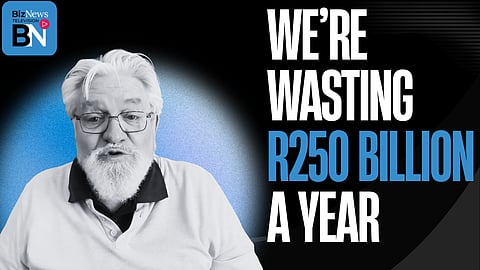
The new Integrated Resource Plan, IRP 2025, released by Electricity Minister Kgosientsho Ramokgopa yesterday (Sunday) means the quantum of electricity sold in 2040 will be R250 billion more to the consumer than if it was done differently. So says Energy expert Clyde Mallinson. “I did an analysis about six months ago where I put an alternate plan together that by 2040 would cost the country 250 billion Rand per year less than the plan that's just been gazetted. So the electricity price will be around 60 to 70 percent more expensive than it could be if we had an alternate plan.” Mallinson says that not only is this the cheapest plan, but that it would produce so much excess electricity that it could lift 12 million households out of energy poverty. "My vision for the country is turn renewable energy into renewable energy dividends for 12 million South African households and take them off SASSA grants and swap them out for renewable energy dividends.” Mallinson points out that South Africa is going through the biggest disruption in the energy sector ever. "And if you imagine trying to plan in the midst of a disruption…It's not an easy thing to do. And that's why the plan should be flexible. And that's why it shouldn't be a straight jacket….And I just don't think our planners have planned for the fact that we need to overproduce. And it's that very overproduction that holds the capacity to drive our economy.”.Sign up for your early morning brew of the BizNews Insider to keep you up to speed with the content that matters. The newsletter will land in your inbox at 5:30am weekdays. Register here.Support South Africa’s bastion of independent journalism, offering balanced insights on investments, business, and the political economy, by joining BizNews Premium. Register here.If you prefer WhatsApp for updates, sign up to the BizNews channel here..Watch here.Listen here.Edited transcript of the interview.Chris Steyn (00:01.548)Yesterday, the Electricity Minister announced the new Integrated Resource Plan, IRP 2025. Energy expert Clyde Mallinson is here to help us make sense of it. Welcome, Clyde. Clyde Mallinson (00:16.93)God, good morning, good to be with you. Chris Steyn (00:20.652)Now, the previous... Clyde Mallinson (00:21.038)Plan actually six years in the making. It was originally called the 2023 plan. And for energy planning, we're meant to bring out a new plan every two years. So we've had three plans in the last 15 years. So we kind of not quite on the ball there, but anyway, 2025 it is. Yes. Chris Steyn (00:40.195)I was going to ask you, the previous one having been released in 2019, why has it taken this long? Clyde Mallinson (00:50.41)I'm actually not sure. It's meant to be, you know, and also when the minister released the plan, there was a bit of contradictory stuff because he said, well, first of all, it's a living plan. You know, it's up for change, frequent change. Well, I thought to myself, well, if only. Then later on, he said, now that this plan is policy, we are gazetting this and you've got to do what this plan says. And I thought to myself, that doesn't sound like a sort of a strategic guideline. It sounds like a straitjacket. So there's definitely some conflicting ideas then as to whether this plan is going to be gazetted into policy law or whether it's going to be what a plan should be. It's a general broad overview of where we think we're heading, but hey, we can change it. And just in that context, every one of the plans they've brought out is immediately it's been brought out as being way out of date because things are moving so fast. And I'll come back to that theme later, just how fast things are moving, because I know that this plan's out of date before it hits the ground. Chris Steyn (01:59.726)Now, if I read it correctly, it proposes significant new gas and nuclear. What is behind this? Clyde Mallinson (02:07.694)Electrons and molecules. But yeah, it's not good basically. It's a clinging to the past. It's a clinging to fossil fuels. It's choosing the most expensive, most inflexible option when it comes to nuclear. I've often described nuclear in the future as being akin to a retired rugby prop in a game of Sevens. If you know what I mean, you need to be agile, flexible. You need to have a game plan. And when we, by 2040, when the nuclear may or may not be built, we will have about 90 gigawatts of solar. So just put that in perspective. 90, 60 gigawatts of wind and 50 gigawatts of storage. So 90, 60, 50. And then we'll have five gigawatts of nuclear sort of wandering around stopping every 18 months for refueling. It'll be bizarre to have nuclear in. Yeah. Chris Steyn (03:10.756)So what you’re saying it's not even realistic and certainly not affordable. Clyde Mallinson (03:18.734)Well, it's the most expensive form and things are moving so quickly. I did an analysis about six months ago where I put an alternate plan together that by 2040 would cost the country 250 billion Rand per year less than the plan that's just been gazetted. 250 billion Rand per year less than the one that's just been gazetted. So you can see it's quite...And when I did my plan, I was using pricing for battery energy storage, which since I did my planning about six months ago, the price of battery storage has halved. The price of the cells has halved since when I did it. So trying to plan with something like nuclear in an evolving technological disruption, where the cost of batteries are now 5% of what they were 10 years ago, is you know you can't plan in the middle of disruption unless you're planning to take advantage of that disruption. You know if you're planning to build better horse carriages and you don't see that the motor vehicle is going to disrupt horse transport then you're on the wrong track. Chris Steyn (04:37.188)So would you describe this plan as catastrophically expensive? Clyde Mallinson (04:42.146)Yeah, well, they're very coy on describing the expenses because on the one hand, there's all the talk about how are we going to, we have to lift people out of poverty and all the talk is that poverty has come about because we haven't had enough energy. And so we've had load shedding and that's led to job losses and everything. And if you look at the plan that I've devised, not just me, but globally, this is the way things are heading. Not only is it the cheapest plan, but it produces so much excess electricity that it can lift 12 million households out of energy poverty. And the current scenario is that people see excess as a problem because the system has to balance all the time. You can't have more and you can't have less. But if you do have more, everyone in the free market knows that if you want to lower the price of a product, you sell more of it. You don't sell less of it. So for as long as I can remember, Eskom has been encouraging us to use less electricity because there's been the shortfall. And so we always, see our demand, our current demand, and then we're trying to meet that demand with nuclear, coal, gas, hydro, pumped storage, wind, solar. We're always just trying to meet the demand. And the future of the electricity supply industry is going to be that we are going to have abundant generation from solar, wind and storage. So solar and wind with storage acting as the sort of equalizer or the shock absorber. And there's going to be a super abundance. We're going to build more than we need. And we are then going to adapt our demand to the generation rather than try and generate to meet our demand. It's a complete flipping… Clyde Mallinson (06:35.72)…of the argument and incumbents can't really see that. They say, you know, why would you ever produce excess from a coal plant more than the country needs? If you you burnt more coal than you needed, you'd have to push the clutch in, so to speak, because you can't have more. So you would never ever want to overproduce. And yet in the future, overproduction is going to be the order of the day. And it's what you do with that overproduction. Do you curtail it? I'm talking about overproduction after you've stored and you've now still got extra, you know, if you've got solar on your roof at home and a battery, come 11 o'clock in the morning, the batteries for your house isn't drawing as much as the solar. And unless you can sell back to the city of Cape Town or someone, you're actually just wasting that electricity. That's the surplus. And it's that surplus that comes mainly in the daytime when economic activity takes place. And the way to utilise that surplus is to basically offer uncapped electricity to 12 million households for the majority of the days of the year. That's what you do. And then watch what happens when you've got access to it. And when I say uncapped electricity, it's a bit like uncapped Wi-Fi. You can use as much as you like, but you can only use it at a certain rate. So you'd have like a 20 amp breaker at your house and you can use as much electricity as you like between say nine o'clock and three o'clock in the afternoon at a fixed price. It's not necessarily free but it's a fixed rate like Wi-Fi and you can use as much as you like but you can't download and upload unless you want to get a bigger circuit breaker and then you'd pay a bit more of a fixed cost. So that's what we should be heading towards. And we're actually staring so far away from that very exciting future that it keeps me awake at night. Chris Steyn (08:34.308)Now, yet it posits 41 gigawatt of coal by 2039. Does that mean that a new Kusile-type station will have to be built even as other coal stations are retired? Clyde Mallinson (08:50.758)You know, once again, a weird contradiction. I can only think that it's a typo. When the thing was being presented, someone on a WhatsApp group I belong to said they're actually using the wrong slide deck during the presentation and there was a bit of a skirmish afterwards and a different slide deck appeared. So 41 gigawatts is more or less what we have at the moment. During the presentation, the minister said that you'll notice that there's no new coal being built. There's a whack of nuclear and gas, but there's no new coal. So if they still sitting with 41 or 40 in 2039 or 2040 or whenever it is, it just looks as if it's either a typo or they don't ever intending, intend shutting any coal plants down. I call it fear of retiring coal or fork. There's a definite fork where you, there's a fear of retiring coal. Chris Steyn (09:48.162)Now, surprisingly, it omits any impact on electricity tariffs. Clyde Mallinson (09:54.339)Well, the impact that I calculated, which I've already mentioned, is that if you do it the way I believe we should do it, it would cost us 250 billion rand per year less on the price of electricity. So that's the impact. So whatever they're doing is going to is the quantum of electricity sold in 2040 at the price estimated based on the IRP will be 250 billion rand more to the consumer than if we do it differently. That's the price difference. Whatever that price, the price is more or less in today's terms. If we just think of today's money in 2050, their model will have factory gate electricity at a price of about one Rand 50 kilowatt an hour. That's factory gate. So that's before delivery and transport and everything. Clyde Mallinson (10:48.91)And the model I did will have a price of about 78 cents. So there's a difference of about 70 cents. And we're talking about, I think it's about 500, no, it's about 380 terawatt hours by 2040. So let's call it 400. So 400 times 70 cents is 280 billion. But in my model, it's actually 250 billion because I've just rounded up the numbers. So the electricity price will be round about 60 to 70 percent more expensive than it could be if we had an alternate plan..Read more.Adv. Mark Oppenheimer: Is the ANC liable for Genocide? - The NdB Sunday Show.Chris Steyn (11:29.06)Now, according to the minister, the plan won't follow the market. The state will lead. So how does that tally with the policy of establishing an electricity market? Clyde Mallinson (11:40.655)Well, it kind of just says no to the electricity market. There's going to be mega auctions. The state's going to control it. It's a problem because I personally don't believe that the... It's an awkward one, this, because when you build primarily with renewables, you've got to stimulate new demand to use the excess that your day factor will produce. Remember, we're going to design a system that gets us through the worst week in winter which means every other day of the year we've got a surplus. So our challenge is to find opportunities for that surplus rather than to curtail it. And it's quite difficult to…if you don't find those opportunities through private endeavour, through lifting houses out of energy poverty, if you're not finding those opportunities, then you have to curtail that surplus. And the problem then is who gets curtailed? Is it Eskom that gets curtailed? Do you switch off the coal? Do you switch off the nuclear? And the answer is no. You're going to have to curtail…. They'll probably want to curtail the wind and the solar to make space for the nuclear and the gas. Remember the gas they're talking about running at a 50% capacity factor. That means it's got to... Sorry. Chris Steyn (12:54.008)Where will our gas come from anyway? Clyde Mallinson (12:58.707)I don't know, they're punching holes in the Free State and the Armersfoort or something. We've been talking about gas for a long time. If it comes locally, it's going to be more expensive than the alternatives. And if we have to import it and degasify LNG and everything, then it's going to be a lot more expensive than the alternatives. So the era of gas is over. It's a...we don't need it. And one of the interesting things is they wanting to anchor this what's called combined cycle gas turbines that have to run at 51% was the number I think quoted capacity factor. And the reason it's like finding an anchor tenant at a shopping centre. So they're saying, well, these these gas out there, but we, you know, if we've got a lot of gas, but we need to be sure we can sell it. So first of all, we need an anchor tenant.The guys say, the anchor tenants are all up in Gauteng and maybe KwaZulu-Natal. And there's not enough of them to justify putting in the infrastructure for importing LNG. And then they say, hmm, we need that anchor tenant. How about if we build six gigawatts of combined cycle gas and we guarantee that it'll run 50% of the time, even if we don't need it to do that? That forms our anchor tenant. And then they'll say, right now we can encourage people to go and punch holes and frack the Karoo and mess up the ocean in order to justify looking for that very expensive local gas or it justifies putting in the infrastructure. Remember, when you're running gas with imported LNG, you've got to factor in the cost of the infrastructure of that LNG as well. You can't just say, the gas costs this. You've got to say, wait a bit. What about all the infrastructure spend before we could use the gas and the pipelines and everything? So you have to, it's akin, it's akin really to the grid constraints that people talk about. There's a gas grid constraint and you've got to factor that cost in. You can't just say, gas is great. It's flexible. You know, let's go for it. So, so they're looking for an anchor tenant to try and then justify… Clyde Mallinson (15:21.187)…the capital infrastructure spend that will be required to enable gas to act as that anchor tenant. Then you've got your big anchor tenant. I won't mention any names, maybe Cash Spar or some damn thing, but you got your anchor tenant. And then you put your little boutiques in, your biltong stall, your fashion shop and your fudge maker. But the anchor tenant is the thing that drives the business case. And that's what they do. Chris Steyn (15:50.648)Now why would government not consider a plan like yours instead? Clyde Mallinson (15:59.149)I have no idea actually, but I bang the drum. I've been banging the drum for, I don't know, about 10 years now. And I'm very aware that we're going through the biggest disruption in the energy sector ever. And we either get on board with that disruption or we try and just ignore it. It's a massive disruption. And if you imagine trying to plan in the midst of a disruption. It's not an easy thing to do. And that's why the plan should be flexible. And that's why it shouldn't be a straight jacket. It should be, this is where things are heading. They're probably gonna head there faster than we think they're gonna head there. You know, abit like box TVs going to flat screen happened a bit quicker than, you know, but it was nice for us that it happened. But I saw my first flat screen TV in Harrods in...to 2000 and whenever it was. And I thought, geez, I wish one day I'll be rich enough to have one of those. Now they give them away if the Springboks win the blooming World Cup. So that's the scale of the disruption. And I just don't think our planners have planned for the fact that we need to overproduce. And it's that very overproduction that holds the capacity to drive our economy. The minister even spoke about the link between electricity production and GDP and well-being. GDP per person versus electricity. So overproduction is a case of saying there's more electricity per GDP. And our problem now is, it's not a problem, it's an absolute pleasure. What sorts of businesses… Clyde Mallinson (17:53.869)…would benefit from low marginal cost surplus electricity during the time when most people aren't sleeping and are economically active. That's the framing. And that's where the private sector should be getting really excited and saying, geez, maybe we can desalinate seawater and store it. We don't have to desalinate all the time. Maybe we can electrify transport and charge the cars in the day instead of in the night when we've got this surplus low marginal cost electricity. The possibilities are actually endless. Chris Steyn (18:30.05)Meanwhile, South African exporters face carbon export taxes. Does this plan go any way to lower our carbon density? Clyde Mallinson (18:37.903)This plan leverages that as a massive advantage. If they stick to the rules in the carbon border adjustment, we will actually get tax credits, not tax penalties, because we'll have zero carbon in our products. So we'll have the lowest carbon intensity, wine, beef, motor cars, you name it. We're so well-endowed with renewable resources in this country as to actually be almost unfair. We've got such an unfair advantage over Europe. We're flipping in the winter, they don't even see the blooming sun. Whenever it breaks through the cloud, it's at such a low angle, you've got to wear sunglasses the whole time because the sun's flipping in your eyes all the time. Not during sunrise and sunset. In the middle of the day, the sun's in your bloody eyes. You know, so they have a massive inter-seasonal change in Europe, whereas in South Africa, with our sunny winter Highveld days, the difference in solar output in summer and winter is big still. But goodness me, it's a tiny difference compared to the inter-seasonal difference in solar in most of those European countries. And yet, more solar in the Netherlands than there is in South Africa. You know, old Jan would be turning in his grave if he thought the Netherlands had more bloody sunshine than South Africa. It's crazy. Chris Steyn (20:12.452)Now Clyde, what's your message to the Minister of Electricity? Go back to the drawing board. Clyde Mallinson (20:17.871)The drawing board is the wrong place for this. Liberate yourself from the so-called energy trilemma. For such a long time now, people have spoken about it must either be affordable or green or secure. And it's a triangle and the three corners of the triangle are fighting with each other… They're fighting. It's a family squabble. And if the one gets gets closer to his corner, the other two are losing out. Well, that energy trilemma has disappeared and we now have a virtuous circle. The cleanest electricity is now also the most affordable and the most reliable. And so there isn't an energy trilemma anymore. So it's not drawing board. Throw away the drawing board and actually understand the scale of the disruption and the possibilities. And the possibility that the best bit is that we can have 12 million households actually owning a stake in this new fleet. And so they would be able to borrow money from private sector banks, buy preference shares in the new fleet and the dividends they would get from the sale of that electricity would exceed what they having to pay back for the money they borrowed from the bank. So from day one they would be cash flow positive and then when their bank loan was paid back they'd have a pension that would be bigger than a SASSA grant. So my vision for the country is turn renewable energy into renewable energy dividends for 12 million South African households and take them off SASSA grants and swap them out for renewable energy dividends. That's my real dream. And so it's not drawing board. It's not tinkering on the edges. It's sweeping away the old and embracing the digital future. Chris Steyn (22:25.646)Thank you very much. That was energy expert Clyde Mallinson speaking to BizNews after the Electricity Minister released the Integrated Resource Plan yesterday. I'm Chris Steyn.