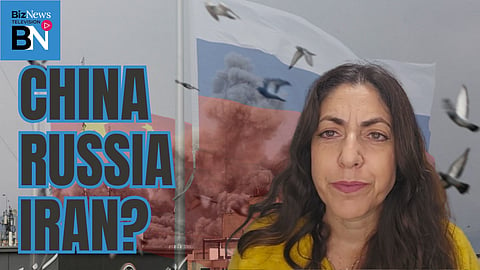
Fears of a global war is one of the questions addressed by Col Sarit Zehavi, the founder of the Alma Centre, in this interview with Chris Steyn. "I don't see neither China nor Russia sacrificing themselves for the Ayatollahs of Iran... And...I don't think that they will go against the massive power that was brought over here to the Middle East by the Americans just to protect a sinking ship." Col Zehavi further comments on Iran's nuclear capabilities; the likelihood of another country using a nuclear weapon agains the Iranian regime; the attacks by Iran on other countries in the Middle East; America's likely staying power in this war; the barrage of attacks on Tel Aviv, the renewed war with Hezbollah - as well as South Africa's support for Iran..Sign up for your early morning brew of the BizNews Insider to keep you up to speed with the content that matters. The newsletter will land in your inbox every morning on weekdays. Register here.Support South Africa’s bastion of independent journalism, offering balanced insights on investments, business, and the political economy, by joining BizNews Premium. Register here.If you prefer WhatsApp for updates, sign up to the BizNews channel here..Watch here.Listen here.Edited transcript of the interview.Chris Steyn (00:01.533)The war in the Middle East has ended another day. I get the latest from Colonel Sarit Zehavi, the founder and president of the Alma Research and Education Centre. Morning, Colonel.Sarit Zehavi (00:12.942)Good morning.Chris Steyn (00:16.039)What is the latest from Tel Aviv? Sarit Zehavi (00:18.061)Well, I'm not in Tel Aviv. I'm based in northern Israel, nine kilometers from the Lebanese border. I can tell you that we had the sirens here in the north throughout the night and the morning. IDF just entered two areas next to the border in the Lebanese side in order to secure the Israeli communities on the Lebanese borderline to make sure that Hezbollah is not there or going down there to launch anti-tank missiles or to infiltrate into our communities because this time, in opposed to two and a half years ago, there is a decision not to evacuate the communities. So people are there, children are there, and we need to defend them, and that's why the IDF entered. All of this is happening after, actually yesterday, Hezbollah entered the war and attacked us with drones and rockets all the way to Haifa.And we understand this is not just war between America and Iran, or between Israel and America and Iran, it is something much bigger than that. Chris Steyn (01:19.593)Were you surprised when Iran started attacking Saudi and Qatar and Dubai? Sarit Zehavi (01:30.701)No, I was not surprised because they said they would do so. I think they made a mistake. But I think it also demonstrates what this regime is all about. Because me and you can say that it's a mistake, that it damaged their interests, they created more enemies. Now maybe Saudi Arabia and the Gulf countries will join us. But actually for them, the way of thinking of the ayatollahs of the Islamic Republic of Iran is different, and they are religiously motivated, it's a different kind of rationality. And for them to attack Sunni states, which is another big enemy, just like Israel and the United States, that are collaborating with the United States, this is what they should do. It's legitimate, even though it creates a bigger war.Chris Steyn (02:27.049)How far do you think Iran will be prepared to go?Sarit Zehavi (02:32.017)…as far as it can. I'm not sure how much it can, because many of the capabilities are neutralised as we speak. We see this with the amount of missiles that are launching. It disturbs our lives. People are getting killed here. But at the same time, it's not the barrages of hundreds or tens of missiles that we've seen two years ago. And we understand that the capabilities will get smaller…as time goes by, the decision-making process in Iran is becoming more and more difficult and we understand that there are different opinions inside the Islamic Republic of which way to go exactly. And that's why I believe that the operation should be very strong, very decisive, to neutralise as many capabilities as possible. I'm very happy that President Trump said most of the Navy was eliminated. This is very important as well.But we all need to be patient. We all know it will take time. Okay, that is wars, you always know how you start and you never know how they're going to end. But we understand it was the least worst choice among others because we had to do that. If we wouldn't have done that, a bigger threat would have been created and we find out in the past two and a half years in Israel that those who want to extinct us are not just preparing for that, they are willing to do that and that's why we are not willing to enable them to have the capabilities to do that.Chris Steyn (04:14.567)Can you tell us more about the factions in Iran? Who is on the one side and who's on the other side?Sarit Zehavi (04:22.472)I want to make it clear, it's not one side or the other side, okay? Eventually you have probably the majority of the Iranian people, even though not all of them, we're talking about more than 80 million Iranians, that are against this oppressing regime, and we've seen what happened two months ago when they went out to the streets, and you have those who support the Islamic Republic. Among those who support the Islamic Republic, it's the families of the IRGC, it's the families of those who are fighting we are fighting against now, and they are still religiously motivated. Inside the Islamic Republic, there are different opinions of what to do. I wouldn't give it too much credit to different ideology or more moderate… I would attribute that to confusion, to dilemmas, to strong dilemmas of how exactly to bring about the surviviness of the Islamic Republic. But eventually, for us, speaking from here, from Israel, we want to see the Islamic Republic gone. It doesn't matter whether there are those who are saying that they want to negotiate now or those who are saying, no, let's just fight. Because those who are saying that they want to negotiate, this is a tactical opinion. It's not that they want to negotiate because they are interested in peace. It's not that they want to negotiate because they are willing to acknowledge the very existence of us over here. They want to negotiate in order to survive, in order to continue to do what they have been doing in the past few years, which is oppressing the Iranian people and even genociding them, which is building ballistic missiles capabilities and nuclear capabilities, and then put us at risk as well, and of course, cultivating the proxies all over the Middle East. Chris Steyn (06:06.727)Is there any chance of the US backing down? Sarit Zehavi (06:09.635)Again, I didn't hear the question. Chris Steyn (06:12.846)Sorry, is there any chance of the US backing down? Sarit Zehavi (06:16.422)You know, I'm an expert on the Middle East. I am not sure I can predict what exactly will happen with the US. It seems like there is a lot of decisiveness to continue, at least for now. Yesterday, President Trump spoke about four weeks. Even for us, it's a long time. You need to understand that in Israel there is no routine. It's a holiday now in Israel. We're not celebrating. Children are not going to school. Businesses are closed. We didn't choose that. We didn't want that. But it's either this or extinction. And that's why it's so important for us to go for that. I hope that the Americans will continue to be with us on that because if they will not and the Islamic Republic will survive this, which is an option, they will get back to those capabilities. It will take them maybe years, but they will invest a lot of money. By the way, a lot of money at the expense of their own people. They do not invest in infrastructures. The people in Tehran don't have enough water, don't have enough electricity, there is inflation, the economic situation is really, really bad in Iran, and yet the resources are all towards war. Before the current war, before the US attacked Iran. The investments were in the nuclear programme, in the ballistic missiles program, and not to the benefit of their own people. So I hope that this time, you know, everybody will work together to truly bring the change because this will affect not only the Israelis, it will affect many people in the Middle East, the Iranians themselves, but also in other countries here that Iran took advantage of in order to build its capabilities against Israel, like Hezbollah in Lebanon and like the Houthis of Yemen. Chris Steyn (00:01.176)What is the current status of Iran's nuclear capabilities?Sarit Zehavi (08:15.523)Now, they don't have nuclear weapons now. They did enrich uranium for 60%, which is not enrichment for civilian purposes. But in order to create bombs, they need to weaponise the enriched uranium. They need to make it smaller in order to put it on a missile. And they haven't done that yet. I believe they made some progress in this process, which they had a lot of difficulties in just before June, before the previous campaign against Iran. And I believe that we succeeded in the previous campaign to postpone, to delay what they have done there. But as far as we understand, by their own declarations, by the way, and things that were published even this morning by Steve Witkoff, we failed to destroy the 60% enriched uranium of about more than 400 kilos. And it is somewhere in Iran, I don't know exactly where, and they were willing to find it again, to bring it from deep in the ground, and to create a bomb out of that. So they don't have that yet. And we, I think that's why the timing was very, very important, to make sure that they are not reviving the nuclear programme. And they did accelerate the ballistic missiles program, which is also a huge problem. I want people to understand that one ballistic missile that our air defence system missed destroyed a neighbourhood yesterday. Like a neighbourhood was erased. And even people who were in the bomb shelters were killed by this ballistic missile, including children in Israel. So that's why it's so important. We cannot only rely on air defense systems and let them do whatever they want. I understand that those programs, the ballistic programme and the nuclear program, were damaged in June, but the fact that the Iranians wanted to, or did, accelerate the recovery of those programmes, especially with the ballistic missile, by the way, with…Sarit Zehavi (10:35.265)… that were brought from China into Iran to rebuild those missiles, to build advanced missiles that will enable Iran to hide them deep in the ground and to weaponise them and to launch them very, very quickly. All of this eventually brought us to this point, to why it's so important to carry out the attack now. Chris Steyn (11:11.357)Would another party, another country, be prepared to use nuclear weapons to finish off Iran?Sarit Zehavi (11:17.099)I don't see what's the benefit of that, to tell you the truth, because the idea is to act against the regime and to bring help, as promised, to the Iranian people. Why? You know, everybody knows what's the damage of a nuclear bomb. It is killing the Iranian, it is killing the people as well. I don't think this is within the interest of any of the sides. Chris Steyn (11:44.093)What do you make of the stance of Russia and China at the moment? Sarit Zehavi (11:48.074)For now it doesn't look like…and actually I talked about it in some of my interviews. I was asked whether it's going to be a global war and I said that eventually I don't see neither China nor Russia sacrificing themselves for the ayatollahs of Iran. Russia and China are interested in the Russian and China Chinese interest and it's not an alliance that is based on ideology or based on shared values; they don't share anything with the Islamic Republic other than money and interest. And that's why I don't think that they will go against the massive power that was brought over here to the Middle East by the Americans just to protect a sinking ship. Okay, which this is what it is, the Islamic Republic. Second, I do believe that the fact that President Trump and even Benjamin Netanyahu had some kind of a level of dialogue with both China and Russia will assist in moderating crises and making sure that they will not join in. I'm saying that very carefully. Again, I know that war is the kingdom of surprises, but I believe that it's not within their interest to protect them that way. It is within their interest to moderate, to see what they can do in trying to stop the operation in a way that they will survive, but not in a way of making this a global war. Chris Steyn (00:00.782)Do you think that those countries in the region that have come under attack are angry with Israel? Sarit Zehavi (13:58.684)I think all of them understand for years, not since the current campaign, that Iran is a threat for them because there is a competition, there is a traditional clash and traditional confrontation…Sarit Zehavi (14:26.979)…between the kingdom of the Shiite Muslims and the kingdoms of the Sunni Muslims, especially when we speak of a regime that is based on the Muslim-Shiite radical ideology, that is based on the idea of not recognizing the Sunnis as leading the Muslim world and viewing the Muslim Sunnis as an imminent enemy, traditional enemy, this is what this regime is all about. So I think that the Gulf countries understand that and for many years identify Iran as a threat. And what was demonstrated here is how big the threat is. They didn't find out anything new over here. It's just we all understood now that they are standing behind their words when they are distributing this kind of radical ideology in their country and outside of their country. Chris Steyn (15:27.913)As you know, South Africa is very supportive of Iran. Do you have a message for us? Well, not for us, but for the country. Sarit Zehavi (15:35.835)South Africa fought for many years to become a democratic state with freedom and equality for its citizens. How come it is supporting a regime that is genociding its own people, that it is so different from those values? There is no democracy in Iran. The supreme leader that was killed was not elected by the Iranian people. He was nominated by a religious council. The religious ideology is not moderate. It is a radical ideology that wants to extant Israel and want to extant America. And on the way they want to extinct those who don't believe in this radical ideology. I don't see what you share with the Islamic Republic of Iran? And how come you're not standing next to the oppressed people of Iran? Chris Steyn (16:36.531)Thank you. That was Colonel Sarit Zehavi of the Alma Research Center on the border with Lebanon. Speaking to BizNews, I'm Chris Steyn. Sarit Zehavi (16:45.635)Thank you for having me.