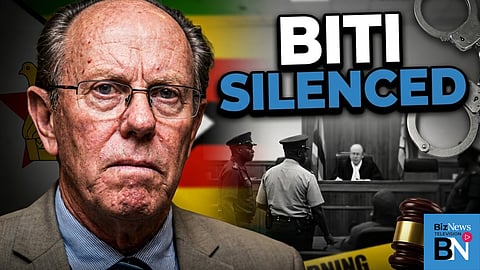
Zimbabwe opposition leader Tendai Biti has been handed harsh bail conditions after spending the past weekend in custody. In this interview, David Coltart, the Mayor of Bulawayo and a former Cabinet Minister, tells Chris Steyn that Biti’s arrest was contrived to punish him for opposing proposed constitutional amendments that would extend the terms of office of the president and parliamentarians by two years, while his bail conditions will ensure that he contributes no further to the debate. “It's a very grim prospect that we face in the country because, in essence, what we are seeing is a Constitutional coup. I think that ZANU-PF has looked at what has happened in Tanzania and Uganda and the fall-out of such violent elections. And they've decided just to avoid elections, quite frankly, for another two years. And if they extend now by a further two years, what's to stop them just extending their terms even further beyond that?”.Sign up for your early morning brew of the BizNews Insider to keep you up to speed with the content that matters. The newsletter will land in your inbox every morning on weekdays. Register here.Support South Africa's bastion of independent journalism, offering balanced insights on investments, business, and the political economy, by joining BizNews Premium. Register here.If you prefer WhatsApp for updates, sign up to the BizNews channel here..Watch here.Listen here.Edited transcript of the interview.Chris Steyn (00:01.545)Zimbabwe opposition leader Tendai Biti has been handed very harsh bail conditions after spending the past weekend in custody. I speak to Mr. David Coltart, the Mayor of Bulawayo and the former Cabinet Minister. Welcome, Sir.David Coltart (00:18.168)Good morning.Chris Steyn (00:20.531)Please list those bail conditions for us.David Coltart (00:25.434)He was granted bail on, I think, payment of 500 US dollars, but the worst aspect of it is the reporting condition and the order which basically stifles him from contributing any further to the debate going on in our country regarding the amendment to the Constitution. And clearly it's designed to prevent him from making any further contribution to that debate.Chris Steyn (01:01.705)Please recap for us the exact circumstances of his arrestDavid Coltart (01:07.832)Well, we've got to put it in context. In February, the Parliament of Zimbabwe announced that there would be a new Constitutional Amendment Bill. And in terms of our constitution, we have a process which allows for public consultation and debate prior to the Bill coming to Parliament for debate in Parliament and a vote on that Bill. Tendai Biti, along with many others in the country, has been fundamentally opposed to the Amendment Bill because he believes that it destroys some of the key foundations of the constitution we agreed in 2013, and he has been traveling the country speaking out against the Amendment Bill. On Saturday, he was in the eastern city of Zimbabwe, Mutare, and he participated in a training exercise, as I understand, of activists who were being taught regarding the problems relating to this bill. The police arrested him using one of our draconian laws which states that prior to any public meeting being held in the country one has to give the police a notice of that. You've got to notify the police and they said that this was a public meeting that he had not given any notification of and therefore an offense had been committed.The law itself is draconian, but even if you apply the law, it was wrongly applied because this was a private meeting. It was not a public meeting. There was no requirement to give the police any notification of the meeting. And in any event, one just has to notify the police. The police haven't been given powers to ban any meetings unilaterally.David Coltart (03:27.789)Clearly, the arrest of Tendai Biti was contrived, was used to punish him for opposing these amendments, but clearly now given the bail conditions has been used to ensure that he contributes no further to the debate which is swirling in the country around this amendment bill.Chris Steyn (03:50.579)So with his voice effectively silenced now, what impact will that have on other members of the opposition fighting these proposed changes?David Coltart (04:02.423)Well, it has a chilling effect on everyone. And let me also say that the arrest of Tendai Biti hasn't come in a vacuum. I was meant to contribute to a debate in Bulawayo two or three weeks ago. That meeting was banned. Another fellow lawyer… was set upon by ZANU-PF thugs a few weeks ago and badly beaten and tortured. He ended up...in hospital as a result of that. And so one needs to see this in this broader context, that it is designed to have a chilling effect on activists who are opposed to these constitutional amendments, but also to the general public. In the coming days, starting on the 30th of March, there's a period of three to four days when parliamentarians will be going countrywide to engage in this process of explaining the Bill to the general public and getting the views of the public. And there's no doubt in my mind that ZANU-PF are busy preparing their own supporters to come to these hearings. But given what has happened in the last few weeks with the beatings and the arrests, that acts as a chilling effect for those who are opposed to the bill and therefore will mean that this process of public hearings in itself has been undermined by this.Chris Steyn (05:43.144)Do you think the public hearings are just going through the motions, a going-through-the-motions process?David Coltart (05:51.456)Well, there's no doubt in my mind. We're deeply concerned about the manner in which Parliament has arranged these public hearings. For example, take the city that I am mayor of, Bulawayo, the second largest city in Zimbabwe. It has a population of some 700,000 people. On Monday, there are two hearings. There's one in the large city hall at 10 a.m. and then there's another hearing in the afternoon in one of the working class areas. So in other words, there are only two meetings to cater for the views of a city of 700,000 people on what is arguably one of the most important and significant amendments to our Constitution. So it's wholly inadequate and clearly it's designed simply to go through the motions. There's a constitutional obligation on Parliament to conduct these hearings. And so there's... They're literally just ticking the box. And I'm no prophet, but I suspected on Monday in Harare that these meetings will be packed with people who have been trained by ZANU-PF, who will seek to dominate these meetings, to crowd out others, to engage in threatening conduct and therefore drown the views of, quite frankly, the overwhelming majority of Zimbabweans who are opposed to these Constitutional amendments.Chris Steyn (07:21.064)Now, if these Constitutional amendments make it, it would mean that the current president could be in power until 2030. Is that correct?David Coltart (07:33.623)Well, it extends not just the president, but the parliamentarians and even in theory, me as a councillor, our terms in office are extended by two years. But that is not the fundamental problem that I have. Our constitution allows for amendments. The key objection to this is that our Constitution has a belt and braces provision that says that if there's any amendment to our constitution which has the effect of extending the term of office of an office holder, whether that office holder is the president or parliamentarian or a councillor, that amendment has to be subjected to the Zimbabwean public through a referendum, not just public hearings like this, not just a vote in Parliament, but a referendum conducted countrywide where every voter is entitled to vote yes or no. And ZANU-PF is seeking to evade that clear Constitutional provision. If they do that as their stated intention, then that constitutes a very severe breach of our existing Constitution. But of course, coming back to your point, I have a fundamental problem. I was elected for five years. That was the contract that I have between myself and the...and the people who voted for me. They didn't vote me in for a seven-year period. And it's not open to me as an incumbent to simply grant myself another two years of office without a clear mandate being given to me by the electorate. There are other provisions in these amendments which are equally concerning. They are overall designed to consolidate power in the hands of the executive and to undermine the other arms of government. They undermine the judiciary, they give the President the power to play a much greater role than was ever designed in the 2013 Constitution, for example, in the appointment of judges. So there are numerous provisions in these proposed amendments, which those of us who were involved in the development of the 2013 Constitution have deep-rooted concerns about.Chris Steyn (10:02.344)What else can you do apart from campaign against the proposed amendments?David Coltart (10:10.198)Well, there is very little that we can do in Zimbabwe. For example, most of the media in Zimbabwe is tightly controlled by the government. Forty-six years after independence, we still don't have a single truly independent radio station. Our broadsheets are controlled by government. And so they control the propaganda mechanisms in the country. So it's very difficult.We do use social media fairly effectively and social media is used by a lot of people. To be frank, and this is a very negative view, I think that ZANU-PF is absolutely determined to push this through. They will go through the motions. They will deny the right to a referendum. And then our only option is to go to the Constitutional Court to challenge this. But the courts even have been undermined in recent years. And so many of us have doubts whether even that process will succeed. So it's a very grim prospect that we face in the country because we, in essence, what we are seeing is a Constitutional coup. I think that ZANU-PF has looked at what has happened in Tanzania and Uganda and the fall-out of such violent elections. And they've decided just to avoid elections, quite frankly, for another two years. And if they extend now by a further two years, what's to stop them just extending their terms even further beyond that?Chris Steyn (11:49.608)Have you kept track of how many times Mr. Biti’s has been arrested?David Coltart (11:56.064)Tendai Biti is an old friend of mine, a fellow lawyer. He's been arrested in the course of the last 20 years on numerous occasions. I've lost count. In 2008, for example, in the run-up to the inclusive government in which we both served. He was Minister of Finance. I was Minister of Education. He was arrested for a long period of time…in fact badly tortured whilst in detention. So he's a very courageous man. He's a highly principled man, a very intelligent lawyer. And I commend him for his courage in standing up in the way he has in opposition to these illegalities being perpetrated by ZANU-PF at present.Chris Steyn (12:51.804)How was he treated while he was in custody the past weekend?David Coltart (12:55.828)I haven't managed to speak to him since his release, but I've had no reports of him being tortured or otherwise ill treated. His lawyers did complain that he had been denied access to his lawyers, but that was the only complaint that they raised in the bail hearing. So my hope is that he wasn't mistreated in any ways beyond that.Chris Steyn (13:22.972)Thank you. That was Mr. David Coltart, the mayor of Bulawayo, speaking to BizNews about the arrest of opposition leader Tendai Biti. Thank you, Sir. I'm Chris Steyn.David Coltart (13:35.213)Thank you.