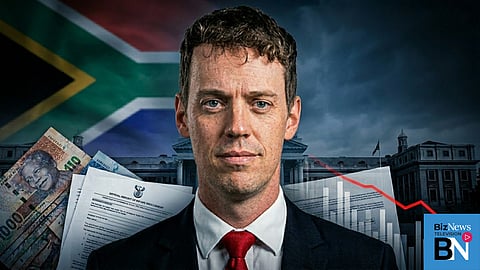
DA finance spokesperson Mark Burke slams the ANC’s procurement reforms as costly, restrictive and ripe for corruption. He warns taxpayers will pay more for fewer services as competition shrinks and politically connected elites benefit. With legal challenges looming and public frustration rising, the battle over state spending could shape South Africa’s economic future and upcoming election outcomes..Sign up for your early morning brew of the BizNews Insider to keep you up to speed with the content that matters. The newsletter will land in your inbox every morning on weekdays. Register here.Support South Africa's bastion of independent journalism, offering balanced insights on investments, business, and the political economy, by joining BizNews Premium. Register here.If you prefer WhatsApp for updates, sign up to the BizNews channel here..Watch here.Listen here.Edited transcript of the interview.00:07:03 - 00:33:03Alec Hogg:Dr Mark Burke is the DA’s spokesman on finance. He joins us today on a big matter. We’ve been seeing a doubling down by the ANC on certain issues - certain things that really don’t make sense - but they’re trying to do a real big one now on the procurement of goods by the public sector. We’ll find out what he thinks about all this.00:33:04 - 00:52:17Alec Hogg:Mark, before we go into that - on Sunday it’ll be two weeks since the DA changed its leadership. A whole bunch of 30-somethings, yourself included, were put onto the stage. You were the first one on stage. I wasn’t quite sure what your post was, but congratulations anyway. Tell us, what did they elect you to do?00:52:19 - 01:17:01Mark Burke:Thank you. I’m still figuring it out. We elect federal leadership at these congresses every three years. There are almost two elections that happen - this might be interesting to varying degrees to your audience, but bear with me.The first election happens a couple of days before all the delegates get together for Congress.01:17:01 - 01:41:04Mark Burke:That’s a Federal Council - a body of about 140 people that makes really important decisions for the party in between these congresses. That council elects its Federal Council Chairperson, which used to be Helen Zille. Most people know Helen in that role. They also elect three deputies to that role and a Federal Finance Chair.01:41:06 - 02:09:16Mark Burke:Then, at the Congress itself, all the delegates - about 2,200 in this case - elect the rest of the leadership, which is our Federal Leader, the Federal Chairperson, and three deputies for that Federal Chairperson.I will admit we should probably change the names of the Federal Council Chairperson and the Federal Chairperson, because that might leave a lot of people confused.02:09:18 - 02:28:05Mark Burke:Combined, that’s the leadership of the party. They go into different fora responsible for decision-making and representing the party.I’m part of that first election on the Thursday, so I put my hand up to become the Federal Finance Chair for the party.02:28:05 - 02:44:11Mark Burke:It has always been a pretty behind-the-scenes role, though it has become more prominent lately. It’s quite an important role for the party. It’s twofold: administering the party’s finances - where we spend money - and how we bring money into the DA.02:44:13 - 03:04:09Mark Burke:We are an organisation that does really well in fundraising, but I want to see that number increasing by a large margin. I’ve got some plans to do so. I envisage an Obama-esque campaign that sources money from all parts of society. I’m excited to step into the role.03:04:12 - 03:24:07Mark Burke:It’s also been a passing of the baton. Helen used to be the Federal Council Chairperson. Enoch Godongwana is our Deputy Minister of Finance - a super bright guy. I work well with him. He’s now the new person - sorry, I’m confusing roles.So, Helen was the Federal Council Chairperson, and the new Federal Chairperson is in place.03:24:09 - 03:40:22Mark Burke:John Steenhuisen is still in his 30s and is now the Federal Leader. A lot of young people have come up through the ranks of the DA or stepped into the DA.We used to have a chairperson of our Federal Council who said, “Don’t mess this up” - using stronger language.03:40:22 - 04:00:03Mark Burke:I hope we won’t mess it up as the baton is handed to us. It’s also good to know that this party now better connects with the average South African in terms of age than any other party. We’ve got energy, but also some steady hands.04:00:05 - 04:10:01Mark Burke:It adds to the list of responsibilities, but it’s also a privilege and an opportunity.04:10:03 - 04:37:05Alec Hogg:Well, it sounds to me like there are a lot of new ideas. You mentioned your own ideas on fundraising - one would think elsewhere as well.And it hasn’t taken long for your new leader, John Steenhuisen, to put a stake in the ground. That’s what we want to talk about today - this public procurement policy that the state now has. There is a proposal by the ANC to do what with this?04:37:07 - 05:05:16Mark Burke:It’s almost progressed from the point of proposal into implementation. That’s the scary thing - and it’s completely unnecessary. It’s exactly the opposite of what the country needs at this juncture, and it needs to be fought.Let me briefly explain what can only be summarised as continued idiocy - trying to throw out more of these regulations.05:05:16 - 05:29:20Mark Burke:There was an Act passed in 2024 called the Public Procurement Act of 2024. The Act tightens even further how government thinks about implementing BEE within its own procurement.Let’s zoom out from the jargon - what does this practically mean?05:29:22 - 06:05:01Mark Burke:It means that whenever somebody does business with the state, they must conform to a certain ownership and management structure to bid competitively.Now, it’s not unreasonable for a government to say: if you operate here, we expect something in return - even a discount.But in this case, government is saying it will likely pay a premium, as long as you meet certain criteria. That’s mind-blowing.06:05:03 - 06:24:19Mark Burke:So you move from asking for a discount to being willing to overpay because of these requirements.I’m happy to come back to why we think it’s unconstitutional, but from that description alone, you can see this will worsen value for money for taxpayers and service delivery.06:24:19 - 06:40:01Mark Burke:If anyone looked at the decay of municipal infrastructure in South Africa, they would ask the opposite questions to what Treasury is asking South Africans to implement.06:40:05 - 06:56:08Alec Hogg:It’s quite complex, as you’ve said. But in essence, we have a government funded by taxpayers, and taxpayers are being asked to give more money to a bad system. Is that a fair interpretation?06:56:10 - 07:29:07Alec Hogg:If you had a failing business, you would look at how many people you employ. Our government employs 1.1 million people. Then you ensure what you procure is done at the best price.But here, you’re saying it’s legislated that you must already pay a premium because of ideology - and potentially an even bigger premium. Am I reading that correctly?07:29:07 - 08:02:11Mark Burke:Absolutely. Think of it like a Venn diagram - a large pool of suppliers narrowed down to a small subset that meets these requirements.If you can only procure from a small portion of available suppliers, you will overpay.08:02:16 - 08:07:04Mark Burke:It’s simple economics.08:07:06 - 08:33:17Mark Burke:It’s like arriving at a rugby match where only one person sells hotdogs - you’ll pay more.Competition drives both price and quality. This policy removes competition.08:33:17 - 08:53:00Mark Burke:Government will argue it forces businesses to change ownership structures, but these are window-dressing measures that make businesses less efficient.08:53:02 - 09:13:13Mark Burke:South Africa is already a tough environment - unreliable electricity, weak transport networks, rigid labour laws - and now businesses must operate with additional constraints.09:13:13 - 09:38:01Mark Burke:It’s like operating with your hands tied behind your back. You add board members or shareholders not for efficiency, but because government demands it.09:38:03 - 10:01:09Mark Burke:This will make procurement more expensive and delivery less efficient.It also fuels corruption - a small group of politically connected suppliers gain access to contracts.10:01:09 - 10:08:02Mark Burke:It’s exactly the wrong measure at exactly the wrong time.10:08:04 - 10:27:13Alec Hogg:It appears to the outside, to a rational mind looking at this, that those drafting this rule are not reading the room. At some point, taxpayers are going to say: no more. You’re just coming in, you’re stealing. We know you’re stealing. But now you want to steal even more and put it into law. Who makes up these ideas?10:27:18 - 11:18:15Mark Burke:It’s almost two seasons that have happened. The original Act was passed in 2024 when the ANC still had a majority.The way they passed it involved pushing it through Parliament, not complying properly with public participation requirements, and using provincial mandates that were effectively generated within the ANC itself.11:18:15 - 11:40:04Mark Burke:So, much like other things the ANC has done when it believes it has absolute power, it rushed it through. Then regulations are drafted to interpret the law for implementation by Treasury and other departments.11:40:06 - 12:17:20Mark Burke:Who comes up with these ideas? ANC individuals and groupings that sit far left of centre, who believe this is how to make a slower-growing economy more equal.Instead of focusing on growing the economy and sharing gains broadly, they focus on redirecting limited resources to connected individuals.12:18:00 - 12:38:20Mark Burke:Do South Africans realise this, and will they vote accordingly?Well, costs will rise - everything from basic goods upwards. That is my sense.12:38:20 - 13:01:13Mark Burke:When I travel and look at polling data, South Africans already feel they are not getting value for tax money. They feel overtaxed.13:01:13 - 13:24:04Mark Burke:The average taxpayer pays up to eight forms of tax - property, income, VAT, capital gains and more. Yet they do not feel they are receiving value for money.13:24:04 - 13:49:08Mark Burke:Public healthcare, policing and infrastructure are failing in many areas. In some cases, going to a state hospital is effectively a death sentence.13:49:08 - 14:10:09Mark Burke:So people are asking: am I getting value for money? The answer is probably no - they feel they are overpaying.14:10:11 - 14:31:06Mark Burke:And yes, I believe this is already reflected in voting behaviour. In 2024, many votes were votes of frustration - saying “no more of this”.14:31:06 - 14:57:18Mark Burke:At least in relation to the ANC, I believe they are already paying an electoral price. It is our job to make people aware of the link between policy and outcomes.14:57:20 - 15:00:16Mark Burke:That’s where we are.15:00:18 - 15:22:21Alec Hogg:A penny is dropping, Mark. There’s no question of that. But what can be done about this? The DA has said the City of Cape Town and the Western Cape government will fight this tooth and nail. What happens next?15:22:23 - 15:54:11Mark Burke:Our conversation today is part of that - making South Africans aware this is the ANC doubling down on failed policy.The DA, including our leadership, has applied to the Constitutional Court. The matter will be heard on the basis that it may not have been passed constitutionally.15:54:13 - 16:33:01Mark Burke:Public participation is key - you must listen to people before implementing legislation. In this case, the process was rushed and significant changes were made without returning to public participation.16:33:01 - 17:10:12Mark Burke:So there are constitutional concerns. If the ANC loses the court case, it will be another legal setback. From our side, we will continue to challenge it legally and politically.17:10:17 - 17:33:17Mark Burke:We will also use Parliament. Regulations under the Act must come back to Parliament for scrutiny, and we will ensure proper oversight takes place.17:33:19 - 18:15:15Mark Burke:We will interrogate the modelling, the cost implications, and why supplier databases are being centralised. We will use every parliamentary mechanism available.18:15:17 - 18:57:02Mark Burke:We will also use media to raise awareness, and we will use the courts to oppose this. If it goes unopposed, it will have serious consequences.18:57:02 - 19:21:13Mark Burke:Ultimately, there will also be an electoral consequence. Local government functionality is directly affected, and infrastructure decay is visible across the country.19:21:13 - 19:38:02Mark Burke:The DA will ensure the ANC pays the price for continuing down this path.19:38:04 - 20:20:09Alec Hogg:At a recent conference, Donald MacKay noted there are at least 40 transformation funds that are not audited, with unclear flows of money - essentially slush funds for politically connected beneficiaries. Is this a doubling down on the crony premium?20:20:11 - 21:06:06Mark Burke:Absolutely. The argument is that this is about equality, but there is no data showing it improves equality. Increasingly, data shows the opposite - wealth is concentrated among a very small group.21:06:08 - 21:30:18Mark Burke:It enriches a connected few and leaves ordinary South Africans dependent on failing services.21:30:19 - 21:53:19Mark Burke:When basic services collapse, poor South Africans suffer most. Wealthier individuals can adapt - through private solutions - but the poor cannot.21:53:21 - 22:13:12Mark Burke:Yes, this is a doubling down on the crony premium, and the ANC should be punished at the polls. We will fight this in courts, Parliament, and implementation.22:13:14 - 22:24:22Mark Burke:If none of that succeeds, then the electoral consequences must follow.22:25:00 - 22:54:13Alec Hogg:I wonder if they really have the time to understand what’s happening in South Africa. If the public understands what is behind this - effectively making the fat cats fatter - there could be consequences no one has even thought about.22:25:00 - 22:54:13Alec Hogg:I wonder if they really have the time to understand what’s happening in South Africa. If the public understands what’s really behind this - effectively making the fat cats fatter - there could be consequences that no one has even thought about.22:54:13 - 22:54:13 Alec Hogg:But let’s not go there. Mark Burke is the DA’s spokesman on finance. I’m Alec Hogg from BizNews.com.