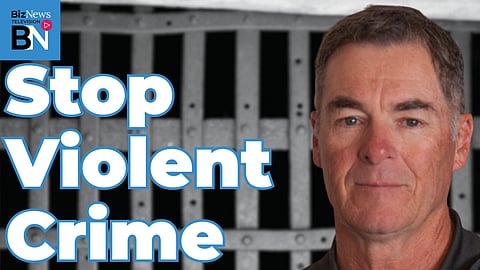
The civic organisation Safe Citizen is today submitting a paper to the South African government around the serious issue of violent crime in South Africa. It is being delivered to President Cyril Ramaphosa, Acting Police Minister Firoz Cachalia, and Ian Cameron, the Chairperson of Parliament’s Portfolio Committee on Police. It is also being sent to every business chamber in the country. In his latest interview with Chris Steyn, Safe Citizen Founder Jonathan Deal says: “We can actually be tough on violent offenders, ruthless about illegal supply, and protect the rights of compliant citizens. And…we need all three…the benefits that we could see would be measurable outcomes in fewer repeat violent offenders on the streets, a faster interdiction of threats, reduced illegal firearm circulation, higher public cooperation with the police…and safer communities without mass restriction…the question is whether government will engage with it and whether community safety policy will finally be driven by outcomes rather than optics. .Sign up for your early morning brew of the BizNews Insider to keep you up to speed with the content that matters. The newsletter will land in your inbox at 5:30am weekdays. Register here.Support South Africa’s bastion of independent journalism, offering balanced insights on investments, business, and the political economy, by joining BizNews Premium. Register here.If you prefer WhatsApp for updates, sign up to the BizNews channel here..Watch here.Listen here.Edited transcript of the interview.Chris Steyn (00:03.189)South Africa has one of the highest crime rates in the world, yet the public debate often fixates on laws and restrictions instead of realistic outcomes. I speak to Jonathan Deal, the founder of Safe Citizen, about what could reduce violence and what certainly won't. Welcome, Jonathan.Jonathan (00:25.39)Morning to you, Chris. Thank you very much for having me on your show again. I've selected this interview to publicly announce the submission of a paper to the South African government around the serious issue of violent crime in South Africa. And that paper is today being delivered to President Ramaphosa, the Minister of Police, the head of the Portfolio Committee on Police in Parliament, Mr. Ian Cameron and the Secretary of Police. We're also sending it to every business chamber in South Africa so that they may also receive and consider our proposals insofar as it might affect business people in South Africa.Chris Steyn (01:12.865)Well Jonathan, what do you propose?Jonathan (01:18.634)I think that we are often asking the wrong questions about crime in most countries in the world and certainly in South Africa at the moment, given the enormous crime statistics that South Africans live with. I think that we could say that despite laws and enforcement, people overall feel less safe. And our point in the paper is that violence is driven by intent, criminal, ideological or crisis driven, not by whether a compliant citizen follows the law. And it's unfortunate that government policy keeps on reacting to tools instead of behaviour. To clarify that a bit, every serious crime analyst will tell you the same thing. Illegal supply matters much more than lawful ownership. Smuggling, theft, State leakage, cross-border trafficking of firearms, is what arms criminals, not responsible and compliant citizens. And until we close those channels, no amount of regulation will meaningfully reduce crime.Chris Steyn (02:31.186)Well, some people would interpret that as a defence of gun ownership.Jonathan (02:39.032)Well, I think that the mistake that we keep making is that we are treating violence as a tools problem instead of an intent problem. And people who are determined to harm others don't suddenly become compliant because a new law is passed. What actually reduces violence is intercepting intent early through effective policing, intelligence, and stopping illegal supply, not by regulating people who already comply with the law. And that brings us to something that I call this what is well known as a substitution theory. And that is that violence doesn't disappear when one method is restricted. It simply adapts. So we've seen attackers substitute vehicles, knives, fire, and explosives across the world. This tells us that the driver, once again, is not the tool, it's the intent. And ignoring substitution of tools leads to policies that look to size it, but solve the wrong problem.So to anybody that would say it's an argument for gun ownership, actually, it's not. I think that what we want to say is that after every tragedy, there is pressure on governments to be seen to act. But visible action isn't the same as effective action. And when policy targets compliant citizens instead of violent actors, the risk doesn't disappear, it simply moves.History will show us that symbolic responses reassure briefly, but they don't produce durable safety. So effective safety policy really would be proportional and it will focus on the risks that cause the most harm most of the time, not the events that drive headlines. So to answer you specifically on that question, this is not a defence of objects, it's a critique of misdiagnosis on the part of the government. We don't argue ideology, we look at outcomes. And to put that more clearly, perhaps, I could say that there's something called the false binary, where public debate will often present a false choice. We either restrict broadly, or we accept violence. That restricting broadly would be essentially what is being proposed by the State in the Firearms Control Amendment Act…Jonathan (05:01.154)…or the change to the PsIRA regulations for the security industry. So we either restrict broadly or we accept violence. And I don't think that that's the right way to go. It's a false binary. And we can actually be tough on violent offenders, ruthless about illegal supply and protect the rights of compliant citizens. And the evidence suggests, Chris, that we need all three.Chris Steyn (05:25.441)You know, after events like Bondi Beach, there's always a chorus of government must do something. So once again, you're now appealing to government to do something, but...Jonathan (05:41.172)I think that one is I've dealt with that more or less by saying that, after every tragedy, there is an expectation that the government will do something. And we've seen this in Australia. The first thing they did within 24 hours was convene Cabinet meetings and come down hard on all the lawful gun owners in the country. Yet the very people who perpetrated that attack were…It is reported or alleged part of a group of people in Australia that were visible in the streets of Melbourne and Sydney for up to a period of a year or two before this event, in some cases, reportedly calling for the death of certain population groups or certain cultures. And the Australian government did nothing to address that.I think there's a similar, there's a parallel in South Africa as well, where we have certain well-known politicians who also hold large public rallies calling for the murder of a certain sector of the population or a certain culture. And once again, the government is doing nothing about that. And I wonder if we have a similar event in South Africa where one or two or a number of the supporters of some of the politicians that are calling for the murder of people actually go and murder people in a public event, is the government then going to turn around and say, gosh, you know, we're very surprised. We never anticipated that. And I think, now we need to ban firearms overnight.Chris Steyn (07:18.241)What would the cost be of your framework not being adopted?Jonathan (07:27.692)I think that the costs, the most obvious costs of getting this wrong is that the areas of impact are the serious and emotional, traumatic effects experienced by South African families, the State resources wasted on healthcare and policing budgets, a loss of social cohesion, loss of skilled taxpayers to other countries, and a knock-on negative effect on business confidence. And that's why just doing something in the moment or doing something to appear to be seen to do something is dangerous. There's a political instinct to do something after tragedy, but doing the wrong thing can actually increase the risk for the country and its citizens. If policy removes lawful, accountable capacity while leaving illegal actors untouched, one may actually widen the window of harm for citizens without intending to do that. And I think that that's what we would see if the Firearms Control Amendment Bill actually came into law, or the PsIRA regulations were brought into law as well.Chris Steyn (08:34.581)What changes could we expect to see should your framework be acceptable.Jonathan (08:41.582)I think that I want to say also today is that we are in very broad brushstrokes covering the document. The document was fairly substantial and it doesn't just raise problems, it actually proposes workable solutions for the government to consider. But the benefits that we could see would be measurable outcomes in fewer repeat violent offenders on the streets, a faster interdiction of threats, reduced firearm, illegal firearm circulation, higher public cooperation with the police, which is probably one of the most important of those measurable effects, and safer communities without mass restriction.Chris Steyn (09:25.377)Well, meanwhile, while we are waiting for government, how do we stay safe citizens?Jonathan (09:36.461)I think that South Africans ought to be involved in fighting crime and in calling for meaningful and effective management of the crime environment. And that's essentially because safety isn't ideological, it's foundational. And I sincerely hope that some of that message and this document will find its mark in South African communities, that people will find a way to get hold of it.It's certainly available for the asking from Safe Citizen. But essentially, in Safe Citizen, we've done our part by putting a serious framework forward. Now the question is whether government will engage with it and whether community safety policy will finally be driven by outcomes rather than optics.Chris Steyn (10:26.785)Jonathan, tell us more about why Safe Citizen was founded and your work.Jonathan (10:36.866)I think after a number of decades in and around the formal firearms fraternity in South Africa, it became apparent to me that as a group of firearms owners, for whatever reason, self-defence, sport shooting or hunting, we're generally a fairly unique and small group within the population of South Africa.And although a united group and with possibly very good reasons for having access, lawful access to firearms, it resonated with me that the public are largely missing from that debate. And it's the public that are living with the effects of violence and crime. So Safe Citizen has undergone a fairly remarkable metamorphosis of late in that we are not really operating anymore as part of the formal firearms fraternity, but we are now positioned squarely where I actually intended us to be from the beginning as a public-focused organisation. So for me, the best member that Safe Citizen could attract would be a 70-year-old granny who has never held a firearm firearm in her life, who never intends to own a firearm, but who is concerned about community safety. So the debate within Safe Citizen circles, at least, and the focus is no longer on ownership of firearms. Firearms, according to the points that I've made today, are critically important in community safety. There's absolutely no doubt about it. But...what we really need is large numbers of people who are concerned about community safety to get behind an action or an activity or a brand like Safe Citizen and use it as a vehicle to send a lawful and civically responsible message to the government.Chris Steyn (12:43.465)And what support have you been able to thus far?Jonathan (12:48.716)We've actually, Chris, we've actually had increasing support in the last two or three months. The growth in our numbers has been significant. People are supporting us financially and with time as volunteers. And we have developed a strong core volunteers. In fact, I'm meeting with them tomorrow and we will soon be taking this message onto radio stations around the country. We are expecting to be viewed on Yussuf Abramjee's show on ETV. And the public profile is growing well. And for the first time, I'm actually feeling confident about the fact that we can make a difference with a lot of people. And it is after all the voters that will get the attention of the government.Chris Steyn (13:42.322)You are apolitical?Jonathan (13:44.874)Absolutely, a cultural and apolitical. I have got, from a Safe Citizen point of view, no allegiance whatsoever to any political party.Chris Steyn (13:57.089)Thank you. That was Jonathan Deal, the founder of Safe Citizen, speaking to BizNews. I'm Chris Steyn.Chris Steyn (14:06.795)Thank you, Jonathan..(The Safe Citizen Submission can be viewed below in full)