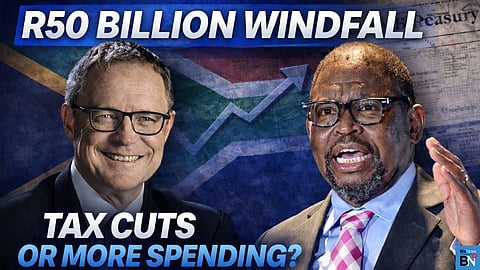
You can register for Dawie Roodt's free post-budget webinar by clicking here..Forty-one budgets later, Dawie Roodt isn’t buying the hype. With a possible R50bn revenue surprise, falling bond yields and stabilising debt, South Africa has a rare window to reform. But will Treasury slash corporate taxes and ease bracket creep - or funnel more money into SOEs, grants and a bloated wage bill? Roodt warns that windfalls tempt politicians… and markets are watching..Sign up for your early morning brew of the BizNews Insider to keep you up to speed with the content that matters. The newsletter will land in your inbox at 5:30am weekdays. Register here.Support South Africa’s bastion of independent journalism, offering balanced insights on investments, business, and the political economy, by joining BizNews Premium. Register here.If you prefer WhatsApp for updates, sign up to the BizNews channel here..Watch here.Listen here.BizNews Reporter.South Africa’s Budget season rarely produces genuine anticipation. For years it has been an exercise in damage control. This time feels different. Not euphoric. Not miraculous. But different.Dawie Roodt should know. This will be his 41st Budget analysis. He began studying fiscal policy before spreadsheets existed, filling in figures from the Exchequer account and Paymaster General’s books by hand at the Reserve Bank. Four decades later, he sees something he has not seen in a long time. A narrow window.The reason is simple. Revenue is surprising on the upside. Commodity prices have helped. Gold and platinum have done the heavy lifting. Roodt estimates the windfall could be around R50 billion. To put that into perspective, a one percent VAT increase raises roughly R25 billion. This is the equivalent of a two percent VAT hike without touching consumers.That is real money.But windfalls create temptation. Politicians rarely struggle to find places to spend. The pressure on the Minister of Finance never disappears. There is always a department that needs more. A wage agreement to honour. An SOE to rescue. A grant to expand. Roodt warns that the only way to force politicians to spend less is to give them less.And yet, this time there is a twist.Lower inflation targets are changing the maths. The shift to a three percent target was more important than many realised. Financial markets reacted immediately. Bond yields fell sharply, by roughly 400 basis points in some cases. That translates into cheaper borrowing for the state going forward.Government debt is largely made up of vanilla bonds. The coupon may be fixed, but yields move with the market. As older expensive debt matures and new debt is issued at lower yields, interest costs ease. Not overnight. Gradually. But the direction matters.If inflation stays low, a virtuous cycle begins. Lower yields reduce the interest bill. That narrows the deficit. A smaller deficit improves confidence. Confidence strengthens the currency and lowers yields further. It is not fantasy. It is basic macroeconomics.There are spoilers, of course. Eskom tariff hikes do not help. Neither does a bloated public sector wage bill. The state remains too large for an economy growing barely above one percent. Roodt expects Treasury to pencil in around 1.4 percent growth. He is sceptical it will reach even that.Growth remains the Achilles heel. You can manage the books, but if the economy crawls, debt to GDP stays stubbornly high. Fiscal discipline without reform is a holding pattern.So what should markets look for?First, the deficit. Roodt believes it will come in better than previously projected, possibly just below four percent of GDP. That is still high, but far from crisis territory.Second, debt to GDP projections. In prior years, investors doubted Treasury’s forecasts. This time, he believes markets may actually believe the path to stabilisation around 78 percent and gradual decline thereafter. If credibility holds, bond yields could fall further and the rand could strengthen.But headlines rarely scream “Deficit improves modestly.”They scream tax cuts.Bracket creep has quietly squeezed salary earners for years. Inflation pushes taxpayers into higher brackets even if their real income has not improved. Adjusting personal income tax brackets would be politically popular and economically sensible. Corporate tax at 27 percent is high by global standards. Reducing it would send a stronger pro-growth signal than another capital injection into a struggling SOE.Do not expect Transnet bailouts to excite markets. Roodt is blunt. He would not allocate windfall revenue to SOEs or municipalities. They have received billions already. Pressure forces reform. Easy money delays it.There is also a political dimension. This is Cyril Ramaphosa’s final stretch in office. Grand legacy projects are unlikely. The state simply does not have the fiscal room for super cities or headline grabbing infrastructure fantasies. Reality has overtaken ideology.What may become permanent, however, is the Covid grant. Social expenditure reform in the direction of a broader basic income structure looks increasingly inevitable. That has long term fiscal implications.So is this a good news Budget?Cautiously, it could be.Interest costs are easing. Inflation credibility has improved. Revenue is outperforming expectations. Debt stabilisation is plausible. These are not trivial developments. After the chaos of the Zuma years, even modest stability feels like progress.But stability is not prosperity.South Africa still grows too slowly. Structural reforms remain stuck. Labour regulation, expropriation uncertainty, and empowerment compliance costs weigh heavily. Fiscal management can buy time. It cannot deliver growth on its own.This Budget is less about fireworks and more about direction. If Treasury resists the urge to splurge, adjusts tax brackets, keeps the deficit contained and reinforces the inflation framework, markets will respond positively. If the windfall disappears into expanded spending commitments, the opportunity will close as quickly as it opened.After 41 Budgets, Dawie Roodt has seen cycles come and go. This one is fragile. But for the first time in years, there is at least a chance to turn discipline into momentum.The question is simple. Will Treasury cut taxes and stabilise debt. Or will it feed the state.Markets are watching.