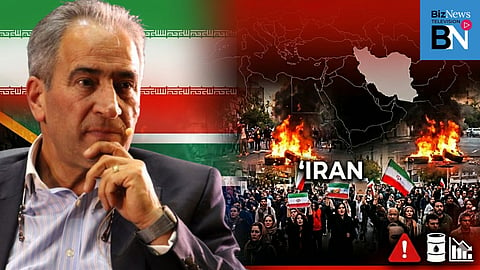
Iran-born economist Iraj Abedian tells BizNews the Iranian regime’s confrontation with the West was inevitable, arguing Pretoria has badly misjudged events by aligning itself with a dictatorship accused of massacring its own people. He says the next three to five weeks will be critical for Iran, the Middle East and the global economy, with major implications for oil, BRICS and South Africa’s foreign policy..Sign up for your early morning brew of the BizNews Insider to keep you up to speed with the content that matters. The newsletter will land in your inbox every morning on weekdays. Register here.Support South Africa's bastion of independent journalism, offering balanced insights on investments, business, and the political economy, by joining BizNews Premium. Register here.If you prefer WhatsApp for updates, sign up to the BizNews channel here..Watch here.Listen here.BizNews Reporter.South Africa finds itself navigating a precarious position amid escalating unrest in Iran, according to economist and political analyst Dr Iraj Abedian. Speaking to Alec Hogg, Dr Abedian outlined the human, political, and economic dimensions of the crisis, emphasising the profound implications for South Africa and the wider global community.Dr Abedian, former professor of economics at the University of Cape Town and former chief economist at Standard Bank, is uniquely qualified to comment on Iran. Born and raised in Iran, he has witnessed the country’s political evolution firsthand, and his expertise spans economics, social dynamics, and international relations.Over the weekend, Iran experienced unprecedented protests and violent crackdowns. Reports estimate that more than 30,000 people have been killed by state forces in response to public dissent. Dr Abedian stressed that the Iranian regime has consistently pursued a strict ideological agenda for nearly five decades, holding its people hostage while exploiting national resources to advance its political objectives. “The surprise was not that it happened,” he noted, “but the timing and manner in which it occurred.”Regarding the recent negotiations with the Iranian authorities, Dr Abedian expressed scepticism about their effectiveness. He suggested that previous international engagements had largely been manipulated by the regime, drawing foreign powers into protracted talks while pursuing its strategic goals. The Iranian government, he explained, has repeatedly demonstrated an ability to outmanoeuvre global actors, whether under Republican or Democratic administrations in the United States.Dr Abedian also criticised the South African government and its ruling party, the ANC, for ignoring expert advice. He described a decline in intellectual debate and evidence-based policy-making within the party since 2009, replaced by factionalism and ideology-driven decisions. This, he argued, has contributed to South Africa’s alignment with a regime responsible for severe human rights abuses, putting the country on the wrong side of history.The economist did not shy away from discussing corporate complicity, highlighting MTN’s partnerships in Iran. “MTN has aligned itself with instruments of suppression and massacre,” he said. He called for the company to issue a statement condemning human rights violations and distancing itself from the Islamic Revolutionary Guard Corps.Looking forward, Dr Abedian outlined three potential paths for Iran. The first, and most optimistic, would see decisive military action dismantle the regime’s infrastructure, allowing the Iranian people to reassert control. The second involves foreign powers installing a transitional government, which carries risks of external interference and limited legitimacy. The third, most catastrophic, scenario would see prolonged instability and revenge-driven violence, potentially spreading beyond Iran’s borders.These developments, he explained, have significant implications for global energy markets. Iran holds the world’s largest natural gas reserves and is the second-largest oil holder. Any prolonged instability could disrupt supply chains for a decade or more, raising oil prices and creating global economic uncertainty. In contrast, a stabilised Iran could benefit both European and South African economies by easing energy costs.Dr Abedian also addressed the complex dynamics within BRICS, noting contradictions among members such as China, Russia, India, Brazil, and South Africa. While the bloc aims to counter US dominance, it remains fragmented on human rights, trade, and geopolitical priorities. He concluded that BRICS cannot be relied upon to rescue South Africa or any of its members in such crises.Finally, Dr Abedian compared US President Donald Trump’s decisive action on Iran to Ronald Reagan’s handling of the USSR, emphasising the potential historical significance of current decisions. “If handled correctly, this could be a defining moment in modern geopolitics,” he said, underscoring the stakes for the Middle East, the global economy, and South Africa’s international standing.In summary, South Africa’s response to the Iran crisis involves moral, economic, and strategic considerations. Dr Abedian’s analysis highlights the urgent need for evidence-based policy, corporate responsibility, and a commitment to human rights, warning that delays and miscalculations could carry severe consequences for the nation and the wider world.