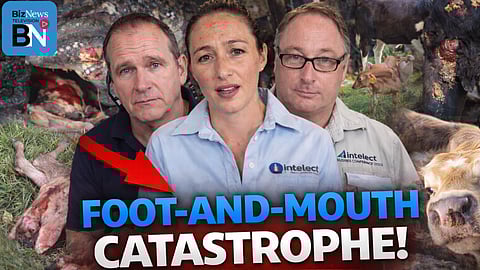
South Africa faces its worst livestock crisis since 1897. Farmers, vets and economists warn that government paralysis on foot-and-mouth disease could devastate food security, rural livelihoods and consumer prices..Sign up for your early morning brew of the BizNews Insider to keep you up to speed with the content that matters. The newsletter will land in your inbox at 5:30am weekdays. Register here.Support South Africa’s bastion of independent journalism, offering balanced insights on investments, business, and the political economy, by joining BizNews Premium. Register here.If you prefer WhatsApp for updates, sign up to the BizNews channel here..Watch here:.Listen here:.By BizNews reporter.When South Africa last faced an agricultural disaster on this scale, Queen Victoria was still on the throne.That is how farmers and veterinarians are describing the country’s foot-and-mouth disease outbreak, a crisis now being compared to the rinderpest catastrophe of 1897. Yet this time, they argue, the devastation is not driven by nature alone. It is being worsened by laws, bureaucracy, and a state that controls the cure but cannot deliver it.In a harrowing discussion with BizNews, farmers, veterinarians, and agricultural analysts painted a bleak picture of an industry under siege. Livestock are suffering, farmers are bleeding cash, and a preventable disease is tearing through herds while those closest to the animals are legally barred from acting.“It looks like a war zone,” said Emma Niland, a New Zealand based agricultural consultant working closely with South African farmers. “Animals cannot eat. They cannot walk. Skin is coming off their tongues. We are seeing losses of four to six thousand rand per animal. Some farmers have been hit two or three times already.”Foot-and-mouth disease is highly contagious but rarely fatal on its own. The real damage comes from the secondary effects. Milk production collapses. Animals lose weight. Hooves and teats blister and rot. Mastitis spreads rapidly. In many cases, animals must be shot for welfare reasons.Veterinarian Andy Lund described scenes he says he will never forget. “We are seeing animals where the hoof wall peels off completely. They are walking on bone. That is not survivable. The mental toll on farmers who have to shoot their own livestock for a disease that is preventable is devastating.”Yet the most explosive part of the crisis is not the disease itself. It is who is allowed to fight it.Foot-and-mouth disease is classified as a state controlled disease under legislation dating back to 1984. That means only the government may procure and distribute vaccines. Farmers are prohibited from sourcing or administering vaccines themselves, even if they can afford them and even if animals are suffering in front of them.Pete Keane, a commercial farmer in KwaZulu-Natal, says this legal stranglehold has turned a serious outbreak into an economic and humanitarian disaster.“If your house is on fire, the vaccine is the water,” he said. “But imagine the law says you are not allowed to throw water on the fire. You must wait for the state to arrive. If they arrive late, or not at all, your house burns down. That is exactly what is happening here.”Keane says 100 percent of his herd has now been infected. He cannot sell animals. He cannot vaccinate. He cannot recover losses. Meanwhile, feed bills and labour costs continue to pile up.“No business can survive without selling anything for six months,” he said. “But that is what is being demanded of farmers.”The crisis cuts even deeper for emerging and subsistence farmers, many of whom store their entire wealth in livestock. Animals are sold to pay school fees, fund weddings, and survive lean seasons. When sales are banned and animals fall ill, those households collapse.“This is people’s bank accounts being wiped out,” Keane said. “If money were being removed from bank accounts in the cities, there would be riots. Because it is livestock in rural areas, it is invisible.”Niland warned that the consequences will soon hit consumers too. “Food prices are going to rise sharply if this is not addressed. Milk production is down. Beef supply will follow. We are already seeing catastrophic balance sheet damage.”Despite repeated warnings, vaccines remain scarce. South Africa currently relies on limited supplies from Botswana, a situation many farmers find absurd given the country’s historic role as a leading vaccine producer. Andy Lund says South Africa once exported animal vaccines globally, including to Europe.“That capability has collapsed,” he said. “We have not submitted viral samples to international reference labs for more than 20 years. Without that, vaccines cannot be tailored to our strains. We are flying blind.”The numbers involved are staggering. Experts estimate that controlling the outbreak would require at least 56 million vaccine doses annually, with boosters every three months. Current deliveries fall dramatically short.Meanwhile, the legal framework remains unchanged. Farmers who attempt to vaccinate without permission risk prosecution. Veterinarians are similarly powerless.“We have people coming to us desperate,” Lund said. “And we are legally handcuffed. That is one of the hardest parts.”The political fallout is growing. The Democratic Alliance has warned that continued state inaction threatens food security and farmer livelihoods. Yet responses from authorities remain muted. Questions directed to the Department of Agriculture are often referred back to the same systems farmers say are failing.Keane believes the solution is straightforward, if politically uncomfortable.“Change the law,” he said. “Let farmers buy vaccines. Regulate safety. Monitor cold chains. But stop blocking action. Every day of delay multiplies suffering.”He insists that commercial farmers would also support emerging farmers, as they already do in many regions, if vaccines were freely available.“We help each other already,” he said. “What we cannot do is wait while animals suffer and livelihoods collapse.”As the disease continues to spread, farmers fear that South Africa is learning the wrong lessons too late. This is no longer just an agricultural issue. It is a test of whether policy can adapt when reality catches fire.And right now, the fire is still burning.