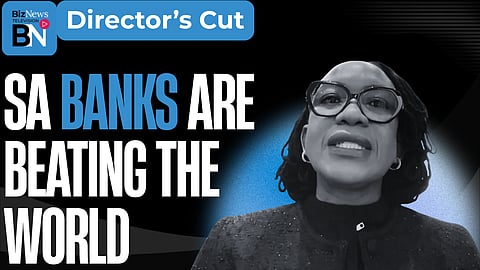
FirstRand CEO Mary Vilakazi joins Alec Hogg for a wide-ranging conversation on booming ROE, business confidence turning the corner, the UK regulatory headache, and why corporate cash is finally starting to move. From competition at home to opportunities across Africa, Vilakazi explains why she believes South Africa is entering a new growth phase despite the political noise..Sign up for your early morning brew of the BizNews Insider to keep you up to speed with the content that matters. The newsletter will land in your inbox at 5:30am weekdays. Register here.Support South Africa’s bastion of independent journalism, offering balanced insights on investments, business, and the political economy, by joining BizNews Premium. Register here.If you prefer WhatsApp for updates, sign up to the BizNews channel here..Watch here.Listen here.BizNews Reporter.South Africa’s biggest banking group is often described as an outlier in global financial markets. While international banks struggle to consistently generate respectable returns, FirstRand keeps delivering numbers that make foreign investors stop scrolling and take notice.That was the subtext of a wide-ranging conversation between BizNews founder Alec Hogg and FirstRand CEO Mary Vilakazi, sparked by the group’s latest trading update for the six months to December.Guidance remains unchanged. Normalised earnings growth is tracking in the mid-teens and return on equity is expected to land between 18% and 20%.In today’s banking world, those are rare figures. “If you look at global banks across different jurisdictions,” Vilakazi notes, “returns in the twenties are actually quite difficult to come by.”So where is the strength coming from?Part of it is simply consistency. The update did not reflect a sudden spike but rather confirmed the trajectory laid out earlier in the year. Strip out exceptional items such as the multibillion-rand provision tied to UK regulatory issues and operational growth is still tracking in solid double digits.But the deeper story lies in the relative strength of South African banking fundamentals. Compared to countries where pricing, transaction fees and customer margins are hemmed in by regulation, SA’s competitive model forces innovation rather than stifles it.“Our regulators did not go the route of regulating fees directly,” Vilakazi explains. “They introduced competition. And competition forces incumbents to modernise, improve service, innovate, and become more efficient.”That environment has created what she describes as a “healthy, vibrant market”, one where banks must constantly adapt to fintech challengers, insurers moving into banking products, and now global digital entrants eyeing the local space.Those competitive pressures, rather than compressing margins, have arguably strengthened the sector.At the same time, conditions inside the broader economy are shifting in ways that matter for lenders.Vilakazi says for the first time in years credit growth is being driven not by consumers but by corporates and medium-sized businesses. That distinction matters.“In previous cycles, growth was consumer-led, which is not what South Africa really needs,” she explains. “This cycle is being led by commercial and corporate activity, which we think is constructive.”The early signs are visible. Machinery replacement has picked up as businesses start spending again after years of sweating old equipment. Credit extensions are gradually rising. Business confidence surveys have ticked upwards, notably in manufacturing. And financing demand from SMEs has strengthened, including from the informal economy where FirstRand has been building a footprint for nearly a decade.“There is a resilient informal economy,” she says. “Its needs are very different to a business operating out of Sandton or Parktown. But that space has shown real growth.”Structural reform is another important tailwind.Vilakazi highlights progress at Transnet, energy market reform, and logistics rehabilitation as early but important green shoots. Infrastructure upgrades, she believes, unlock real productive investment, particularly among mid-sized firms that form the backbone of credit demand.“The economy needs fixed investment,” she says. “These are the kinds of projects that facilitate productive capital formation.”Households may also benefit in time. She points to the reduction of future inflation targets, which could support lower interest rates and eventually kick-start a more sustainable retail credit cycle.“Housing remains a major backlog,” she notes. “Clearing title deeds, improving affordability and stabilising inflation could create opportunities two to three years down the line.”Yet challenges remain.Chief among them is regulatory uncertainty in the UK, where investigations into historic motor finance commission practices continue. The drawn-out consultation and redress process has consumed management attention and capital provisions, even after FirstRand secured partial legal victories that reduced potential liabilities.Vilakazi is clear that while the group will remain pragmatic, outcomes must be proportionate.“You cannot operate in a market where there is unlimited liability,” she argues. “Capital must be deployed where business cases make sense.”Despite the regulatory fog, the UK business itself continues to grow as management focuses on niche expansion and operational progress while specialist legal teams fight the regulatory battles.Closer to home, rising competition is keeping local management teams sharp.From Capitec’s push into business banking to Discovery’s move into premium retail products and the arrival of digital challengers, the incumbents face an increasingly fragmented landscape.“There’s no room for complacency,” Vilakazi says. “We constantly analyse where customers are borrowing from, why they go elsewhere, and whether our offerings are still relevant.”Her answer is not merely defensive. Growth opportunities remain widespread, particularly in underbanked and SME segments.Internationally, FirstRand remains keen on East Africa, especially Kenya, though deal flow has been elusive as competition heats up and consolidation opportunities fail to materialise. In the absence of acquisitions, partnerships offer another route to participation without full-scale market entry.But the bigger message from Vilakazi remains rooted in South Africa itself.While headlines are often dominated by political noise or diplomatic flare-ups, she urges a calm reading of the fundamentals.“These headlines are unhelpful,” she says, referring to recent geopolitical tensions with the United States. “But when you look under the hood, many working relationships remain strong.”Progress is visible on multiple fronts. South Africa has exited the FATF grey list. Business confidence is edging up. Ratings outlooks have improved. GDP growth remains modest but positive.“Over the past 18 to 24 months we have been constructive about South Africa’s direction,” Vilakazi tells Hogg. “Now we are starting to see green shoots on the scoreboard.”Her optimism is measured, not giddy.“Execution still matters,” she cautions. “Reforms must maintain momentum. Cities must deliver basic services. Confidence depends on consistency.”Yet her closing assessment is unmistakable.“We are not in the same place we were two or three years ago. The direction of travel has improved.”For a banking group whose fortunes rise and fall with the broader economy, that shift matters. And for investors scanning the globe for quality at value prices, it may explain why South African banks remain quietly compelling while much of the world’s financial sector struggles to keep pace.