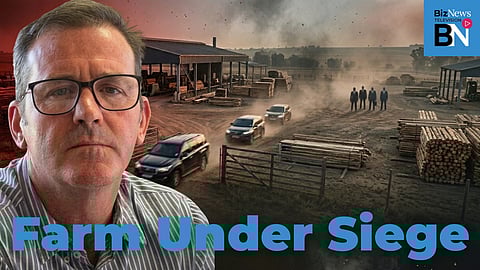
One month after a dramatic raid on Normandien Farms near Newcastle in northern KwaZulu-Natal, owner Sean Hoatson recounts how dozens of parliamentarians and officials allegedly stormed the property without following biosecurity protocols. Despite searching for labor and immigration violations, inspectors reportedly found no wrongdoing. Hoatson describes the incident as political overreach and intimidation, raising concerns about investor confidence, rural job security, and respect for lawful business operations..Sign up for your early morning brew of the BizNews Insider to keep you up to speed with the content that matters. The newsletter will land in your inbox at 5:30am weekdays. Register here.Support South Africa’s bastion of independent journalism, offering balanced insights on investments, business, and the political economy, by joining BizNews Premium. Register here.If you prefer WhatsApp for updates, sign up to the BizNews channel here..Watch here.Listen here.BizNews Reporter.A month after a dramatic and controversial visit by public officials, Normandien Farms near Newcastle in northern KwaZulu-Natal remains at the centre of a growing debate about parliamentary oversight, business confidence and biosecurity compliance.In an interview with Alec Hogg, Sean Hoatson of Normandien Farms described what he characterises as an aggressive and unnecessary incursion by members of the Parliament of South Africa, accompanied by officials from the Department of Employment and Labour and armed police.Hoatson, whose family business employs around 3,000 people across operations in KwaZulu-Natal and the Western Cape, said the incident occurred on 4 April at the group’s sawmill site just south of Newcastle. According to his account, approximately ten SUVs carrying between 40 and 50 parliamentarians and officials arrived without prior notice.Normandien Farms is a diversified agro-processing enterprise with forestry, sawmilling and beverage interests. The Newcastle sawmill functions as a central hub for the broader farming and forestry operations. Hoatson said that while labour inspectors are legally permitted to conduct inspections, the scale and manner of this visit were unprecedented.“They fought their way in,” he alleged, claiming that security staff attempting to enforce standard access controls were overwhelmed. He further alleged that members of Parliament filmed on site and made public accusations of racism and non-compliance before any findings had been established.A key point of contention was biosecurity. The farm maintains strict foot-and-mouth disease protocols, including chemical spraying of footwear and vehicles before entry. These measures are designed to protect livestock from a highly contagious, state-controlled disease that has had serious implications for the agricultural sector.Hoatson claimed the visiting group refused to comply with these procedures. “There was absolutely no respect for our processes or our people,” he said, arguing that such disregard undermines national efforts to contain foot-and-mouth outbreaks.Despite what he described as a sweeping inspection aimed at uncovering illegal immigrant labour and employment violations, Hoatson said no substantive breaches were identified. All documentation, he maintained, was found to be in order.However, shortly after the visit, the business received prohibition notices relating to dust and what he described as minor housekeeping issues. Hudson contends these were disproportionate and appeared to be an attempt to justify the disruption. He said management was later told informally that operations could resume quickly once certain minor matters were addressed.The incident has sparked wider questions about the limits of parliamentary oversight and the appropriate conduct of inspections. Hoatson insists there was no legal basis for such a large delegation from Parliament itself, noting that local labour offices conduct routine inspections without incident.“There’s not a legal motivation for Parliament to come in and do that,” he said. “The local labour office does inspections on a regular basis. There was no need for this from Parliament.”Hoatson believes the visit may have been politically motivated, possibly linked to broader labour market pressures in sectors such as textiles. He suggested the farm was targeted as a prominent regional employer.The community response in Newcastle, he said, has been largely supportive of the business. Normandien Farms plays a significant role in the regional economy, providing employment in a rural area where alternative opportunities are limited.While legal steps have reportedly been taken, including the lodging of complaints at the local police station, Hoatson said there has been no apology from any political party or from the portfolio committee involved.The broader concern, he argued, is the signal such actions send to investors and entrepreneurs. “We welcome inspections,” he said. “But they must be conducted in a manner that is respectful and lawful.”At a time when South Africa’s leadership has repeatedly emphasised partnership between government and the private sector to drive job creation, Hoatson believes incidents of this nature risk entrenching mistrust.For now, Normandien Farms continues its operations. But the episode has left lingering questions about the balance between legitimate oversight and what Hudson calls intimidation - and about how that balance affects the country’s fragile investment climate.