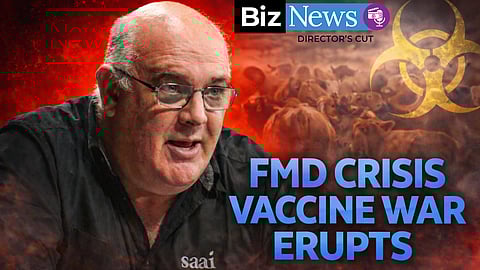
As South Africa’s dairy and beef sectors teeter on the brink, agriculture leader Theo de Jager goes head-to-head with government over foot-and-mouth disease. With vaccines allegedly delayed, prices questioned and bureaucratic control under fire, he warns: every day lost could cost farms – and food security – dearly..Sign up for your early morning brew of the BizNews Insider to keep you up to speed with the content that matters. The newsletter will land in your inbox at 5:30am weekdays. Register here.Support South Africa’s bastion of independent journalism, offering balanced insights on investments, business, and the political economy, by joining BizNews Premium. Register here.If you prefer WhatsApp for updates, sign up to the BizNews channel here..Watch here.Listen here.BizNews Reporter.South Africa’s foot-and-mouth disease crisis is no longer just about animal health. It has become a high-stakes battle between desperate farmers and a government department accused of red tape, poor communication and blocking practical solutions.Theo de Jager, executive chairman of SAAI and one of the most experienced agricultural leaders in the country, did not mince his words in a recent interview. Farms are collapsing. Dairies are shutting down at a rate of two or three per week. Enterprises built over generations are buckling under the weight of a disease that, he argues, could be contained far faster if government stepped aside and let farmers act.The Agriculture Minister, John Steenhuisen, has committed to blanket vaccination of the national herd. De Jager supports that decision. But months later, the rollout remains painfully slow. Only 12,900 locally manufactured doses have been distributed so far. Meanwhile, outbreaks are spreading into critical dairy regions including the Western Cape and along the Garden Route.If foot-and-mouth disease reaches the mega dairies near Malmesbury or along the Garden Route corridor, De Jager warns, the economic damage could be irreversible.At the heart of the dispute is control.Government insists on maintaining full oversight of vaccine procurement and distribution. Farmers argue that “state control” does not mean government must physically manage every ampule, syringe and storage facility.De Jager draws a clear distinction. The state should regulate and monitor. It should not monopolise logistics that the private sector can execute more efficiently.In Brazil, which recently regained its foot-and-mouth-free status after vaccinating nearly 300 million cattle, vaccines were placed directly into farmers’ hands under government supervision. The system relied on tracking and reporting, not bureaucratic bottlenecks. De Jager says that approach was endorsed by internationally respected veterinarian Dr Gideon Bruckner.In South Africa, however, vaccine imports from Turkey and Brazil are stalled pending permits and approvals. One supplier reportedly had a million doses ready to ship within days. Farmers remain waiting for signatures.The pricing controversy has further inflamed tensions.Industry sources say vaccines can land on farms for around R55 per dose. Yet the department indicated costs of up to R300 per dose. Even if that figure is calculated annually, farmers argue it remains several times higher than necessary. The gap has raised suspicions about inefficiencies, tender processes and potential profiteering.For farmers who are already bleeding cash, price matters. Every day of delay increases losses.De Jager insists farmers are not pushing for illegal imports or unsafe vaccines. Four vaccines are already certified for use in South Africa. The request is simple. Allow certified manufacturers to supply their local agents directly. Track every dose through barcodes and digital records. Let commercial farmers vaccinate their own herds under regulated conditions.There are roughly 14 million cattle in South Africa. Around 7.5 million belong to commercial farmers with proper handling facilities. The remaining animals are in communal and peri-urban areas, where vaccination will require greater state coordination.De Jager’s proposal is pragmatic. Let farmers handle their own commercial herds quickly. Let the state focus its capacity on communal areas, where containment is more complex and outbreaks more likely.The political implications are significant.Foot-and-mouth disease affects export markets, food security and rural employment. It is also testing Steenhuisen’s leadership. Farmers are questioning whether the minister has firm control over his department or whether entrenched bureaucrats are setting the pace.One flashpoint has been the dismissal of Dr Darnie Woodendale from a ministerial task team after he refused to sign a confidentiality agreement. Woodendale is widely respected in veterinary circles. His removal has deepened mistrust among producers.There is also frustration over outdated regulations written in the 1980s for managing red-zone outbreaks around Kruger National Park. Those rules were never designed for nationwide blanket vaccination. Yet three months after policy changed, new regulations have still not been implemented.Farmers say this is not how you win a war against disease.Behind the technical arguments lies a stark economic reality. When dairy farms close, jobs disappear. When export markets are restricted, foreign currency earnings shrink. When disease spreads unchecked, the long-term damage to South Africa’s agricultural reputation can last years.De Jager believes the solution is within reach. Certified vaccines exist. Supply lines exist. Farmers are ready. What is missing, he argues, is administrative urgency and a willingness to share responsibility with the private sector.The longer the stalemate continues, the greater the risk that the crisis escalates beyond containment.In the end, this is not simply about veterinarians versus bureaucrats. It is about whether South Africa can align science, logistics and political will before a manageable outbreak becomes a national agricultural disaster.Farmers are asking for speed. Government is asking for control.Time will decide which approach prevails.