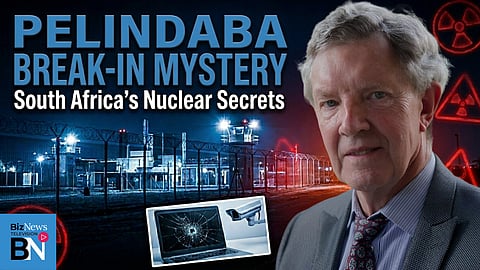
There are growing fears that nuclear weapons could be used in the Iran war. That has brought renewed focus on that 2007 attempted armed robbery at South Africa's nuclear research site, Pelindaba, and the “security” of the country’s large, high-quality enriched uranium stock. Chris Steyn asks Dr. Kelvin Kemm, a member of the South African Council for the Non-proliferation of Weapons of Mass Destruction and the former Chairman of South African Nuclear Energy Corporation for his assessment. Asked whether it would be possible for South Africa to bypass the council and secretly gift another country some enriched uranium, Dr Kemm says: “It should not be bypassed because if the council is bypassed then the government is breaking its own rules and that would be serious…I would like to say that I think that's pretty much impossible.” Detailing South Africa’s nuclear weapons programme under Apartheid, Dr Kemm says the country was busy with the seventh nuclear device when former President FW de Klerk ordered a stop. “A couple of them were smaller than the Hiroshima weapon of the Second World War and some of them were bigger than that.” Dr Kemm also details SA’s future nuclear power plans..Sign up for your early morning brew of the BizNews Insider to keep you up to speed with the content that matters. The newsletter will land in your inbox every morning on weekdays. Register here.Support South Africa's bastion of independent journalism, offering balanced insights on investments, business, and the political economy, by joining BizNews Premium. Register here.If you prefer WhatsApp for updates, sign up to the BizNews channel here..Watch here.Listen here.Edited transcript of the interview.Chris Steyn (00:01.477)There are growing fears that nuclear weapons could be used in the Iran war. That has brought renewed focus on that 2007 armed robbery or attempted armed robbery at South Africa's nuclear research site, Pelindaba. I speak to Dr. Kelvin Kemm, a member of the South African Council for the Non-proliferation of Weapons of Mass Destruction, the former Chairman of South African Energy Nuclear Energy Corporation and currently the chairman of Stratek Holdings. Welcome Dr. KemmKelvin Kemm (00:39.502)Thank you for having me Chris, it's a pleasure to be here again.Chris Steyn (00:45.115)Dr. Kemm re-capp for us the Pelindaba incident.Kelvin Kemm (00:51.116)It was a very mysterious incident that happened quite a few years ago now. And some people broke in by coming through the fence. And they then went and got into the control room of the security of the site. It wasn't near the reactor or anything like that. And they had weapons…four of them were armed. And it was at night. And there was a fellow on duty, and he had his girlfriend with him at the time. And they came in there with guns and they both got injured. The one fellow was shot but survived, okay. And it was quite a mystery…the security people were then called and so on and so forth. And that's what happened. Now the odd part of it was they knew how to get in by putting pieces of cardboard into electrical contacts to override some of the high security around the fence.And it was quite mysterious and people wondered what they were doing. It really couldn't have been anything tackling the serious nuclear stuff because it was still far away from getting anywhere near that. They only went to the tower where the security people sit during the night. But still, it was quite a strange thing. They took a laptop and a couple of other things, but it really was quite a mystery. I don't think any real satisfactory answers ever come out of it.Chris Steyn (02:13.073)So it seemed like it was an inside job, but nobody was ever arrested. And the case has never been solved.Kelvin Kemm (02:20.38)It would appear so in the sense that they knew how the things worked. So somebody either like an inside job or somebody told somebody how to override the security system by putting bits of cardboard and electrical contacts and so on. Because there's quite sophisticated defenses there, of course.Chris Steyn (02:40.487)Now, the person who was shot, sued Pelindaba because apparently security took over 20 minutes to arrive. Do you know what happened with that case?Kelvin Kemm (02:50.539)No, I don't know the end result of all this. I said it was quite a few years ago now, so I forget the details. But he was actually on duty as a security person. He was there with his girlfriend. So the fact that it took security a while to arrive, exactly why I don't know, that was before my time there. But maybe what they would have done is go on and checked other things if they got a call going directly to him. He was not necessarily the first priority. The first priority would have been having a look at other facilities.He was after all the security man himself, who was in the security tower. They should have been in a position to defend themselves. In fact, they shouldn't have been able to get into the security tower. They did it by getting a stepladder from somewhere as well, which they also knew where the stepladder was. And so the whole thing was, it was a bit of an interesting situation by the end of the day, so you can see what happened. Luckily, no particular damage was done, other than this fellow getting shot, which he recovered from. There was no...large-scale damage or anything to… any of the systems there. So it's gone past into history now.Chris Steyn (03:56.711)And how much enriched uranium is there now, Dr. Kemm?Kelvin Kemm (04:02.759)There's quite a lot. I can't tell you what's there, but there's quite a lot. So that's about all I can tell you. What it is, too, is it's good quality material. South Africa did a good job in the past. You'll no doubt be going to mention where did it come from. And South Africa under the pressure of the era before 1994, way back in the 70s, in fact…Kelvin Kemm (04:32.773)…we started to develop the technique to enrich uranium. You need to enrich uranium because uranium when it comes out of the ground is 99.3% of an isotope called U238, which is what you don't want. And the valuable one is only 0.7%. So what you want to do is increase the percentage of that 0.7 by taking the 238s and throwing them away, so to speak. And we do that up to a percentage of 5%. And that is what the uranium that Koeberg runs on. Then there's the next level, which is about 10%. And that's the SMR, Modern Small Modular Reactor Type, range up to 10 or 15. And then the international community way back made a decision that 20% was the go-low-go barrier for military and civilian. If you stay under 20, you're in the civilian ballpark. Soon as you pass the 20 mark, you're going towards military stuff, and you shouldn't be doing that unless you had a very good reason to do. The Iranians currently have got, apparently, uranium at 60% enrichment, and that is what has been concerning the US and the Western world. Why are they sitting at 60 when they keep claiming that they are totally peaceful about it? And they've got that. That's still not good enough for a weapon. We went way beyond that. And we did that initially because the fuel to Koeberg and to the Safari reactor at Pelindaba was blocked by international sanctions. So the authorities at the time gave instructions for South Africa to ensure that we do not run out of nuclear fuel for the three nuclear reactors. And we didn't…We were able to completely create fuel for both the Safari reactor and the Koeburg reactors. And we did that. And to do that, you have to enrich uranium.But when we started to, we developed a completely South African process, a unique process, the Vortex Tube process. Then when we did it, we discovered, not only can we make the reactor grade enriched uranium, but if we keep going, it goes up and up and up to weapons grade uranium. So when that was reported to the Cabinet, the Cabinet said, let's actually carry on and do it. So they carried on and developed the weapons grade uranium. So that's what happened at the time.Kelvin Kemm (06:56.675)The stimulus was because the fuel had been cut off by the Western world.Chris Steyn (07:03.076)Dr. Kemm, with everything that we are hearing currently about police and political capture, how safe is South Africa's enriched uranium?Kelvin Kemm (07:14.658)Chris, it's very safe. It's in a secret place. Only a couple of people know exactly where it is. In fact, only a few people know it even exists, but the international community knows. The spy networks of the world know, so what I'm saying now is not going to be news to any of them. And it's within a large site, 2,000 hectare site, which has got a high security fence around it. It's also a multiple building, some 150 buildings on the site. And it's in a building, it's in somewhere, and very secure. It's also not that big in terms of volume. It's a lot in terms of enriched uranium. But it's not as if it's truckloads or something like that. To make a nuclear weapon, you need a piece about like that…. …. So a piece like that will give you an almighty bang. So you can imagine it's common knowledge now too that South Africa actually produced six and a half nuclear devices. And F.W. de Klerk became president when they were halfway through the seventh. And De Klerk at the time said, look, going for nuclear weapons is not going to get us where we want to go. Let's declare to the world that we have it. Let's make peace about this issue. Shake hands, sign the Nuclear Non-Proliferation Treaty, which is a treaty that says we undertake not to make nuclear weapons or use them anyway. And he then ordered: stop today. And that today was in the middle of the seventh weapon. They literally told the guys, put your pencils down now and walk out the front door, which they did. And they locked the door. And I've been inside there and the pieces of paper are still lying on the desk and there's still handwritten notices on the wall, who's on duty tomorrow morning. And things like this is quite eerie because there's no outside windows or anything. So there'd be no...vandalism or theft…Kelvin Kemm (09:12.831)So that's why we were six and a half. Yep. No, you might have said how big were they and they were different sizes. A couple of them were smaller than the Hiroshima weapon of the Second World War and some of them were bigger than that.Chris Steyn (09:32.058)Dr. Kemm, if South Africa decided to secretly give some enriched uranium to another country, who would have to authorise its transport or its removal from the facility?Kelvin Kemm (09:43.295)Well, firstly, Chris, must mention the Pelindaba Treaty. There's a Pelindaba… Treaty which is signed by African countries. I think all the African countries, maybe two minor ones haven't, but as my memory serves, they've been signed. And the Pelindaba … Treaty was the first one in the world that said an area will declare itself a nuclear weapons-free zone. So that came into effect quite a few years ago now. So we are already in the treaty that says we are a weapons-free zone. We also have agreements with the International Atomic Energy Agency, UN, and others that we will not pursue any weapons of mass destruction in the future, or which weapons that nuclear is part of it. And I'm on that council, as you mentioned in the beginning. So in principle, what you ask, it would only be authorised at the highest level of governmentBut in fact, the Council… is there to stop anybody doing it, whether it's the government or private enterprise. Anything of that nature comes through the council. And the council has a look. Is this something that could conceivably be used in a weapon? And if it is, then the council asks for it to be examined. And if there's any suspicion, it will be prohibited.Chris Steyn (11:06.704)Could the council be bypassed?Kelvin Kemm (11:09.692)It should not be bypassed because if the council is bypassed then the government is breaking its own rules and that would be serious. But I'd find it really difficult because to bypass it; somebody would have to physically go to where the material is and take it. Therefore authorities there would have to open the gates and open the doors and so on and so forth.And they all know that if anything like that happens, they would have to report it to their council and the authorities. They'd have to have a number of people that are in on the criminal aspect, so to speak, to be able to get to the point where it's taken out without anybody's knowledge. I would like to say that I think that's pretty much impossible.Chris Steyn (11:57.207)What is South Africa's nuclear competence like right now?Kelvin Kemm (12:02.754)It's very good, Chris. Nuclear has been hammered by the extreme Greens for years. But we have got a sophisticated set up here. A lot of people do not believe it. But NECSA, the South African Nuclear Energy Corporation today, is like 2,000 people. It's a world leader in the export of nuclear medicine. Every three minutes, somebody somewhere in the world is injected with nuclear medicine from Pretoria. And every three hours, somebody's life is saved.That's the rate at which we're the only reactor in the world that runs 365 days a year sending nuclear medicine all over the world. We've got highly sophisticated setups. Koeberg runs exceedingly well. It's known to be a model in the world of how to run a nuclear reactor well. It has just achieved a milestone just a few days ago, doing 365 days continuously on reactor number two, running full ball. And that's very good. It's close to a record, although they're going to deliberately take it offline in a couple of weeks' time for maintenance. So they're not trying to break the record of the continuous run. And we've got lots of nuclear around the country. Numbers of universities have nuclear divisions. And we've got South Africans all over the world, which is one way pleasing to see South Africans in all sorts of places running nuclear operations. Also, but sad that they're gone. We need them to come home.Chris Steyn (13:36.74)South Africa plans to introduce more nuclear power. How is it going to be done?Kelvin Kemm (13:43.074)Well, the plan at the moment is we need new stations like Koebergs on the coast. Eskom some years ago acquired five sites around the East Coast and the West Coast of South Africa. Two of them are quite advanced now, up to the point where environmental impact assessments have been essentially done. And there's a whole lot of legality that one has to go through to get to the point where the site is made available to actually build. One is by Jefferies Bay… And there's one next door to Korberg…And both of those are ready to build on. We're planning, actually, to do both. But it will be decided which one is first. …The idea would be to start building a reactor when you're part of the way through doing the first couple of reactors there. You then start on the second one. That's the most productive way to do it. Those will come out at some thousands of megawatts. That will be about 50% bigger, if not twice the size of Koeberg. And then over and above that, there's small modular reactors. The thing with the big reactors like Koeberg, they need the ocean for cooling. So you constrain basically, you put them on the coastline, unless you have a very big inland lake, which we don't have. Russia has a thing like Lake Baikal, which is very clean water, and the water level virtually never changes. South African lakes go up and down a lot, depending on drought conditions, so it's too risky to try to use the Vaaldam or something like that for a big nuclear reactor. So years ago, it was realised that that was the case, and so South Africa became the first country in the world to embark on designing a small modular reactor for commercial use. And that was the initiation of that ….modular programme. And that was to have a small reactor on about 100 megawatts output that is designed to not use water at all. So it's used helium gas cooling. So the original thoughts were to put them at a gold mine or to put them at inland towns in the Free State or things like that. Now we've developed to the point of an idea like a cell phone system, having reactors all over like cells and each reactor has its own connections around it. So you spread them across the country rather than having the big centers and then transmitting along the way. We need both…Kelvin Kemm (16:07.42)…need the big ones where you can, and you push the power inland, like from near Jeffries Bay into the eastern side of the country. And then there's sites on the other side to push them from the western side, which you need to dot nuclear around. And there's been a lot of interest from African countries as well. We've had quite a few African countries contacting us. And they are showing great interest, because clearly they're in the same position. Many of them have no sea at all, and they have no big lakes. And those that they have, the levels change a bit too much and so on. So there's huge interest in the small reactors.Chris Steyn (16:44.72)A PBMR class reactor was also developed for export. What is happening with that?Kelvin Kemm (16:51.438)Okay, well, what happened was when the project started, it started out of Eskom in that there was a fellow there who was running around the passage of saying, let's build a reactor. And the CEO of the time was Alan Morgan. As he spoke to me and said, is this guy crazy? Was he onto something? And after a bit of discussion was decided that he was probably onto something and it was worth it to give it a try. And that was Professor David Nicholls, who's now the current chairman of Necsa. And so he gotBack then, people loved to say that the first budget of the first year was 25,000 Rand. And that was the budget that was essentially for pencils and paper to show that this thing was actually feasible. And it went on to be developed into what was called the Pebble Bed Modular Reactor. The Pebble means that the fuel is the size of a tennis ball, and uranium is in that. And you put all these balls into a big tank, basically, and you blow the helium gas through it, and it comes out at a temperature of 750, which is very hot. Reactors like Koeberg are between 250, 300 normally. So the 750 in itself has got interesting industrial applications. So that's what happened. And the pebble bed got to the point where they started actually building it. The pressure vessel was purchased and arrived in South Africa, and various sub-assemblies were made. Then the 2008 financial crisis hit in the US. And that spread around the world. And a number of the US banks had been backing the South African initiative, not with money, because we didn't have the money at the time, but the psychology of having the big banks saying, we're onto this for export reasons. They all pulled out under 2008. Then the 2010 Soccer World Cup was in South Africa, and the government was looking for money for soccer stadiums and so on. And that was when President Zuma pushed President Mbeki out. So the change of president and President Zuma then said, let's put some of these big things on hold while we think about it. And the PBMR went on hold. Everybody thought it would last a few months, and it lasted until basically 2026. It was taken off hold only just a few weeks ago to go back again. So that's what the initiation of the whole story was. So South Africa is the world leader in starting the whole idea of commercial SMRs.Kelvin Kemm (19:10.531)Professor Nicholls likes to point out that when he spoke in Europe and I spoke in the UK, explaining to people saying South Africans are on the wrong track… You don't want to go small, you want to go bigger and bigger. And we said, we have a reason. Now everybody's climbing on the bandwagon around the world saying, you know, the SMR idea is a good one. In other words, we're right, but nobody's crediting us.Chris Steyn (19:32.624)Meanwhile, how involved is local business?Kelvin Kemm (19:36.336)The big business, not at all. It's been sad. I've been hoping that an Anglo-American, a Sasol, somebody like that would realize that this is the future and then put some money in. We find it very difficult. A number of the top CEOs I've spoken to said, we don't want to get involved with the word nuclear. We're scared of that. We'll stay away. But best of luck to you. Best of luck. I hope you keep going, but don't involve us. Now, we need somebody like that. Meantime, a little of the smaller business, medium and smaller,calling us on a regular basis, like, I supply stainless steel systems, I supply pumping systems, I supply this, this, and this,,,we're having numerous of people calling us to say they want to be in the supplier pipeline. So it shows you the amount of business activity that can be triggered once the thing gets rolling. And in meantime, what we are finding is we've got interest from around the world. We've had a top fellow from Wall Street here a couple of weeks ago, amazed to discover what we're doing right now. We've got one of the richest people from an Asian country who's come to see us. They're talking about substantially financing. We've had people from Europe and quite a few places calling us. And one of the big humps we have to get out is convince them we actually know what we're doing, whereas the US and companies in the UK don't have to do that. I was guest speaker in New York a couple of months ago. 500 people come to the function. And somebody asked me, is there a tarred road between Pretoria and Johannesburg? Somebody else says, is there an airfield in your country big enough for an airbus to land? In the meantime, we're trying to convince them we know how to build a nuclear reactor, and they don't know if we've got a tarred road. When the visitors come here, they look around and they're saying, good heavens, this is just so much further advanced than we had any idea, which is not what the Americans have to do…. So we've got all of that to do and we're getting no help from the Sasols or from the Anglos or from anybody like that. I've had leading engineering companies say, right behind you, sit to the CEOs right behind you and don't tell anybody. Don't, because we're scared that the Green demonstrators will come in and…Kelvin Kemm (22:01.133)…throw things at our front door and so on. You've got to get past that. You want to find somebody who can see the future together with us. We're getting good support from the government, psychological support. They've got no money from them either.Chris Steyn (22:20.047)Thank you. That was Dr. Kelvin Kemm the chairman of Stratek Holdings speaking to BizNews. I'm Chris Steyn.