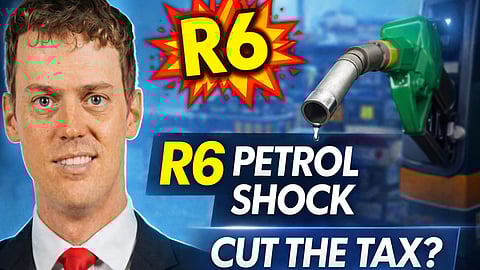
As fuel prices surge, The Democratic Alliance's spokesperson on finance Dr Mark Burke warns that taxes are worsening the crisis - and reveals a bold proposal to cut levies and ease pressure on motorists..Sign up for your early morning brew of the BizNews Insider to keep you up to speed with the content that matters. The newsletter will land in your inbox every morning on weekdays. Register here.Support South Africa's bastion of independent journalism, offering balanced insights on investments, business, and the political economy, by joining BizNews Premium. Register here.If you prefer WhatsApp for updates, sign up to the BizNews channel here..Listen here.Edited transcript of the interview.00:00:08 – 00:00:34Alec Hogg:Well, according to the Department of Mineral and Energy, and they bring out a daily number, we are set for at least a five rand increase in the petrol price, maybe six rand. And it just doesn't seem right that you have these administered prices. There is a hopefully temporary spike in the international oil price and a fall in the rand.00:00:34 – 00:00:55Alec Hogg:And so motorists have got to pay more. Mark Burke is the finance spokesman for the Democratic Alliance, and he doesn't think it's right either. So we've managed to get hold of him at Parliament, just to see why he is standing against this.00:00:55 – 00:01:19Alec Hogg:Mark, thanks for coming on to tell us your insight on this. I've been following the figures every day, and they are published daily by one of the DMRE's subsidiaries. And it's actually scary. It's like every day you see that the petrol price goes higher and higher, and even now you get a six rand per litre increase.00:01:19 – 00:01:52Alec Hogg:Now next week there's another three rand coming thereafter, because the recovery on petrol is already high. And then you look at diesel — it's even worse. So maybe you can just give us your understanding of why it is that South Africa has got this system where the price of petrol doesn't adjust every day as the oil price does, but actually only changes once a month?00:01:52 – 00:02:29Mark Burke:Yep. So as you've noted, the difficulty lies in the way that South African petrol and diesel prices are constructed. Almost 30% of that price goes towards fuel levies. And within that, there are two — the general fuel levy and the Road Accident Fund levy.As part of government's attempts to shore up the fiscus, every time somebody adds fuel to their vehicle at the pump, there's this roughly 30% amount that comes off to the taxman.00:02:29 – 00:02:54Mark Burke:And that adds a significant chunk to the national fiscus. To give you an idea, between those two levies, you've got about R150 billion flowing into the fiscus.So to answer your question, government is incentivised to make sure they get their cut at the pump.00:02:54 – 00:03:19Mark Burke:And on top of that, the process has developed over time so that there's a measure of uniformity in fuel prices inland and on the coast. These things combined result in what feels like a controlled price.00:03:19 – 00:03:39Mark Burke:Given the global oil price shock that we're undergoing at the moment, government has to do something to absorb some of the shock for South Africans, because it will be a debilitating factor for our economy come the 1st of April.00:03:39 – 00:04:17Mark Burke:The increases you've mentioned — close to six rand per litre for petrol and nine rand per litre for diesel — represent almost a 50% increase in diesel.What we can't control is the base cost — how much the world pays for a barrel of oil. But what we can control are these levies.So what the DA has come out and said today is that we are proposing a 50% reduction in both the general fuel levy and the Road Accident Fund levy.00:04:17 – 00:04:28Mark Burke:Those two levies combined add about R6.35 per litre, and a 50% reduction would mean about R3.17 relief at the pump.00:04:28 – 00:05:28Alec Hogg:Yeah, it's radical. But if you step back from it, if you had a business going through a similar situation, you would look for cutting costs somewhere.It's funny, Mark — you remind me of a discussion I had with Trevor Manuel many years ago. He was known as a good finance minister, but he brought in the fuel levy. I remember saying at the time that these things never go down — they only ever go up.So why has it taken the DA to come up with this? It feels obvious that something needs to be done.00:05:38 – 00:06:07Mark Burke:You're right — taxes always seem to go up, and government tends to expand its reach over time. At a crisis point like this, we have to reassess.Our proposal is a 50% reduction in these levies, but it does come at a cost of about R6.5 billion per month to the fiscus.00:06:07 – 00:07:25Mark Burke:We’ve identified ways to fund this without increasing taxes. For example, the Compensation Fund had a R21.7 billion surplus. That alone could give us three months of relief.There are other sources too — enough to provide at least six months of breathing room without increasing the fiscal burden.00:07:47 – 00:08:23Alec Hogg:There are also dozens of transformation funds sitting with billions, poorly audited. Why not use that money now?00:08:23 – 00:09:42Mark Burke:Exactly. The Compensation Fund alone holds over R100 billion, with relatively low liabilities. There are many such inefficiencies across government.What we’ve tried to do is present a funded, practical plan that can be implemented quickly.00:09:56 – 00:10:17Mark Burke:We’ve sent this proposal to the President and the Finance Minister. Now it’s about whether government chooses to collaborate — or not.00:10:17 – 00:11:02Mark Burke:The war in the Middle East is outside our control. But wasteful government spending is not. That’s where action must happen.00:11:02 – 00:11:55Alec Hogg:If nothing changes, we could see even bigger increases next month. Is there anything more that can be done?00:11:55 – 00:13:07Mark Burke:We could go further — even to a 100% reduction in levies — but beyond that, government would have to subsidise fuel, which is a much bigger conversation.00:13:08 – 00:14:17Mark Burke:There’s massive inefficiency in government — including ghost workers and unused funds. We need to address it urgently.00:14:18 – 00:15:28Mark Burke:I’ve come from the private sector, and I still see myself as someone trying to improve systems. If we get this right, we can genuinely help South Africans.00:15:28 – 00:16:12Mark Burke:Treasury is trying to improve efficiency, but it’s not happening fast enough. We need to accelerate these reforms.00:16:36 – 00:17:27Alec Hogg:How much wastage is actually in the system?00:17:27 – 00:18:26Mark Burke:There’s a huge amount — but it’s difficult to quantify. And that’s part of the problem.00:18:59 – 00:20:09Mark Burke:Ghost workers are a major issue — people on payrolls who don’t exist. In one case, 10% of employees were fake. It’s widespread and needs urgent attention.00:20:09 – EndAlec Hogg:Dr Mark Burke from the Democratic Alliance — thanks for your insights.