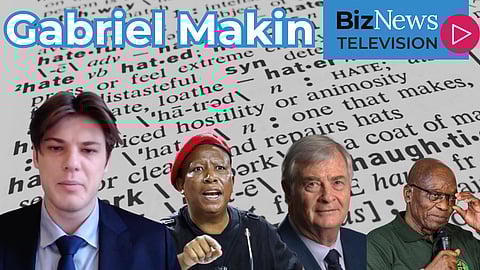
Eighty-three (83%) of Economic Freedom Front (EFF) voters feel that the Kill the Boer song “land somewhere between irresponsible and hate speech”. That is according to a recent Social Research Foundation (SRF) survey on public perceptions around hate speech, free speech, - and that controversial song. In this interview with BizNews, the SRF’s Research Director Gabriel Makin says of that 83%, 57% of EFF supporters say that the song is clearly hate speech as it calls for direct physical harm specifically against white Afrikaans farmers who are being murdered in disproportionate numbers - and as such believe it should be banned. “So that's a majority of the support base of the political leader who's driving the kind of narrative around Kill the Boer saying that actually the song that he's singing is hate speech and that he the song itself should be banned and he should be barred from singing it.” Similarly to EFF voters, former President Jacob Zuma’s MK supporters also express opposition to the song Kill the Boer. “They think it is irresponsible to sing or they think generally it should be banned.” Commenting on these significant findings, Makin says: “…one of the trends…that emerges from our data is that the bulk of South Africa is moderate, it's staid, it's pragmatic. It's not the kind of racially obsessed, radical, radical populist population that some of our political leaders wish it were.”.Sign up for your early morning brew of the BizNews Insider to keep you up to speed with the content that matters. The newsletter will land in your inbox at 5:30am weekdays. Register here.Support South Africa’s bastion of independent journalism, offering balanced insights on investments, business, and the political economy, by joining BizNews Premium. Register here.If you prefer WhatsApp for updates, sign up to the BizNews channel here..Watch here.Listen here.Edited transcript of the interview.Chris Steyn (00:02.431)How do Economic Freedom Fighters supporters really feel about the Kill the Boer song? We speak to the Social Research Foundation’s Gabriel Makin about its latest survey. Welcome Gabriel.Gabriel Makin (00:17.368)Thank you so much for having me out.Chris Steyn (00:19.911)What percentage of EFF supporters interpret that song in a literal way?Gabriel Makin (00:27.278)Well, firstly, I think it's important before we get into the findings of the poll, I just want to give you a kind of outline of exactly what we were doing. So about a month ago, our pollsters Victory Research approached us and said that they were interested in doing some research while this is a hot-button topic on what is the public opinion on freedom of speech and then towards the song Kill the Boer. And so we went into the field for about two and a half, three weeks this month and we were interested in polling all South Africans. So we usually focus our political polls on registered voters. This was all South Africans because we wanted to see what the country actually believed. And so on the question of what do EFF supporters believe Julius Malema is saying when he sings the Kill the Boer? We asked them, we gave them essentially four options people in this question, which is One, he is just celebrating an old Struggle song. Two, he's being provocative, but not literal. Three, he literally wants to go out and kill white Afrikaner farmers and Four, he's using it to protest the ANC government and failures on land reform. And amongst EFF voters, about 57% will say that when he's singing the song, he's just celebrating an old Struggle song. 15% would say that he is being deliberately provocative, 2% say he wants to literally go out and murder Afrikaans farmers. And 27% will say that it's a protest against the ANC's slowness on land reform.Chris Steyn (02:23.057)Okay, so only 2% take it literally feel they have to go out and obey. What percentage think it's hate speech? Of EFF supporters in particular?Gabriel Makin (02:38.958)So, of EFF supporters, it's about 57% who will say that when asked a question…We again gave a kind of list of possible options for people on what they think it is that the Kill the Boer is. And number one was it's irresponsible to sing because racial tensions are still high, but it does not constitute hate speech. Number two, the song is clearly hate speech. And number three is it's harmless and an old Struggle song.Amongst EFF voters, this is one of the more interesting findings given that you would expect that there would be support for this. 57%, so that's more than a majority of EFF supporters said that the song is clearly hate speech as it calls for direct physical harm specifically against white Afrikaans farmers who being murdered in disproportionate numbers. As such, I believe it should be banned. So that's a majority of the support base of the political leader who's driving the kind of narrative around Kill the Boer saying that actually the song that he's singing is hate speech and that he the song itself should be banned and he should be barred from singing it.Chris Steyn (03:55.967)So if I interpreted the stats correctly, about 83% of Economic Freedom Fighters supporters are actually opposed to the song.Gabriel Makin (04:04.844)Yes, exactly. When you add in the other option, is that it's irresponsible to sing you get to this 83%, which is extraordinary. I often say though that, you know, when I've been doing the polling now for two and a half years, and whenever we kind of drill down into what EFF supporters believe, it's very clear most of the time that in fact, the bulk of EFF support would be very moderate centrist people in their political beliefs. You know the EFF success as a political party doesn't come so much from the policy package that it offers and it even doesn't really come from you know these the stunts like the Kill the Boer stunt that that Julius Malema because has pulled because as you can see it's actually not that popular amongst his supporter base.You see, the reason we think that the EFF has been so popular and been so successful is that that red beret is a marketing tactic. You put it on and you're suddenly given a sense of belonging. And so if you are a poor, unemployed young person in South Africa, who feels as though mainstream opportunities, mainstream institutions have ignored me, when you can be a part of something, anything, it's incredibly appealing and when it's a political movement filled with young charismatic people, all of a sudden you can see how you get to the point where you have a supporter base who are moderate, of run-of-the-mill average South Africans in terms of their beliefs, but because of, you know, circumstance or whatever it is, they find the EFF appealing because it gives them a sense of belonging more than anything else.Chris Steyn (06:03.519)In stark contrast, supporters of the Freedom Front Plus gave you a very different response. Won't you just take us through that, please?Gabriel Makin (06:15.854)So when we included, I gave you a lot of data on the Freedom Front Plus here specifically because it's a constituency that's very active in the kind of debate around Kill the Boer. And Freedom Front Plus voters are the, I would say the most sensitive, obviously, to the Kill the Boer song. So we had about, as you said, just over 80% of EFF voters, 83% of EFF voters who said that the song song land somewhere between irresponsible and hate speech. Now when according to Freedom Front Plus voters, 80% say that the song is clearly hate speech. So that's no…there’s no kind of beating the beating around the bush; they are this is song is hate speech and it should be banned 80%, and then 20% who said that the song is an old Struggle song, it's harmless and we shouldn't really worry about it. And so I think this talks to something else that's inside of our data that I hope maybe we can flesh out a little bit more because this poll wasn't just about people's opinions on Kill the Boer, it was also about people's opinions on free speech more broadly. And one of the findings that did emerge is that amongst minority voters in the country, Indian, Coloured, white, there is a higher degree of kind of sensitivity towards hateful speech in terms of when we ask Coloured, Indian, white voters versus black voters, you know, should racism be classified as hate speech, minority voters will actually in higher percentages than black voters say that in fact the racism, bigotry, homophobia, sexism, misogyny, these things should be classified as hate speech and should be banned. Whereas black voters said no, these should be classified as hate speech as such, but and they don't want to see them banned. And so it's difficult to tell exactly what…Gabriel Makin (08:36.632)…where this is coming from. But to some degree, you can kind of look at the historical context where you could see that, you know, minority voters think that they maybe should believe that these, you know, racism should be hate speech and banned because they feel a certain degree, especially amongst white voters, certain degree of guilt for what happened in Apartheid. And they feel as if, you know, it is the correct thing for them to believe.So it's interesting that, of course, the Freedom Front Plus voters are very opposed to it, but they aren't just opposed in the sense that they think it's a bad thing to do. They are opposed in the sense that they think that people, that Julius Malema should not be allowed to say, that it should be completely banned from being chanted in public, which indicates a kind of yes, it's opposition, but it's not really the opposition one might as a kind of liberally-minded, democratic supporter want because it's an opposition that says no, people should not be allowed to do this. It's not an opposition that says, it's unfortunate that people say this, we want to explain to them why it's a bad idea, but I don't want to take away their freedom of speech. It's a it's a, it is saying no, you should not be allowed to say this…Gabriel Makin (10:04.568)Freedom of speech does not extend to these certain words, does, it draws out some interesting dynamics that the country still has to deal with, I think.Chris Steyn (10:16.351)What about former President Jacob Zuma's MKP supporters? How do they feel?Gabriel Makin (10:25.07)So again, I think, you know, if I were to kind of be a political leader as a moderate centrist that I am, and I were to ask for a voter base to have certain beliefs, you know, a combination of the ANC, the EFF, MK and ANC voters, I think would be the best, most moderate grouping that you could find in the country, despite everything that all the party's leaders say and the policies they push. So what you'll find again is that very similarly to EFF voters, MK voters are opposed to the song Kill the Boer. They think it is irresponsible to sing or they think generally it should be banned. You know one of the trends that the Social Research Foundation we always try to talk about and that emerges from our data is that yhe bulk of South Africa is moderate, it's staid, it's pragmatic. It's not the kind of racially obsessed, radical, radical populist population that some of our political leaders wish it were. In fact, most people, you know, they, most people are concerned with their lives improving by finding a job or earning more money in the jobs that they have and they wish that their politicians I guess would be kinder and focus more on solving problems but the kind of rhetoric and the angry firebrand approach is not really likely to win you much support in South Africa outside of a very very limited minority of voters who are extreme. Of course, I'm not saying that there are no radicals in the society, but I'm saying generally, even amongst the far left populist parties, you won't find these radical people who might be terrified of like, you know, driving their agenda forward. So it's, again, it's a very similar to the case of the EFF, where these are moderate, pragmatic people who think that it's actually…Gabriel Makin (12:48.654)..it’s unfortunate that people are singing songs that isolate a minority in the country and they think it's distasteful and that they wish it wouldn't happen.Chris Steyn (13:00.223)Are there any other significant findings that you would like to highlight?Gabriel Makin (13:04.128)Yes, I would like to go back to this question of freedom of speech, because I think that the question of freedom of speech is a broad concept of something that really hasn't been properly hashed out in South Africa, and I'd like to do a little bit of that. So we opened the poll on Kill the Boer with a battery of questions around freedom of speech, and so the first question we ask I how important is freedom of speech to you? So we haven't defined what freedom of speech is and we'll get into the definition of freedom of speech in a second. Essentially it was something like 93% of South Africans said that it's very or quite important. So in the country people believe yes, you should be allowed to speak freely. But then we asked the follow-up question, is which one of the following two statements best captures the idea of freedom of speech. So if you basically if you were to define freedom of speech, what is it? And there's two options basically the same with, you know, very important difference. Firstly, it's everyone has the right to freedom of expression, which includes the choice to cause offense to others. Then the second is everyone has the right to freedom of expression, but that does not include causing offense to others. So why we did this is that in fact, we believe - as the Social Research Foundation - that there is only one liberal democratic definition of freedom of speech; which includes the choice to cause offense to others. Because of course it does. You do not need freedom of speech to protect statements such as the sky is blue, because no one is going to try to stop you from saying that the sky is blue. But you need freedom of speech to protect offensive speech. And offensive speech is difficult to define because obviously offense is taken, not given. So offensive speech could be, to an ANC member,pointing out that, you know, during Angie Motshekga's term, the Department of Basic Education was essentially completely destroyed. And to an ANC loyalist, that would be incredibly offensive speech. But that's what freedom of speech is there to do. It's there to protect freedom of speech,Gabriel Makin (15:28.11)better protect the offense of speech. So why do I highlight what we think of as the correct definition? Well, it turns out that 82% of South Africans think that freedom of speech does not include the right to cause offense to others. So they essentially believe in a definition of freedom of speech which precludes the idea of freedom of speech. But the reason why that is, I think, is because it's multi-faceted and it's worth kind of diving into a little bit. Number one, I think I don't think that this comes out of a place of kind of malice or the desire to control what people are saying and control what people are thinking. I think primarily it comes from a desire to be decent people. You know, going back to this idea that South Africans by and large are decent folk who are concerned about their communities and progressing their own lives.And so what it is is that they don't maybe realide that by saying freedom of speech should not cause offense to others, what they're really pointing to is they wish that when people are talking we can just be polite, kind and caring towards each other, that we don't try to be offensive in our language. Number two, I think that because South Africa doesn't really have a, although we're a liberal democracy now, we've never really developed a liberal democratic tradition of free speech. you know, I'm thinking here of the First Amendment in the United States, which, you know, has 250 plus years of jurisprudence surrounding it, and a very clear tradition of being protected in the United States, or even a place like the United Kingdom, where freedom of speech is seen as one of the primary rights that people have. In South Africa, during Apartheid, we didn't have freedom of speech. And now, although in our Constitution freedom of speech is enshrined, the jurisprudence around freedom of speech is so messy and so all over the place, we've never really developed a coherent definition of what is freedom of speech in South Africa. And so people generally think that freedom of speech isn't so much the right to say what you like as long as you aren't calling for direct violence, which is…Gabriel Makin (17:52.504)…freedom of speech understood in the liberal democratic tradition, but they think of it as a kind of legalistic pseudo thing where, you know, lawyers, there's some words that you can prevent people from saying or some ideas that you can stop people from having, and that we can use the court system to essentially figure out, you know, this is protected, this isn't protected. And we come to this kind of grey area. The problem being eventually, you know, the reason why you have freedom of speech is that you want to be able to be offensive and point out when the powerful in society are going wrong. Really, that's really what you want to be able to achieve with it. But the problem is, is that if you let the courts litigate exactly what is being said, and if you let people, and you don't have a clearly defined tradition, eventually a powerful person might decide, well, you know, anti-government, things against the government aren't protected as freedom of speech. And all of a sudden you actually can be stripped of your freedom of speech in this legalistic manner, because that's how any authoritarian will cross your freedoms. They'll do it a kind of step at a time using parts of least resistance so that people just walk themselves slowly towards the position that the authoritarian would want to be in. And so, you know, this is a very long-winded answer to say that what we found is slightly worrying in that people in South Africa need to be taught exactly what is freedom of speech really is and what you should be and what we should be aiming towards and that, you know, I think thatthe fact that Kill the Boer has caused this opening up of dialogue on what is freedom of speech, what isn't freedom of speech. We should realise that, you know, as a society, we don't really have a good definition and we need to figure out exactly what it is we categorise as freedom of speech. And I would hope that that might lead to us kind of broadening…Gabriel Makin (20:18.504)…our freedom of speech and broadening the protections that it offers so that we don't have cases in which, like Kill the Boer, you have a class of speech being protected because the person who said it was in a quote-unquote protected class, but some you've had issues, cases in the Constitutional Court that coming from a defendant who maybe is it from a different class of people who have said far less offensive things will be found guilty of hate speech. You know, these, the fact that this is, so the jurisprudence is so muddied really filters in to the beliefs in South Africa.Chris Steyn (21:08.711)And how representative was this survey? Did it bear out what you would pick up, trends you would pick up from these parties in other surveys?Gabriel Makin (21:21.704)To an extent. So the survey was about 800 people with a margin of error of 5%. So it's quite a small survey with quite a large margin of error. So we should be…but it is is demographically and geographically representative of the country and not just of registered voters, but all adults in the in South Africa. And generally the the findings that we picked up that are questions that maybe have been repeated in previous surveys are similar to what we have found. So, there is still, you can say that you can kind of know that we are dealing with the same sets of South Africans that we've been dealing with in all of our polls.Chris Steyn (22:11.017)Okay, thank you. That was Gabriel Makin of the Social Research Foundation speaking to BizNews and I am Chris Steyn. Thank you, Gabriel.Gabriel Makin (22:19.746)Thank you very much for having me on.