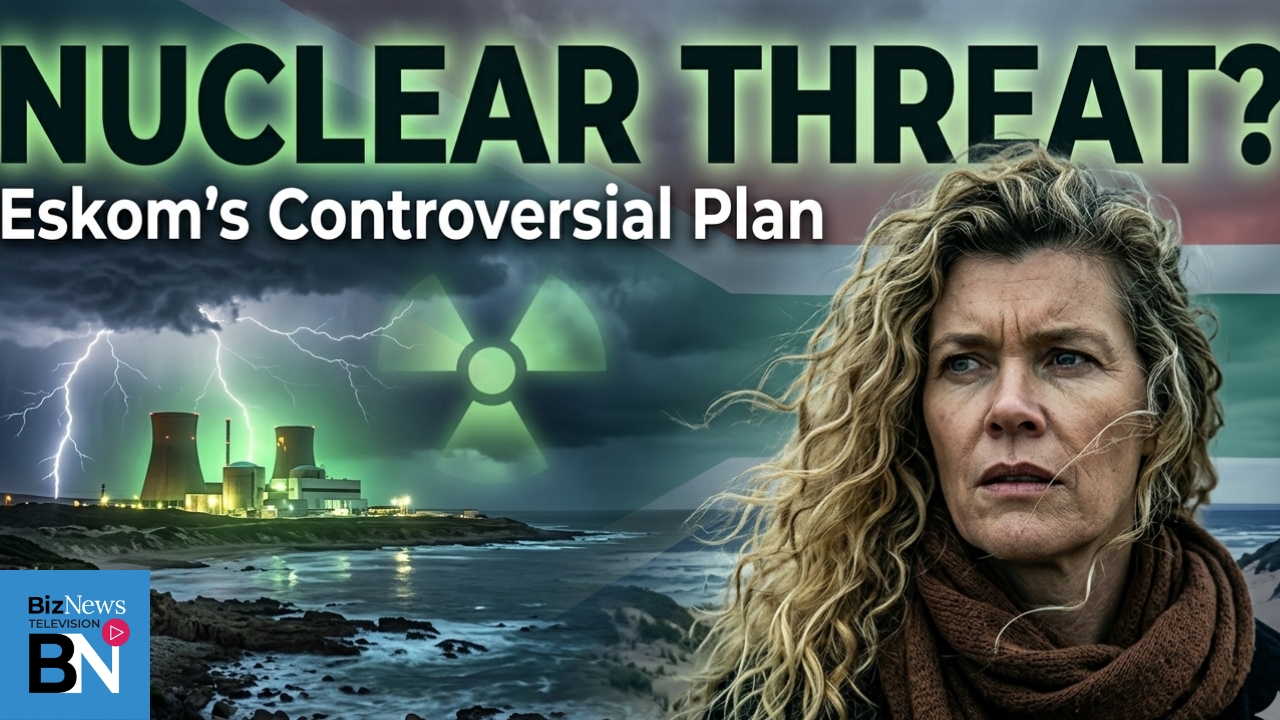
Is South Africa about to repeat its most expensive infrastructure mistakes? Ten years after a corruption-laden Russia/Zuma initiative was shelved, the controversial proposal for a nuclear power plant at Thyspunt near St Francis is back on the table. Communities in the Eastern Cape are sounding the alarm at a siting decision rooted in a 'homeland-distant' priority of a fearful Apartheid Regime. In this interview, Alec Hogg speaks with Trudi Malan, a passionate local activist and leader of the Thyspunt Alliance. She exposes Eskom's flawed scoping reports, the deadly lack of evacuation routes for residents, and the devastating threat to a global heritage site recognised as the cradle of modern humankind. Capping it all was the shocking arrogance displayed by officials at the required 'town halls' required as part of the public participation process. This is a must-listen for anyone concerned about South Africa's energy future and the protection of its heritage..Sign up for your early morning brew of the BizNews Insider to keep you up to speed with the content that matters. The newsletter will land in your inbox every morning on weekdays. Register here.Support South Africa's bastion of independent journalism, offering balanced insights on investments, business, and the political economy, by joining BizNews Premium. Register here.If you prefer WhatsApp for updates, sign up to the BizNews channel here..Watch here.Listen here.Edited transcript.00:00:10:07 - 00:00:43:03Alec Hogg:Well, here's a story that I have got a particular interest in going back some years. I remember talking with Andrew Feinstein. Remember him? He was the guy who was campaigning against the nuclear proposal that the Jacob Zuma administration wanted to bring in. Feinstein, a former member of the ANC, in fact a Member of Parliament here in South Africa who was ejected by the ANC because of his exposures, maintained that there were going to be lots of palms greased by the Russians, who at that time had the inside track.00:00:43:05 - 00:01:13:20Alec Hogg:Well, some of that was put away ten years ago, has resurfaced — this time in St Francis. And the leader, I guess, of the Kouga group that is standing against this or exposing it, is an activist. Her name is Trudi Malan, and we'll find out more about her and why she is so angry in just a moment.00:01:13:22 - 00:01:22:14Alec Hogg:Trudi, good to be talking with you. Just a little bit of your own background and how you got involved in this coalition, as you call it?00:01:22:16 - 00:02:22:00Trudi Malan:Yes. So it’s Thyspunt Alliance, the coalition. To avoid confusion — we always get it wrong — Kouga is the harbour, Kouga is the municipality that we are in, and I am a resident of St Francis, which is close to the area that is earmarked.We’ve been involved in this, submitting comments and responding to the environmental impact assessment, since as long as I can remember living here — which is nearly 25 years. So it’s been a long road.My background is more in journalism, but I got involved in environmental issues and work in penguin conservation and marine conservation a lot of the time. My passion is for this area, not just because I live here, but because it is really, really special and a very valuable site from other perspectives as well.00:02:22:02 - 00:02:25:21Alec Hogg:So you mentioned Thyspunt — is that just down the road?00:02:25:23 - 00:02:54:05Trudi Malan:Yes. So Thyspunt is earmarked, or has been the preferred site for Eskom previously. Thyspunt is situated between Oyster Bay, Cape St Francis and St Francis Bay on the one side, and then inland Humansdorp. So that kind of triangle — it’s 12km from Cape St Francis and St Francis Bay, 3km from Oyster Bay, and about 23km from Humansdorp.00:02:54:07 - 00:02:59:22Alec Hogg:And why was it selected as the potential site for a nuclear plant?00:03:00:00 - 00:04:24:21Trudi Malan:Well, it’s one of the issues of great contention, because these sites were selected during the apartheid government’s time. They selected five possible sites. One of the criteria was that sites weren’t allowed within 100km of the old homelands, because that would have been considered a threat.At that time, they also didn’t have the strict environmental conditions and heritage gradings that we’ve got now. So the sites were selected in the 1980s, and Eskom started buying up land for some of them.There were five sites: one in the Eastern Cape (Thyspunt), two in the Western Cape — Bantamsklip and Duynefontein next to Koeberg — and then two in the Northern Cape.In the previous environmental impact assessment process, although Thyspunt was the preferred site, the department gave authorisation for Duynefontein next to Koeberg. That’s where the next phase of nuclear was supposed to be.But now it would seem there are new plans from Eskom, and suddenly we’re back where we were 25 years ago with Thyspunt.00:04:53:05 - 00:05:12:15Alec Hogg:Eskom has been having public meetings. How have local residents reacted? Have they been interested, or like many South Africans, not really paying attention?00:05:15:19 - 00:07:13:08Trudi Malan:Our community is a very strong community. Despite the fact that the consultants were pretty disrespectful — they picked venues that were too small — the community turned up.They asked very good questions, many of which couldn’t be answered. The draft scoping report was published on 1 April — April Fool’s Day, which now makes sense — and then meetings were held shortly after Easter.Meetings in St Francis Bay, Sea Vista, Jeffreys Bay and Oyster Bay were all very well attended. People had clearly engaged with the documents.But it’s difficult — the format limits discussion. Meetings are about two hours, and it’s hard to raise high-level scientific concerns in that time. Still, the community absolutely showed up — not to a party, but to a nightmare.00:07:13:10 - 00:07:36:14Alec Hogg:You immediately think of the “not in my backyard” effect. Clearly locals are upset — but what’s the broader concern for South Africans?00:07:36:20 - 00:10:08:02Trudi Malan:Yes, the “not in my backyard” argument exists — but it is our backyard, so we must engage.But nuclear is a much bigger issue. South Africans need to ask: is this where we want to spend our money?The site itself is incredibly important. It forms part of what can be called the cradle of modern humankind — the region between Mossel Bay and St Francis. It has immense heritage value.In 2024, the South African Heritage Resources Agency gave Thyspunt provisional Grade 1 protection. It also has a one-of-a-kind headland bypass dune field system — a rare interaction between wetlands and moving dunes.From a biodiversity and environmental systems perspective, it is extremely important. These systems affect water security and broader ecosystems.If someone asked me where not to build nuclear plants in South Africa, I would say Thyspunt and Bantamsklip.00:10:08:04 - 00:11:51:23Trudi Malan (continued):We believe Eskom is trying to force a square peg into a round hole. They should have revisited site selection years ago. Areas like Coega, already industrialised, would make far more sense.Nuclear is a national issue — we need broader engagement. Are we risking a stranded asset? Should we rather consider alternatives?00:12:10:09 - 00:12:24:19Alec Hogg:From an economic perspective — especially given past concerns — what have experts said about the potential impact?00:12:24:21 - 00:14:04:01Trudi Malan:It’s difficult to say. There’s always concern about who benefits financially.This could be the biggest project South Africa has ever undertaken — not just in energy. So we must ask serious questions about affordability and long-term impact.00:14:04:04 - 00:14:46:16Alec Hogg:Is there any involvement from Rosatom? Previously it was a Russian-driven project.00:14:46:21 - 00:16:23:20Trudi Malan:At this stage, it’s unclear. Unlike before, the proposal is very broad — it includes multiple reactor types and technologies.Previously, specifications suggested only Russian suppliers could meet requirements. This time, it’s still wide open. We don’t yet know who government is engaging with.00:16:23:22 - 00:18:25:05Trudi Malan (continued):Evacuation is a serious concern. There is only one road serving the region. The prevailing wind direction is towards residential areas.These risks haven’t been addressed yet — they’ve been deferred to later stages.00:19:31:14 - 00:20:15:20Trudi Malan:The scoping report period was very short for such a large volume of information. We requested more time and eventually got an extension.We will now submit detailed scientific responses.00:20:15:20 - 00:21:07:18Trudi Malan (continued):The Department of Forestry, Fisheries and the Environment must decide whether the report is adequate. We believe it is not.00:23:16:06 - 00:24:19:09Trudi Malan:From an environmental and biodiversity perspective, it will be very difficult to justify approval on such a sensitive site.00:26:04:19 - 00:26:56:23Trudi Malan:We will engage with organisations like OUTA and others. The issue is much bigger than just this site — it’s about national energy policy.00:28:33:11 - 00:29:26:23Trudi Malan:Eskom has indicated construction could start in 2030, which seems unrealistic given timelines and approvals.00:30:22:10 - 00:31:04:13Trudi Malan:When asked about trust, Eskom’s response referencing Kusile and Medupi was disappointing. People expected accountability, not defensiveness.00:31:45:13 - 00:32:09:01Trudi Malan:There’s a disconnect between Eskom and ordinary South Africans dealing with real electricity challenges.00:32:10:00 - 00:32:39:19Alec Hogg:Trudi, thank you for sharing these insights. This is clearly a story we’ll continue to follow closely.00:33:23:09 - 00:33:25:05Alec Hogg:I’m Alec Hogg from BizNews.com.