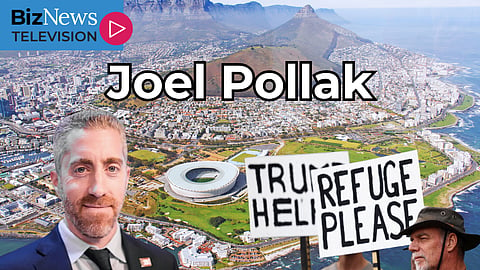
The man who narrowly lost out on becoming the US’s ambassador to South Africa provides a taste of the excitement he would have generated in this feisty interview. Joel Pollak offers an alternative view to the SA government criticism of the first 49 Afrikaner refugees who arrived in Washington yesterday. He also provides insight into how the Trump Administration views the issue in this discussion with BizNews editor Alec Hogg..Sign up for your early morning brew of the BizNews Insider to keep you up to speed with the content that matters. The newsletter will land in your inbox at 5:30am weekdays. Register here.Support South Africa’s bastion of independent journalism, offering balanced insights on investments, business, and the political economy, by joining BizNews Premium. Register here.If you prefer WhatsApp for updates, sign up to the BizNews channel here..Watch here:.Listen here:.BizNews Reporter.A symbolic landing in WashingtonWhen 49 Afrikaner families arrived in Washington and were greeted by senior US officials, it marked more than a diplomatic gesture. According to Joel Pollak, senior editor at Breitbart News, it was a powerful indictment of South Africa’s failure to protect its own citizens. “These are refugees,” Pollak insists, “not because they want green cards, but because they fear for their future.”A refuge from race-based hostility?The Trump administration’s embrace of Afrikaner asylum seekers has provoked outrage and skepticism back home. Critics say it’s a political stunt. But for Pollak, the symbolism is justified. “They’re fleeing expropriation, racial targeting, and indifference from their own government,” he says. “Even if some just want better lives - so what? That’s more than can be said for millions who enter the US every year.”“Kill the Boer”: Malema’s global megaphonePollak doesn’t mince words when discussing Julius Malema. “He is the best lobbyist for Afrikaner refugees,” he claims. “His speeches, his chants, his popularity - they terrify the outside world.” Malema’s presence, Pollak says, is no longer seen as fringe. “When crowds chant ‘Shoot the Boer’ and the courts refuse to act, it tells the world all it needs to know.”When democracy doesn’t deliverWhat of those who stay? Alec Hogg presses Pollak on whether emigration is the right path for political change. Pollak’s response is blunt: “If you vote every five years and nothing changes, is that democracy? Especially when your vote is drowned out by a majority who see you as an enemy?”He points to places like Mpumalanga and Limpopo, where Afrikaners are outnumbered and outvoted - and left voiceless. “Cape Town offers a glimpse of what’s possible. But for many outside the Western Cape, political hope is dead.”The Western Cape: South Africa’s last stand?In one of the interview’s most compelling arguments, Pollak makes the case for devolving power to the Western Cape. “When you land in Cape Town, it feels like a different country. Better governance, functional services, rule of law. That should be marketed to the world.”While he stops short of advocating outright secession, he urges the Western Cape to distance itself - administratively and reputationally - from the rest of South Africa. “Investors need to know they’re not backing a failed state if they invest in Cape Town.”Land reform, BEE and the exodus of talentPollak draws a direct line between race-based policy and South Africa’s brain drain. “You can’t run a modern country on resentment. When young white farmers are told they must give up land their families worked for generations, what future are you offering them?”He argues that BEE and expropriation have created a climate of hostility that pushes out not just Afrikaners, but skilled professionals of all races. “South Africa is exporting its future - one plane ticket at a time.”America’s quiet South African revolutionThe US, Pollak says, is benefiting quietly from South Africa’s failures. From Elon Musk to Patrick Soon-Shiong, South Africans are leaving behind dysfunction and thriving abroad. “Our greatest export isn’t gold - it’s people,” he says. “Talented, driven people who are unwelcome at home.”He adds that the Afrikaner arrivals are merely the start. “They won’t be the last. And Washington knows that.”The cost of ignoring warning signsIn his most chilling remarks, Pollak compares South Africa’s political trajectory to Rwanda’s in the early 1990s. “Julius Malema is a genocidaire in the making. We’ve seen this before - hate speech, crowds cheering, no consequences. The world ignored it then. Will it do so again?”Pollak warns that unless the international community takes a firmer stance, future generations will ask why no one intervened.Between loyalty and survivalPollak acknowledges those who remain behind to build a better South Africa - but says they shouldn’t be judged for leaving either. “Not everyone has time to wait for reform. Some have children to feed. Some just want safety.”His final thought? “South Africa needs to decide: is it willing to lose its people just to hold onto its ideology? Because the world is watching. And now, finally, it’s listening.”