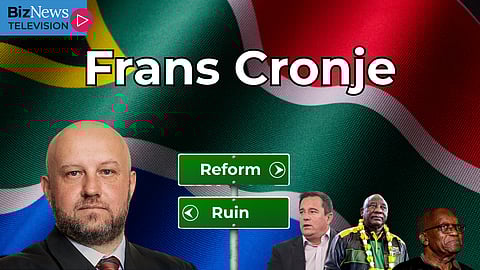
In this powerful assessment of SA’s recent political drama, SRF chairman Dr Frans Cronjé suggests we’ve witnessed a historic watershed where “nice guy” politics finally bit the dust. By succeeding through employing previously absent ruthlessness, he says the Democratic Alliance is sure to enjoy the sensation and likely to adopt a far more aggressive approach in future. That could be exactly what SA needs to reverse destructive economic policy and start turning around a sinking economic ship. He spoke to BizNews editor Alec Hogg..Sign up for your early morning brew of the BizNews Insider to keep you up to speed with the content that matters. The newsletter will land in your inbox at 5:30am weekdays. Register here.Support South Africa’s bastion of independent journalism, offering balanced insights on investments, business, and the political economy, by joining BizNews Premium. Register here.If you prefer WhatsApp for updates, sign up to the BizNews channel here. .Watch here.Listen here.BizNews Reporter.The ANC is bleeding. The DA is emboldened. And if South Africa’s coalition government doesn’t deliver real economic reform—and fast—it may collapse under the weight of its own contradictions. That’s the stark warning from political and economic analyst Dr. Frans Cronje in a frank and far-reaching conversation with BizNews editor Alec Hogg.The starting point was the ANC’s stunning defeat in a rural KwaZulu-Natal by-election, where it came a distant third behind Jacob Zuma’s MK Party and the IFP. It was a safe seat, now lost, and to Cronje it signals far more than a local upset.“If you don’t create jobs, if you don’t have any growth and investment, then yeah—expect that your support is going to fall away faster and faster,” Cronje said.He noted the traditional ANC support base has eroded simply because material conditions haven’t improved. “Through Mandela and Mbeki, we added 500,000 net new jobs per year. Under Ramaphosa, it’s under 100,000. The people know it—and they’re voting accordingly.”GNU: A fragile triumph over doomsdayFormed to avoid what the DA dubbed a “Doomsday Coalition” with the EFF and MK, the Government of National Unity (GNU) initially inspired hope. At its 100-day mark, it enjoyed 58% approval. But by 200 days, that number had dropped to 48%.That decline, said Cronje, reflects a deeper truth: “Simply avoiding the worst is not enough. If the GNU doesn’t restore growth, it will collapse—taking the ANC and possibly the country with it.”He emphasized that restoring growth requires more than slogans. South Africa’s fixed investment sits at just 15% of GDP. It needs to rise to at least 25% to support growth of 4-5%—which in turn would generate the 500,000 jobs per year needed to stabilize the nation.But that won’t happen unless investor confidence improves—and quickly..Read more:.Corné Mulder: GNU must unite or fail — as Trump-era US eyes ANC’s foreign blunders.The DA’s trojan horse momentThe DA, long seen as junior partner in the GNU, has found its moment of steel.Recently, the party successfully forced the ANC into an embarrassing climbdown on a proposed VAT increase. The result wasn’t just economic—it was psychological. For the first time in decades, the ANC looked weak. The DA looked powerful.Cronje believes this power shift may be even more significant than the ANC’s electoral losses. “Early in the GNU, the DA acted like a guest in the ANC’s house. Not anymore. Now they’ve employed real power—and they’ll do it again.”In doing so, Cronje says, the DA may have taught itself how to win, and taught voters that the ANC can be beaten.ANC: A party too big to save itself?Why, then, can’t the ANC fix the mess? Cronje argues it’s not a lack of understanding—but a structural problem.“The ANC’s National Executive Committee is like a board of 100 people who don’t like each other. Even if they all wanted the same thing—which they don’t—they still couldn’t agree. And the president? He’s a consensus-seeker in a situation that calls for cold-blooded leadership.”What South Africa needs, Cronje says, isn’t a "cupcake president," as Neil de Beer quipped, but a ruthless reformer—a Deng Xiaoping, a Lee Kuan Yew, or at least someone who refuses to split the difference on every decision.If such a leader doesn’t emerge, he warns, we’ll either drift along in economic stagnation or—more dangerously—face a populist explosion driven by a youth unemployment rate over 70% in some demographics.What comes next: Realpolitik and the future of the GNUWith tensions rising inside the GNU, particularly after the VAT debacle, the risk of collapse grows. Cronje points out that if the DA exits the GNU, it would leave the ANC with a razor-thin majority and force it to rely on a handful of unpredictable smaller parties. That, in turn, could lead to a vote of no confidence in President Ramaphosa—a move that polls suggest even a significant chunk of ANC voters might support.More startling still, Cronje reveals a tectonic shift: Black South African opinion is now significantly diverging from ANC voter opinion—something that was nearly unthinkable a few years ago.Reform or RuinFrans Cronje is unrelenting: South Africa’s economic challenge is not rocket science. It's basic. “We’re not asking our finance ministry to win Nobel Prizes,” he says. “Just do what every emerging market does—create an environment in which people are willing to commit capital.”The ingredients for success are there: a young population, a decent infrastructure base, strong entrepreneurial potential. What’s missing, says Cronje, is courage—the will to act, to reform, to defy the comfort of consensus.And until that happens, South Africa remains on a knife’s edge—one bad election, one economic shock, or one populist surge away from disaster.