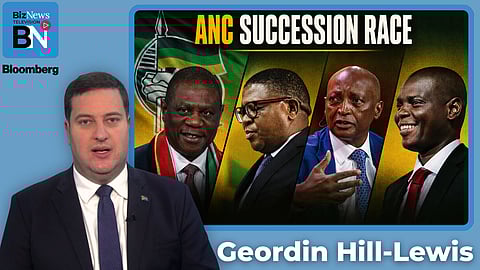
Newly-elected DA leader Geordin Hill-Lewis has warned that the ANC’s looming leadership battle could destabilise both South Africa and the Government of National Unity. In an interview with Bloomberg’s Joumanna Bercetche, he argues that bitter factional infighting inside the ruling party poses a major threat to reform, while also outlining the DA’s stance on Iran, fuel-price pressure and its plan to grow support ahead of the local elections.Sign up for your early morning brew of the BizNews Insider to keep you up to speed with the content that matters. The newsletter will land in your inbox at 5:30am weekdays. Register here.Support South Africa’s bastion of independent journalism, offering balanced insights on investments, business, and the political economy, by joining BizNews Premium. Register here.If you prefer WhatsApp for updates, sign up to the BizNews channel here..Watch here.Listen here.Edited transcript of the interview.00:00 – Joumanna BercetcheI want to start off by asking you about the biggest global development that has really been at the forefront of people’s minds, at the forefront of the news over the last six weeks, and that is the ongoing war in Iran. Now, South Africa has traditionally had a long-standing relationship with Iran. How does the DA position itself on this specific war?00:30 – Geordin Hill-LewisWell, firstly, thank you very much for those words of congratulations, and it’s good to join you. But let me say two things can be true at the same time. Firstly, the ANC’s relationship with Iran is ill-considered and indefensible, and they should not be close to Iran at all.00:54 – Geordin Hill-LewisAnd I wouldn’t say that it is true that South Africa has a close relationship with Iran. I would say that it’s true that the ANC has a close relationship with Iran. The ANC is no longer the government of South Africa. It is still the largest party in South Africa, but it is now part of a coalition government of national unity. That government has not yet had the space or the right to properly discuss and debate foreign policy.01:24 – Geordin Hill-LewisAnd the ANC has continued to operate as though it is basically in charge alone and can determine foreign policy on its own. Of course, that’s not the case. It is now a proper partnership government, or it should be a proper partnership government: a two-way street that has to be give and take, and we would like to properly and thoroughly debate the wisdom of that relationship, or lack thereof. That is the first thing that is true.01:54 – Geordin Hill-LewisIt is also true, though, that this war is not achieving anything meaningful or helpful for the world, while putting a great deal in peril and imperilling the global economy, causing terrible energy price rises, again jumping significantly today, and really isn’t achieving much and is of dubious justification.02:23 – Geordin Hill-LewisBoth of those things are true, and we hope that the war draws to a very speedy conclusion.02:33 – Joumanna BercetcheAnd you talk about the energy crunch that is to come and that we’re already witnessing in various energy markets, South Africa being a key oil importer here. Should the government be doing more, or pre-empting the hit that consumers are going to take from the eventual rise, and continued rise, in energy costs?02:58 – Geordin Hill-LewisWe’ve already seen it here in South Africa. We’ve seen some heavy increases at the pump for petrol and diesel prices. And that’s causing knock-on effects, obviously, in food prices and has inflationary effects across the economy just at a time where, for the first time in a number of years, we’ve got inflation down to where it should be.03:21 – Geordin Hill-LewisSo it’s come at exactly the worst time. It’s also just at a time when this new coalition government I spoke about earlier is starting to drive the economic reforms necessary to actually see the green shoots of growth back in this economy, which has really not grown meaningfully at all for many, many years. So it comes at the worst possible time. Now, the government has actually taken action. In fact, the party I now lead, the Democratic Alliance, insisted, or proposed, that the government temporarily cut fuel taxes, and they did in fact do that. So there has been a temporary slashing of fuel taxes and that’s brought some ease at the petrol pumps for consumers, but not a lot. We’ve still had a significant increase owing to those import prices.04:15 – Geordin Hill-LewisSo that’s why, and the state has got no fiscal room to do more. We can’t ease those fuel taxes any further. So really our firepower to try and shield consumers is already used up, it’s already spent. So it just underscores the need to draw the conflict to a close as soon as possible so that we can get a return to some normalcy in energy prices.04:46 – Joumanna BercetcheBefore we move on and talk about domestic politics, I also just want to draw on your expertise, being Mayor of Cape Town before you took on this new role. The closure of the strait has been, again, a huge development with a huge amount of repercussions on some of those markets that we were just referencing. And I wonder whether, from South Africa’s perspective, it has actually presented a maritime opportunity, and whether you are detecting higher levels of activity of ships docking, refuelling around the port. What is your sense of whether this actually creates an opportunity for a country like South Africa?05:29 – Geordin Hill-LewisYes, that’s actually true. You are right. Looking out at Table Bay, which is our harbour in Cape Town in South Africa, last week, I can’t remember when last I saw so many ships parked in the bay waiting to dock at Cape Town Harbour. So it is definitely the case that one of the kind of strange offshoots of this conflict is actually that it is, as you described, I think perfectly, a maritime opportunity for a port city like Cape Town. And I hope that we are maximising that opportunity right now. And I have no doubt that our shipping companies and ship supply companies and repair companies and so on are doing exactly that.06:19 – Geordin Hill-LewisBut let me say, obviously we must take every opportunity that we can get in a society with very high unemployment. But still, the cost to the wider national economy of a massive fuel price crunch is far greater than the opportunity for Cape Town from the greatly increased maritime traffic.06:43 – Geordin Hill-LewisSo I still think, while we must convert those opportunities, we still want to see this conflict over as soon as we can.06:52 – Joumanna BercetcheWell, you’ve made it clear that the DA are in favour of staying in the grand coalition. And let me just ask you: in your opening response, you highlighted some differences that you have with the ANC, especially vis-à-vis the relationship with Iran. But I wonder whether, from your perspective, it is preferable to remain in a multi-party coalition as opposed to a one-on-one tie-up with the ANC.07:26 – Geordin Hill-LewisLook, we don’t have a strong preference either way. The multi-party coalition is purely a fig leaf, really, to provide the ANC political cover on its left flank so that it can’t be accused of doing business only with us. So we must just cut through the noise and say exactly what it is. That is what it is. It’s just political cover. But essentially, the two parties that make up the huge majority in this grand coalition are the ANC and my party, the Democratic Alliance. The rest really are there just to provide cover.07:54 – Geordin Hill-LewisBut the key thing is that, yes, I am a supporter of it. I am a supporter of remaining in it because the alternative, just to give international viewers some context, is two radical left-wing parties that would, in our view, in our estimation, be incredibly destructive for South Africa’s future and for our national economy. And so, while the ANC and ourselves, there’s no love lost between the ANC and ourselves, we are implacable opponents, we do agree on this one thing, and that is a very important thing, and that is that the alternative is much, much worse for South Africa.08:49 – Geordin Hill-LewisSo in that spirit, we must try to make it work so that we can try to get those green shoots of growth in this economy to grow a bit stronger and provide the growth that has been so absent from the South African economy for so long under years of bad policy under the ANC government.09:11 – Joumanna BercetcheAre you going to push for the DA to get a larger share of Cabinet posts? Initially the push was to get 10 to 12 seats and in fact you ended up with half a dozen. Is there going to be a rethinking on that front?09:28 – Geordin Hill-LewisI very much doubt that there’s any renegotiation of the original coalition agreement that is on the table now. We’ll have to get through to the next election. We have a local government election in November this year, but even though that’s not a national government election, it will be a key testing time, or testing point, for the government of national unity.09:54 – Geordin Hill-LewisAnd if — there’s a lot of water to pass under the bridge — but the political polling looks very, very good for my party, for the DA, and looks very bad for the ANC in most of the major cities in South Africa, that’s a good thing for our country. But it also could provide an opportunity to rejig and shake up the GNU at that point. Otherwise, it will probably retain its current formulation through to the next national election.10:24 – Joumanna BercetcheAnd looking ahead to those municipal elections, as you just flagged, what are the DA going to do to ensure that they get a higher proportion of the votes from the black electorate in those elections?10:40 – Geordin Hill-LewisWell, there’s a fascinating thing happening in South African politics. Again, for international viewers who may not follow our politics closely, it really is such an incredibly fascinating time in South Africa because the old, very stuck racial silos of our politics are starting to break down. And the reason for that is mainly because so many things are not working. So many things are unfortunately mired in dysfunction, particularly at a city level.11:06 – Geordin Hill-LewisThe city I’m speaking to you from now, the wonderful city of Johannesburg, is in a really parlous state of deterioration and it must be rebuilt. It is the most important city in the whole of the African continent. It must be rebuilt. It must be fixed. And more and more voters, from every community across the racial spectrum, are saying: actually, what’s most important in South Africa is that we start to build a country that works, that we start to repair these institutions, that we start to rebuild these cities, that we end the wide-scale corruption that has been at the root cause of crippling these places.11:35 – Geordin Hill-LewisAnd so people are focused more and more on who’s going to get the job done, who’s going to make these things work, and less and less on race. Now, of course, this is South Africa. Given our past, it’s certainly not irrelevant, but it is becoming less and less relevant by the day, and I think we must take heart from that.12:15 – Joumanna BercetcheWe had the appointment of yourself as leader of the Democratic Alliance. And I think one of the other questions people have is: what happens next year when there will be a new leader appointed for the ANC? Do you foresee any troubles to the coalition with a new potentially incoming leader?12:38 – Geordin Hill-LewisIt is a moment of profound risk, let me put it like that. It’s impossible to look into the crystal ball and say what the ANC’s internal factions will do. That party is fraught with, riven with, division and is driven really by money politics. That’s the kind of motive force of politics and power inside the ANC: money and access to state resources. And so the fights will be incredibly bitter.13:05 – Geordin Hill-LewisAnd we will have to reassess what it means for the coalition government and for the country thereafter. It’s very hard for us to predict, but we sincerely hope — let’s put it this way — we sincerely hope that there emerges a leadership that is able to see the bigger picture of what is right for South Africa and that is able to put the best interests of South Africa ahead of the very powerful monied crony interests that now run that party.13:43 – Joumanna BercetcheAnd in your speech yesterday, you talk about your ambition to make the DA the largest political party in South Africa. How are you going to achieve that? And what exactly are you going to do that will resonate with voters that hasn’t been done before?14:03 – Geordin Hill-LewisWell, it links to my earlier point around the politics of competence and the politics of getting a country that actually works and moves forward. Because I think many South Africans, a growing majority of South Africans, are just sick and tired of seeing every basic service, every state function, every state department eroded and dilapidated through corruption and mismanagement. And so the tide really is turning.14:30 – Geordin Hill-LewisAnd so I think that’s the first big opportunity. The second big opportunity for us is really to be much more present in communities where we have not garnered a huge amount of support in the past. We do at least have a small amount of support. We have a small base to grow from there. But to be much more present there, to be much more active and champion the issues that voters care about, particularly here in this city, as I said, South Africa’s largest city, Johannesburg.14:59 – Geordin Hill-LewisAnd to win them to our cause. Now, that’s not going to happen overnight. They won’t all vote for us immediately. But that’s not the point. The point is steady growth in the right direction. And I think we can do that.