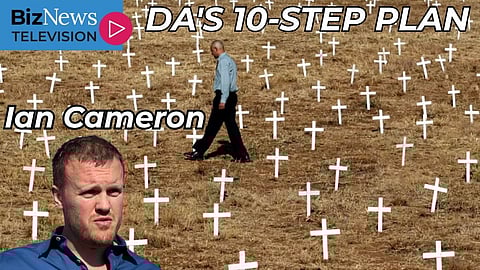
The Democratic Alliance (DA) has drawn up a 10-point plan to deal with farm attacks. In this interview with BizNews, Ian Cameron, the DA spokesperson on Police, says the plan will be submitted to the Minister of Police “and there's a lot of engagement ahead of us regarding rural safety”. The plan includes the establishment of a specialised Rural Safety Unit within SAPS; the strengthening of rural crime intelligence; fixing the criminal justice system with prosecution-led investigations; treating farm murders as targeted, premeditated crimes; declaring farm attacks and stock theft as priority crimes; institutionalising partnerships with local stakeholders; equipping SAPS with forensic tools and skilled investigators; rebuilding trust between police and rural communities; supporting emerging farmers; and opposing Expropriation Without Compensation. “I think what's really positive is the fact that Parliament officially recognises that we've got a problem in rural safety and we shouldn't get distracted by definitions of just what kind or just who specifically always is influenced. The point is, farm attacks have been recognised. Farm murders are recognised. We have a crisis, we need to address it and it's got a significant influence on sustainability in the country.”.Sign up for your early morning brew of the BizNews Insider to keep you up to speed with the content that matters. The newsletter will land in your inbox at 5:30am weekdays. Register here.Support South Africa’s bastion of independent journalism, offering balanced insights on investments, business, and the political economy, by joining BizNews Premium. Register here.If you prefer WhatsApp for updates, sign up to the BizNews channel here.The auditorium doors will open for BNIC#2 on 10 September 2025 in Hermanus. For more information and tickets, click here..Watch here:.Listen here:.Edited transcript of the interview.Chris Steyn (00:02.104)What will it take to restore law and order to South Africa's rural areas? We speak to Ian Cameron, the Democratic Alliance spokesperson on Police. Welcome, Ian. Ian Cameron (00:14.835)Thank you Chris, it's good to be with you again. Chris Steyn (00:18.638)Ian, your party has a 10-point plan to deal with farm attacks. Please take us through those points. Ian Cameron (00:26.989)Yeah, so firstly, just as context, the 10-point plan really is a holistic way of looking at a more integrated approach to tackle the whole rural safety issue and more specifically, farm attacks. Now, why we've once again released this plan is because just over the last month or so, and you and I have spoken about it, there was a joint adoption of a report between the Agriculture Committee and the Police Portfolio Committee regarding rural safety and farm attacks. And obviously, no one can deny the fact that we've got a problem with rural safety and certainly can't deny the fact that we've got an issue with farm attacks. Before I touch on the 10-point plan, it's also important to mention that farm attacks be acknowledged as being disproportionately violent to a lot of other crime and that if someone in a rural community, especially when it comes to a worker on a farm or a farmer himself or herself for that matter, is killed in such a brutal way, then very often it takes very, very long for that same place to be economically active again. So it sounds very insensitive of so directly just going to the economics of it, but we need to understand the ripple effect of it is major. So the DA specifically continues to call for a more specialised approach with regards to farm attacks. You can't use an urban policing model or a model that would work with regards to fighting abalone poaching or infrastructure theft and do the same thing with rural safety. So you need a specialised component. And that's the first point of the 10-point plan to say that you have dedicated detectives that can specifically zoom in on farm attacks. You've got dedicated intelligence services that can specifically zoom in on verifying and processing and operationalising intelligence and information in rural areas and that we really start building a, I want to call it, a prosecution-led investigation model where we can zoom in on whether it's syndicates or gangs or whatever the grouping or individual is targeting a specific rural area. Remember that we very often see a mix that you might have farm attackers that are also involved in, for example, stock theft. And stock theft is a heavily syndicated… Ian Cameron (02:50.622)…operation and therefore we need a specialised approach. That includes the second point, the strengthened rural intelligence service, and then the criminal justice system broadly speaking is the integration between the prosecution and the investigation. You know, it sometimes feels like detectives in the South African Police Service - and sometimes rightly so - always blame the NPA but then sometimes I speak to members of the NPA and they then blame detectives again and it's this to and fro of both which becomes quite frustrating so we need a better integration there. Furthermore we say that it should be considered priority crimes and that capacity should even be strengthened inside DPCI, the Hawks, to investigate these matters and combat them. And then something that I think is critical is to really institutionalise partnerships with stakeholders on the outside. So whether it's community safety structures, you know, farm watches, community policing forums, et cetera, but seeing what we can do to better empower those structures to do more. Police do not have the capacity to really combat crime effectively in the country. And it's gonna take a long time to get to that point. So we don't have a choice but to incorporate the private sector, incorporate community structures - and then obviously see what we can do to, for example, pull in municipal law enforcement, which can also play a huge role. And then the last three things, Chris, is to rebuild trust, to restore the trust deficit that's between the police and communities. The only way of doing that is what I've already mentioned, is to have an integrated approach where you actually have results. We don't see the same criminal back out on the street, once again out on bail or later on parole when you know that there's no way that the relevant person has been rehabilitated and once again commits the same offence. And the last two is supporting emerging farmers, making sure that you build a very, very strong network there. And there's a part of that as well that speaks to engaging traditional leadership and pulling them into the local rural safety model because they've got a significant amount of influence. Ian Cameron (05:07.712)And I think it's underestimated what a huge role they can play to pursue justice. And then to conclude is to oppose Expropriation Without Compensation. We need to completely, completely and I think in isolated way, that might be a whole discussion on its own, but it's the 10th point on the 10-point plan to say we need to combat, I almost want to call it a political crime to ensure you don't have other kinds of crimes in the area. Chris Steyn (05:33.39)Now Ian, what support do you have for this plan? Ian Cameron (05:38.144)So a lot of it has been noted in the joint report along with many other inputs or additions from other parties that are part of the Agricultural Portfolio Committee and the Police Portfolio Committee. It will obviously be submitted to the Minister of Police and there's a lot of engagement ahead of us regarding rural safety. I think what's really positive is the fact that Parliament officially recognises that we've got a problem in rural safety and we shouldn't get distracted by definitions of just what kind or just who specifically always is influenced. The point is, farm attacks have been recognised. Farm murders are recognised. We have a crisis, we need to address it and it's got a significant influence on sustainability in the country. We hope to see in the upcoming budget process that we would see an increase in resources pushed to rural safety capacity in rural areas. I am very concerned about the fact that we can push all the capacity we like…If we don't get rid of the rotten potatoes, it doesn't change the situation. So that is quite frustrating. But again, Rome wasn't built in a day and it's going to take time to clean up a structure that has been really badly damaged over quite some time. Chris Steyn (07:05.73)Thank you. That was Ian Cameron, the Democratic Alliance spokesperson on Police speaking to BizNews about his party's 10-point plan to deal with farm murders. Thank you very much, Ian. I'm Chris Steyn for BizNews. Ian Cameron (07:18.313)Thank you, Chris.