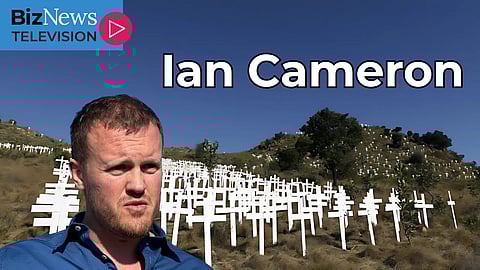
In his latest interview with BizNews, Ian Cameron, the Chairperson of Parliament's Portfolio Committee on Police, busts myths and misconceptions about farm attacks. He speaks about the role that illegal foreigners sometimes play in these attacks and gives a breakdown of which nationalities rank in which provinces. He also shares research done of the motives and modus operandi of farm attackers gleaned from interviews with dozens of convicted felons. “So it's simply not as simple as saying that it's one group versus another because it's more complex than that.” Cameron also dissects the latest quarterly crime statistics that show a 10% decrease in murder. He further gives an insight into the current priorities of the Portfolio Committee on Police, one being the return to work of certain cops after disciplinary processes. “Now we've discovered one in the Eastern Cape that, in his disciplinary, admitted to committing an armed robbery. He admitted that he committed an armed robbery and his sanction in the disciplinary was two months of unpaid suspension and he's back at work. It cannot be that that is the type of people, that those are the kinds of people that we allow back in the police.”.Sign up for your early morning brew of the BizNews Insider to keep you up to speed with the content that matters. The newsletter will land in your inbox at 5:30am weekdays. Register here.Support South Africa’s bastion of independent journalism, offering balanced insights on investments, business, and the political economy, by joining BizNews Premium. Register here.If you prefer WhatsApp for updates, sign up to the BizNews channel here.The auditorium doors will open for BNIC#2 on 10 September 2025 in Hermanus. For more information and tickets, click here..Watch here:.Listen here:.Edited transcript of the interview.Chris Steyn (00:01.654)The debate on farm murders has divided the nation and is making headlines across the world. We speak to Ian Cameron, the Chairperson of Parliament's Portfolio Committee on Police. Welcome, Ian. Ian Cameron (00:16.714)Thank you very much Chris, it's a critical discussion that we need to have. Chris Steyn (00:22.946)Please give us your perspective on farm murders. Ian Cameron (00:28.032)Sure, so first of all, I must start by saying that I think farm attacks and farm murders are oversimplified very often. It very often happens, and I read opinions where people say it's purely one thing, let's say political, or they say it's purely another, let's say robbery or robbery aggravating. And, you know, it's just simply not that simple. Farm attacks should be considered a very complex crime category. And there many reasons for that and I'm going to share that with you. Now as context, I worked with farm attacks for close to a decade. I think all in all, I somehow had contact either on the scene with the victims, suspects, et cetera, with close to 300 specific incidents, my team and I at that stage. So I've really, I've seen a very broad range of farm attacks, the cruelty, how those scenes compare to urban scenes, and I'm gonna share that with you as well. I think to start with, it's important to understand that South Africa has different kinds of demographic structures or demographic layouts across the country, which is logical in terms of cultural differences. But there's an important part that one must consider to start with, and that is the role that certain illegal foreigners might sometimes play. You know, if you look at attacks on the eastern side of the Free State, you would often see that they are people that come from Lesotho. If you look at parts of northern KZN, for example, they may be from Swaziland or eSwatini. You might in...I always use the example of Hartebeespoort or Brits, you'll very often see Mozambicans and Zimbabweans. In parts of Mpumalanga, you might only see Mozambicans. And then sometimes you've got groups that are a blend of a whole different bunch of people, whether they are from Namibia in the Western Cape, very, very often we see that suspects are from Namibia originally. Ian Cameron (02:47.509)And then you've got incidents, we use KZN and Gauteng as an example, in rural areas where the entire group is South African. So it's simply not as simple as saying that it's one group versus another because it's more complex than that. Very often over the years as well, one must consider that farm attacks, very often the attackers themselves might have links with other syndicated types of crime. Let's say stock theft for example. Stock theft has developed to a point in South Africa where it's become a really big syndicated type of crime. It's not just to feed so-called hunger. Sometimes the perception is created that, you know, sheep or cattle or whatever the type of stock might be is purely stolen because people go hungry. But it's not always the case. It is very often because of a syndicated, bigger type of operation that's operating in a specific area. Now, the research that I like to refer to is the research done by Professor Rudolph Zinn. In my opinion, probably the person that has done the most direct research with regards to farm attacks in South Africa. He has spent significant time interviewing the actual convicts, the convicted felons that are now in correctional centres about why and how, what was the motive behind the attack. And Zinn went and he interviewed tens, if not close to a hundred of these, of these, felons and spoke with them about why they did it. It's very interesting. He spoke to them about the modus operandi as well. Now, a few things stood out. The one was that they look at victims that are supposedly weaker than your general kind of person in the public. So they usually look for older victims. They look for maybe a woman that lives on a farm alone or maybe with children, but they go and look who a victim might be that is more vulnerable, generally more vulnerable. The perception that Zinn came to or Zinn discovered when questioning these felons was also that there's a perception that they think that farmers in South Africa all have large amounts of cash, one, and two large amounts of firearms. Now, along with that, there's a perception, and it's very often a very accurate one, that help… Ian Cameron (05:14.032)…is a long way away. In other words, it's an isolated type of incident, not isolated in the sense that it doesn't happen often. It's isolated in the sense that you're far away from help. They know that police, neighbours, et cetera, would take a very long time to get there. And then two, it happened quite regularly that there's some form of internal information that they receive. Not necessarily always an inside job as such, but that people are threatened over a long period of time. They would go to a tavern for example, local tavern, they would drink there, people would ask them about the farm that they work at and so these attackers would gather information. Another part that was very interesting was that the attackers would actually sometimes go and store the weapons or whatever tools they might use during the attack weeks already before the actual attack. They would go and hide it, they would dig holes, you know, close it up in a hole and hide it on the farm for when they are going to go and commit the crime. And then another interesting part is that they would actually do reconnaissance sometimes for up to weeks ahead of the attack to plan how they were going to do this. Obviously there's a risk if they think there are firearms, they might know or think that those firearms could be used on them. So they need to plan properly. So that's the practical summary of how the attacks generally happen, how they look. But then there's a critical part with regards to the disproportionate force that is often seen in farm attacks. Now people can say whatever they want, they can debate genocide or not genocide, we can get to that still. To me, the critical point is that disproportionate force and violence is often seen in farm attacks, where you would have an urban robbery that would last five to 15 minutes. I have personally visited a farm attack scene where an attack and the torture lasted up to 11 hours where victims, and I always use the example, it was extremely disturbing, where his nail marks were stuck in the carpets from how they dragged him through the house, torturing him over and over and throughout an entire night to get access to whatever they thought he had. Now, there are many examples of that, but there's definitely a disproportionate force. Now, what I came across over the years… Ian Cameron (07:39.539)…that some victims had told me, some of them would understand whatever the language was that the suspects would be using and very often the suspects would actually start quarreling amongst each other while they are doing the attack. So one would say, boil the water, we want more, you know, we want to get cash or weapons or whatever it might be. The other would say, we're not here for that, we're not going to torture people. And they would quarrel and bicker amongst each other and then very often it leads to that point. Other times, of course, it starts like that immediately. In parts of the Western Cape, as an example, we don't often see torture happening, although it has definitely happened. It's not necessarily the same way that we see in other provinces. And so the dynamics change. During my time working with it, less than 20% of incidents included torture. And still to this day, those that did include torture was was something out of hell. A very famous story at that time, years ago, was the story of Nicci Simpson. Nicci was attacked, she lived on a small holding just outside Fochville, just outside Johannesburg, close to the North-West border. And Nicci lived on her own, she's not very well off, never, well, in long time wasn't, and still isn’t, and they used an electric drill to drill through her knees and her feet. And they really, really hurt her. And when you would speak to Nicci afterwards, I visited her several times. Her neighbours were also attacked, the man having been murdered in the dairy on the farm. And when you spoke with them, you could feel the immense trauma and the pain that they had experienced. So it is something, it's absolutely horrific. So no one can take away from the brutality that we very often see. Now, then we get to the next part, where a lot of people want to constantly compare farm attacks to other types of violent crime. And I understand why people do that, because people always want a variable for them to be able to say, but is it worse than this, or is it at that level or not? Now, my approach differs. I... Ian Cameron (10:05.519)…don’t think you can just compare it to for example gang violence because the entire dynamic is different. This past weekend, and I know we're still going to talk about that, 26 or 27 people were murdered in the Cape Flats, just in a space of 48 hours. That's a war zone rate. I'm not aware of any farm murders over this past weekend. Forgive me if I missed something, but I'm not aware of that. But it would be unfair from both the issues to try and compare them as though one life is worth more than another. But there's something very unique when it comes to a farm attack that must be remembered. That when a farmer or a farm worker or someone on that farm is killed, there's a very good chance, especially when it's amongst farm workers and farmers, that someone won't eat in that very week again. The ripple effect of it on not only your, I almost want to call it your family economy, and on that farm economy and then your rural economy is significant. Compared to if you or I get murdered today, which is horrific and it's sad and it's traumatising to think about, chances are the world's just gonna continue tomorrow, but it doesn't have necessarily a ripple effect on everyone else around us, in such a significant way at least immediately. So those are just a few thoughts. In terms of the demographics of victims affected, it is certainly not just one demographic that's affected. The perception is often created that it's just one group that faces torture. I also do not agree with that. In the majority of cases, it must be highlighted that the cases that I had exposure to, and this is just purely my personal opinion, was that most of the victims that were tortured were white on those farms. But I have a significant problem that now we're forcing this thing because of what happened last week in the US. Now it's becoming a race debate and I think we're missing the ball. I think it is of tremendous importance that we do not start rating the value of humans based on their skin colour and that we're not busy with the debate on classification instead of focusing on this specific matter becoming a priority crime and understanding… Ian Cameron (12:27.63)…what a major, major negative impact it has on rural communities. And I'm not talking about Big Agri, you know, the massive companies and so on. I'm talking about, I love how outside, the Southern African Agri Initiative always speak about it. They speak about family farmers, what impact it has on the family farming community. That's where we should be focusing. The last two parts, Chris, about what makes a farm attack unique apart from the disproportionate violence is one, it's the only one, the only violent crime in South Africa that is politically encouraged, where certain people, and you know who I'm talking about, can continue to sing songs that encourage killing. They can sugarcoat it all they like. It is hate speech, and it is incitement of violence. And whoever doesn't see that, including some of our courts, I'm extremely concerned about the compass used to determine that it is just purely freedom of speech. It cannot be that in a democratic country where we're aiming for a democratic, sustainable future that that is allowed. So that's the first part. The last one then is the fact that it's often encouraged or cheered on on social media. Very often you would read on social media about a farm attack or a farm murder and it'd be something horrific. And then you read the comments and you see how people laugh about it, how people say, well done, and they encourage these horrific horrific things. What saddens me sometimes is that often before I never ever and I have never mentioned race when telling or sharing information about a farm attack. The assumption is very often made that because I said it's a farm attack that it's a white victim and then it gets cheered on until I and they would specifically say you white this and that. As soon as I say but hang on it wasn't a white person, then suddenly it goes quiet. There's this awkward silence. And it shouldn't be that way. It is absolutely tragic that anyone should be faced with this type of violence..Read more:.BN Briefing: Chief Rabbi on "cursed" Ramaphosa; Hekpoort squatter crisis; Trump's corporate backlash.Chris Steyn (14:37.362)Thank you for the fascinating insight, Ian. There are so many myths and misconceptions. Thank you for clarifying many of those. Tell me, what do the latest crime statistics tell us? Ian Cameron (14:54.083)Yeah, so generally speaking, Chris, it's a better picture, just purely from a numerical perspective. There is a decrease in murder. You can see over a 10% decrease from the quarter statistics that were released. But still, in the fourth quarter of 2024-25, which is January to March of this year, we have seen about just over 5,700 murders. It equates to, if I'm not mistaken, about 62 murders per day. Now if you compare it to previous years where we often had up to 80 murders per day, per quarter, it's good to have a decrease. So I think it's important to give a certain credit to that. I already saw people saying, yeah, but the statistics lie and they're false and so on and so forth. And I know there are some of the statistics that could be questioned in terms of whether they are manipulated on station level and I'll speak to that now. But in terms of murder specifically, generally speaking, murder is a pretty accurately reported crime. It is probably the most accurately reported crime, and therefore it is probably our best indicator of where we are at regarding crime in general, and obviously specifically violent crime. The bad indicators would look at something like rape, where we look at close to 40,000 rapes in the same time period and if you look at the statistics I'm convinced - and we've seen studies before - that probably only two or three out of ten rapes are actually reported. So it's a very difficult crime to police and therefore rape would not be considered an accurate statistic to indicate where we are at with crime. Obviously it’s a difficult thing to indicate where we are at. It's important to add some kind of numerical value to it. But sexual offenses in general are not accurate indicators. The indicators that show decrease on almost all the major crime categories would include robbery, aggravated circumstances, assault with the intent to commit grievous bodily harm. Ian Cameron (17:14.542)So most of the contact crimes showed some kind of decrease. What was very interesting, significant decrease in parts of the Western Cape, specifically around areas in City of Cape Town, where the city of Cape Town Metro Police and to a certain extent from the Western Cape Government pushed in the law enforcement advancement programme members. The problem is though that that's mainly visible policing. And this is where we can talk about that now too, but this is where the challenge comes in that they can only prelease up to a certain point and then they need to hand the case over to SAPS and SAPS to the MPA. And unfortunately, that's where many of the cases will come off. Chris Steyn (18:02.702)Now you mentioned almost 30 people killed the past weekend on the Cape Flats. Like you said, it is a war zone. Ian Cameron (18:12.747)Yeah, so I mean last night again in West Bank I'm aware of one incident where four children were shot, one of them dead. I'm not sure what happened this morning regarding those four children exactly and what their status is, but you can't keep up with the numbers. Now, you know, it becomes very frustrating because when we look at, for example, the Anti-Gang Unit. You know, we did oversight at the Anti-Gang Unit with very stringent recommendations quite a few months ago. And up until today, the only thing that they fixed is they painted one of the buildings and they filled a few potholes in the parking area. Vehicles weren't fixed, the members weren't sent for additional training, and the list goes on. It comes to the point where tomorrow during the Portfolio Committee when we work through these statistics, we're going to have to ask some difficult questions as to what is the point of oversight when the police simply do not listen. Now often the answer is they can't get to all the requests and questions, but I beg to differ. And we need to start clarifying that they have got a certain responsibility to fulfill the recommendations that come from, for example, the Portfolio Committee of Parliament, broadly speaking. Yeah, so it becomes frustrating because we also saw a message yesterday that was doing the round that was leaked from SAPS where they are now going to start pulling people or members, police members from stations in and around the Metro to go and work in the Cape Flats with a focus on gangs. Now, obviously we want people to combat gangs, but you're robbing Peter to pay Paul. The questions I would have for them is have you spoken to the South African Revenue Service to start targeting specific kingpins? Have you confirmed the integrated strategy with the NPA and with Home Affairs? And I can go through the entire list. And I know what the answer is. It's simply no, because there's this siloed kind of approach. And we're stuck with the mentality of sending large groups of uniformed police members into these areas. Ian Cameron (20:27.764)And then we do high frequency, low-level arrests instead of zooming in on the kingpins, using two things, two critical things. There's prosecution-led investigation, where the prosecutor plays a role from the beginning to the end. And we go and look at intelligence-led policing. That generally speaking, we don't aimlessly drive around and hope that we're going to catch someone, but that we literally allocate our resources according to the intelligence that we've gathered with the relevant people on ground level. Chris Steyn (20:57.902)Meanwhile, what other pressing matters will the committee be focusing on in the coming days, Ian Cameron (21:06.773)So there quite a few things. Obviously the Crime Stats are one of the key focus points at the moment, but just some things that have come up over the last few weeks. You and I spoke about the private security regulations. Now, very interesting, not too long ago, you'd remember that quite a prominent so-called businesswoman was arrested in Johannesburg during a raid by the South African Revenue Service. And during that raid, they also seized a whole lot of assault rifles and other firearms that belonged to a known taxi boss's security company. But yesterday I received information, it was in the media already, I was just a little bit too slow to notice it, but I received information that that security company is still continuing to function the way that it did. And when I questioned PSiRA about this, they responded and said, there's no wrongdoing, the person was just renting space from that property, or the business was just renting space from the property owner. Now, something very, very wrong there. They are wanting to push and force more regulations down the throat of the good guys in the industry, but the bad ones can continue like this despite being in direct contravention of not only their own regulations, but also that of the Firearms Control Act. You know, there are so many pieces of legislation that this does not add up with. So that's one of the things we will have to zoom in on and follow up on. We also have started questioning quite a few incidents where after disciplinary processes, as you saw with the VIP 8, cops are still allowed to go back and work. Now we've discovered one in the Eastern Cape that in his disciplinary, admitted to committing an armed robbery. He admitted that he committed an armed robbery and his sanction in the disciplinary was two months of unpaid suspension and he's back at work. It cannot be that that is the type of people, that those are the kinds of people that we allow back in the police. And again, we see some of the unions playing a key role in ensuring that these criminals come back into the police. Now, you would remember how angry some of the unions were when I called the VIP 8 thugs. You also had very creative descriptions for them. And it… Ian Cameron (23:33.523)…really is critical for us to clean that out. So it's going to be interesting to see the reaction. I must be honest, it is frustrating at the moment with some of the SAPS matters because it really seems like it is extremely slow. The positive part is that they have announced that they are really positive projects in the pipeline to come with forensic labs. And I am quite convinced that the General, specifically the Divisional Commissioner of Detective Services and Forensics that has been appointed to spirit this initiative is able to do the job. So I'm excited about that. It really is positive. And if this project with the CSI does roll out properly and hopefully there's more collaboration with universities as well, we should not have DNA backlogs and other types of forensic issues as prominently as we've had in the recent past. And then the last one, Chris, is questioning when we will see the SAPS Amendment Bill come forward. You know, the SAPS Amendment Bill is something that's been talked about since I think 2002 or 2003. Still not done. And it's something that we must get under eye because we, one, need to start questioning and amending parts of the disciplinary process. There are links to be made there. And then also the use of force. I think we need clarity on that. And also, and that's not just for the sake of civilians, it's for the sake of the police as well. Because cops sometimes get punished for doing their jobs and they do their jobs well sometimes and then they receive unfair sanction or punishment. Chris Steyn (25:19.266)Thank you. That was Ian Cameron, the Chair of Parliament's Portfolio Committee on Police, speaking to BizNews. I'm Chris Steyn. Thank you, Ian. Ian Cameron (25:30.291)Thanks Chris.