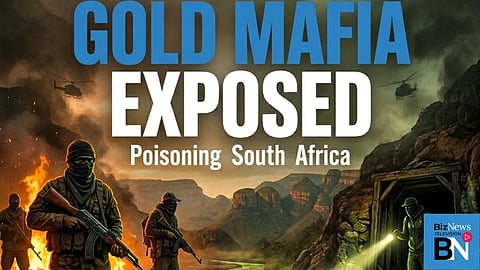
Heavily armed illegal mining syndicates are no longer just a problem for abandoned shafts and remote communities. In this interview, De Wet du Toit of the Blyde River Task Force tells BizNews how zama-zama operations linked to foreign criminal networks are threatening South Africa’s water systems, tourism economy and wildlife heartland, while residents, farmers and activists face growing danger on the ground..Sign up for your early morning brew of the BizNews Insider to keep you up to speed with the content that matters. The newsletter will land in your inbox every morning on weekdays. Register here.Support South Africa's bastion of independent journalism, offering balanced insights on investments, business, and the political economy, by joining BizNews Premium. Register here.If you prefer WhatsApp for updates, sign up to the BizNews channel here..Watch here.Listen here.Edited transcript of the interview.Alec Hogg 00:10:05 - 00:33:13Well, you've probably heard about Zama- Zamas and the way that they are illegally mining gold and then you get the outrage from certain parts of the media that they're getting stuck under mines, and we got to pull them out and look after them. That's probably about the upside of what are we going to discuss this morning. These Zama- Zamas 00:33:15 - 01:04:13Not just for guys who need to scrape together a living. They organised in certain areas syndicates heavily armed and ruining a big part of South Africa's future. A big part of South Africa's economic drive, which is think about the Kruger National Park or the Mpumalanga province in the east of South Africa. There is, however, a group of people who are standing up and trying to do something about it.01:04:15 - 01:24:19It's an extraordinary story, and we talked today to De wet du Toit, who's involved in what is called the Blyde River Task Force. He is, I suppose, talking to us under considerable threat to himself. But we need to get the story out.01:24:21 - 01:45:19De wet , thank you for joining us. When I read your email, it it stopped me in my tracks. Let's just go back a little. Everyone's heard of Zama-Zama. And as I mentioned in the introduction, it's, these poor guys, you know, they come from wherever, and they scratching a living by by it, by digging in old gold mines and so on.01:45:21 - 02:03:15But the people you're dealing with are not, worthy of any kind of sympathy. And perhaps you can just unpack for us who are these heavily armed illegal gold mining syndicates or and why they've targeted the Blyde River area.De wet du Toit 02:03:17 - 02:22:10Good morning, Alec. Thank you so much for having us. Yes. So the heavily armed enforcers in this industry, generally in South Africa, especially in this part of the world, is the Basotho people. They are from Lesotho.02:22:10 - 03:06:18And all these foreign groups have kind of entrenched themselves in, in this area. They are heavily armed. They use, small arms and sometimes, even up to RPGs. And, and they are the enforcers. So they are they are the, the criminal group that, that use this violence, to set down the, the rules and the laws or the Zama- Zamas and, before you are tempted to think that this is just another type of security or the informal mining, the brutality that these guys are capable of is03:06:20 - 03:34:00something that's that's kind of hard to, to get your mind around. Are you talking about mass killings? Mass burials. You must remember that within the illegal mining, you have generally have three groups. It's the it will be the Mozambicans, the Zimbabweans and the Sothos. And a lot of these guys, if not most of them, it's not 99% or undocumented.03:34:04 - 03:55:09is also why you see the the utilisation of poisons like, like cyanide and mercury, that's just completely unregulated and making its way into our water systems. I mean, we we are, in effect, talking about the complete water systems from source to ocean being poisoned.Alec Hogg 03:55:11 - 04:17:21It's an extraordinary story. And we know that mining is heavily regulated. Especially gold mining because of the points that you make. No, cyanide is was used, and the whole time is used to use cyanide. They didn't know any better. And, of course, the area that we're talking about here, Pilgrim's Rest, the Blyde River Canyon, gets down to Barberton.04:17:23 - 04:37:02That is the first area of gold discovery in South Africa. And it's it's a different type of gold mining to what's happening in the advertisement. So from what I'm understanding from you, these guys, who may have had some training in the mining industry being pursued, and it was a it was a lot of migrant labor that came from suit.04:37:02 - 04:54:09You in, in years gone by. They are now mining for the for who the who's who's who's organising all of this because you don't get a whole bunch of a militias protecting you. If you just popping along to try and scrape a little bit of gold out of the out of the rocks.De wet du Toit (04:54:11 - 05:05:14)Yeah. So, like, with any other type of syndication, you get different levels. That's responsible. So we're and it's quite a complex network.05:05:16 - 05:12:22And, so we're talking in terms of who runs the show and who calls the shorts05:12:22 - 05:46:09We talking about, up to very, very senior political level in LeSotho. We see some of these syndicate leaders posing with a senior, LeSotho politicians next to the helicopters. We know that there. And I have to be very careful with my words. I'm going to. I'm going to use "allegedly", but it's, it's quite often more than allegedly, but, you have senior officials in, in on our side, even within the police force.05:46:09 - 06:18:18I'm talking up to a general level. It's what we it's what, the evidence and the, the, the witness statements points towards. So, and then, of course, there there's everything from corrupt mines. They, there's corrupt mines that that assist in processing the gold. Because gold is very difficult to regulate. It's very difficult to say once it's been smelted and turned into jewellery.06:18:20 - 06:36:17It's very difficult to fingerprint and to ID back to the source. It's different to diamonds. Diamonds. You can easily you can easily ID gold. Not so much. And so the gold is washed through a network. Of course the the money is laundered as well.06:36:20 - 07:04:12So at the end of the day, I would say the BaSothos is that we talking about the enforcers who carry the small arms that are out in the wilderness in the middle of nowhere, occupying the hills around the processing facilities and on the processing facilities themselves. They they manage and run the shocks, the mining shafts. These guys are not on the top tier of of this, syndication.07:04:14 - 07:23:08They're closer towards the bottom, sort of the higher bottom end of that tier. But definitely they are the dangerous ones. These are these are the guys that are gonna take you out. They're all going to be the ones that are ultimately going to pull the trigger.Alec Hogg 07:23:08 - 07:53:17It's extraordinary story. Okay, so we've now got this crazy situation where almost like a foreign force is coming into South Africa, scraping out or mining gold illegally. We don't see anything of it in, as taxpayers. It's happening within very short distances of police stations. I come from the rural area myself. I know that in the rural area everybody knows everything.07:53:17 - 08:15:17So it's not like this is all. This is all a mystery. There's no question that those, members of the law enforcement in South Africa are aware of what's happening, but what are they doing about it? Are these, is there any defense because we can talk about your role in a moment, but is there any defense from the state apparatus?08:15:19 - 08:22:22Against this activity, which does appear to, as you've outlined it, appear to be pretty hectic.De wet du Toit 08:23:01 - 08:52:08So the short answer is not nearly enough. The the problem has mushroomed and, it's really spiraled kind of out of control in the last 3 to 5 years. There's been plenty of warnings. There's been media coverage by, entities, famous investigative journalism, entities like carte blanche, and so on. So it's not like this problem is, is unknown.08:52:10 - 08:59:19It it's been known for quite a while, and yet it's been left to spiral out of control.08:59:21 - 09:08:18To make it even worse, it is the fact that in many cases, the government is the owner of the land and the government is in control of the land.09:08:18 - 09:40:21So the government is, is, is guilty on 2 or 3 fronts, if not more. Very often in some of these areas that are very heavily, affected. For example, like you just mentioned, one of the first, big processing sites we uncovered in our own work and by the media was, and a cluster of processing sites within one kilometre of the four countries police station.09:40:23 - 10:16:15And they were they were largely left unchecked. And so now what you'll see is you'll see sporadic operations from the police, mostly. Mostly, caused by political pressure from upstairs. And, and we've been successful to some degree to also generate, a bit of pressure in the media. Now, you see these sporadic, police operations and they are largely window dressing, window dressing exercises, because...10:16:15 - 10:33:19what the syndicates will do once we generate media attention and there's a bit of a spotlight on the problem, they'll simply switch from day shift to night shift. So if you move through the day, it looks like, wow, look at, how the how much better the problem has gone.10:33:19 - 11:05:09But if you stay for the second 12 hours of the day, you'll see, oh my goodness, this is like in the words of some of the men, this looks like a shopping mall. And and it's off in the middle of nowhere, the amount of lights and torches moving around. Operating at nights. So the the reaction from government so far hasn't been anywhere close to what it needs to be in order to solve this problem.11:05:17 - 11:06:00And, they do not contribute, in terms of tax to our country.11:13:04 - 11:24:17They are taking potential jobs, from our local people. And they are risking we're talking about hundreds of thousands of jobs they're putting at risk downstream.11:24:17 - 11:39:09And so all these jobs, all this tax, is being put at risk by foreign syndicates who quite frankly, they they just don't care, what they're putting into this, this water, it's not their problem.11:39:09 - 11:43:14It's not their it's not their families. It's not their communities.Alec Hogg 11:43:15 - 11:48:04What brought you to this? To this story? Are you from the area?De wet Du Toit 11:48:06 - 12:01:22So I worked I worked at one point in big five, for a number of years. And that is how for the first time, I came across illegal gold mining.12:02:00 - 12:16:22And that that that was the first time that that I've started, dealing with illegal gold mining and, and I, I realized and I noticed just the brazenness of it, just, it's a relentless onslaught.12:17:00 - 12:41:16Now, if you look at the gold price and what the gold price has been doing, and you couple that with the desperation of, Mozambicans, Zimbabweans, rural, Mozambicans and the. And then you can clearly understand why you have this relentless on. And of course, the problem is the chemicals that these guys are using on the banks of the rivers in order to process the gold.12:41:16 - 12:46:04And if you put all those things together, you have a recipe for a disasterAlec Hogg 12:46:05 - 12:48:03So what is big five?De wet Du Toit 12:48:07 - 12:56:22Big five is your your, your your big, big five animals like lion that the and so on.Alec Hogg 12:57:00 - 13:02:11But you said. You said you worked on you worked at big five. What did you mean by that.13:02:13 - 13:03:22I thought it was a company. Maybe.De wet Du Toit 13:04:02 - 13:27:02You know, we worked I worked for the, for the oldest, anti-poaching company in the country. And I ran a paramilitary, training program that have really good training. And within that company, we worked on a lot of these Kruger, type sites with rhinos and elephants and these kind of things.Alec Hogg 13:27:02 - 13:58:04Okay. So anti-poaching, high adrenaline. You you then from from fighting. The poachers discovered this. Probably an even bigger problem, that's going on here in in the gold, in the illegal gold mining. But, De Wet, this Blyde River Task Force, tell us a little about it, because if the if the state is not doing what it needs to be doing, there are some people who would say, whoa, why you guys getting involved?13:58:04 - 14:16:22Is this not vigilantism? Are you are you not? Going into an area where Pretoria should be should be involved, even though we know Pretoria is a Pretoria doing anything, ever really been pretty well evidenced. Tell us about the the, the task force.De wet Du Toit 14:17:00 - 14:47:03Yeah. So, so right off the bat, So if I can rewind, we we we watched this problem expand and unfold for a number of years and we it became very clear. But despite all the compliance, despite all the scientific evidence, and no one was coming to fix this problem for us. And that's really how we started getting involved.14:47:03 - 15:12:12So we had a couple of challenges. One obviously was resources. We don't have the resources that other entities are going to have because we we need to ask for donations. We need to find ourselves this. So resources was always going to be a problem. So we had to decide on a strategy with regards to how we were going to address this issue.15:12:12 - 15:22:03And, and so we, we are paramilitary trained. A lot of the work we do is kind of reconnaissance based stuff. 15:22:05 - 15:41:22We do much more than that. We actually look way more at, intellectual strategy. So what we did from the get go was we brought together a team of, I want to say intellectual people and passionate people, like minded people who wanted to see this problem solved.15:41:22 - 16:17:04So we set up, a coalition, which consisted of a number of different, entities, including, a panel of scientists who advised us with regards to testing or water so that we could put together, an evidence stack that we can submit to a court of law because we're not simply trusting in the fact that we're going to solve this through patrols and through the use of firearms.16:17:08 - 16:23:18That's a very small component of this, where we're going to have to think much bigger, much bigger than that.16:23:20 - 16:29:19So we use the media. I'm not sure if you've seen some of the media, what we've done,16:30:01 - 16:49:00So, so we use media, we, we're, we're in the process of working very closely with, very good attorneys who have proven, litigation track records. We're in communication with the various departments.16:49:03 - 17:14:07We have made it very clear that we want to work with them. And not against them. And we've also made it clear that we are in the process of putting together, evidence stack. And we've been, really successful in getting some of the first accredited proper scientific testing, evidence sets back.17:14:19 - 17:49:21So we we've we've managed to collect, in a short amount of time. We've managed to already identify use of signage. We've been able to quantify the quantities that are being used that's making its way into the rivers. And we we've managed to, detect mercury as well. And the quantities and we talking like between 3 to 6000 the times the, the recommended, safe.17:49:23 - 18:13:09Quantity of these toxins that are making its way into, into the rivers, you know, that arsenic has dramatically increased over the last six years or so, even downstream, by picking up, a steady rise in arsenic, levels. That's, of course, a byproduct of, of mining.Alec Hogg 18:13:11 - 18:37:16it's a real South African story, one that, we've seen in, for instance, the south coast of KZN, where people are defecating, in the rivers upstream, and you can't swim there in certain areas anymore because the lagoons are now contaminated with flesh eating bacteria. This is, of course, far more concerning because it's been done deliberately for profit.18:37:18 - 18:59:12But it sounds like the wild way started of it just to close off. Give us some, just give us some, some color of of what is going on. How a residents, able to somehow not find themselves or not get themselves into a position where one of these enforcers from the Zama- Zamas has decided to take a part of them.De Wet du Toit18:59:14 - 19:27:11So they navigate this either through leaving the town and not coming back. We've had a number of people reach out to us saying we let it. We can't do dangerous. Thank you for what you're doing. And then we have a number of people who now have successfully pivoted to take advantage of this, this black market economy. And they're staying there.19:27:11 - 19:33:11They they are selling large quantities of consumable items to those Zama- Zamas 19:33:13 - 19:45:04And then you have the people who have been, murdered or executed or, or, quite severe, physical consequences.19:45:04 - 20:05:06Lucky Maphanga, an activist. So almost to this day, almost a year back, he was shot. They, there for speaking out. And that's a very stark reminder to us that this is no joke. My colleague, we just finished a mini project with me. He's been shot. Three times. This is. This is no joke.20:05:06 - 20:09:03This is, this is a violent, syndicated..20:09:07 - 20:10:01type of crime.20:10:05 - 20:37:19so yeah. And right now we, we we have a new minister in the DFE, and we believe it's, it's a competent minister. Nobody's perfect. I'm not perfect. I'm sure there are imperfections with him as well. But I think we have a sliver of hope that within the next couple of years, we can start applying pressure to the various different departments and, and, get this, problem sorted out.20:37:19 - 20:50:12It's going to take, it's going to take, a couple of years, I can tell you that. But we have no option. We, we have to protect our water. It's, it is absolutely crucial.Alec Hogg 20:50:12 - 20:53:13Are you talking about Willie Aucamp as the new minister? De Wet du Toit 20:53:15 - 21:09:05Yes, I'm talking about Willie Aucamp its a DA portfolia at the moment, so is agriculture. Also DA, portfolio. We had some dealings with the previous, minister as well.21:09:05 - 00:21:21:20So, we've already reached out I'm, conversations with him, and, I'm hoping going forward, we can start getting the the support that we need regarding this issue.21:21:22 - 21:52:14Well, it's an extraordinary story. And, De Wet du Toit, thank you for sharing with us. The the insights on someone who's on the ground. He's actually busy with, addressing a Wild West situation. You you just you got to you got to kind of beggar belief sometimes that this is happening in a civilized society like South Africa, where, a part of the country is being carved out.21:52:16 - 22:12:13And of course, some of the locals, as you mentioned, they're quite comfortable with it because they profiting from it. But the real issue here is the data that is being picked up by the Blyde River Task Force, showing that this is not a localised problem for gold rich areas, that the old timers had been mining or had been mining 150 years ago.22:12:15 - 22:30:05This is a problem that stretches right into the tourism industry, the heart of the tourism industry. So really, Willie Aucamp you've got the portfolio? It's see if you can be able to do anything about it. De Wet du Toit is the leader of Blyde River Task Force. I'm Alec Hogg from BizNews.com.