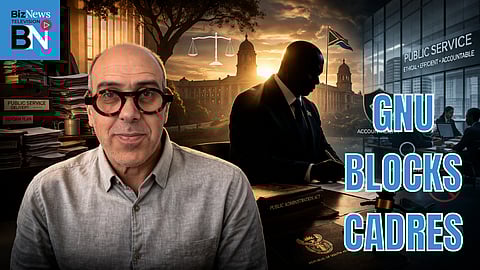
President Cyril Ramaphosa's assent to the Public Service Amendment Bill has been hailed as the most significant reform since 1996. In this interview with Chris Steyn, Ivor Chipkin, the Director of New South Institute (NSI), says “we've got now in law a distinction between political office and administrative office…Our politicians, our president, our cabinet ministers and our MECs no longer have the power to recruit and to make operational decisions inside departments. And senior officials extraordinarily can no longer be office bearers of political parties. Again, quite extraordinary…it blocks cadre deployment, makes cadre deployment essentially illegal or …very, very difficult.” Chipkin predicts that the new law is also going to change “the shape of…elite contestation”, saying: “Essentially what the new act does is it reduces the ability of a dominant political party, whether it's the ANC or any other party, to deploy people into the State directly and therefore to gatekeep access to State resources.” Chipkin also explains how South Africa’s foreign policy is “strongly influenced” by political networks, both within the ANC, but also outside the organised political networks..Sign up for your early morning brew of the BizNews Insider to keep you up to speed with the content that matters. The newsletter will land in your inbox every morning on weekdays. Register here.Support South Africa's bastion of independent journalism, offering balanced insights on investments, business, and the political economy, by joining BizNews Premium. Register here.If you prefer WhatsApp for updates, sign up to the BizNews channel here..Watch here.Listen here.Edited transcript of the interview.Chris Steyn (00:01.279)President Cyril Ramaphosa's assent to the Public Service Amendment Bill has been hailed as the most significant reform since 1996. I speak to Ivor Chipkin, the Director of New South Institute. Welcome, Ivor. Ivor (00:17.176)Chris, good morning. Great pleasure to be on your show, but also it's a very auspicious moment.Chris Steyn (00:23.325)Indeed, and it wasn't an April Fool's joke when it was signed on April 1, was it? Ivor (00:30.222)Well, I hope he didn't intend it as a joke. It's now been gazetted so the joke would be on him because it's now law. And I hope it doesn't turn out to be a joke on all of us. But I think it's a huge development. Yeah. Chris Steyn (00:44.051)What exactly, sorry, what exactly are the implications of this law? Ivor (00:50.06)Well, if I can answer that question in several ways. One is by going back in history, because I think in Africa in particular, our academics and our public culture doesn't really pay much attention to things of government or public administration in particular. So we like to talk about class struggle and talk about culture and we talk about post-colonialism and decolonization, etc. But we very, very seldom pay attention to the mechanics of government and in particular how institutions function in South Africa. And as a result, we don't always appreciate the threats that we face and also the huge breakthroughs which the country has made. Starting with the transition, South Africa, the ANC inherits a public administration that it doesn't trust to implement its policies in 1994 when it comes to government. There have been these agreements…transition negotiations for the sunset causes. I think that was Joe Slovo's expression… one of those sunset causes guaranteed existing public servants that they would not be removed and they would keep their pensions a way of forestalling what Thabo Mbeki argued was potential counter-revolution driven from public servants and one of the results of this agreement was that the ANC government when it came to power in 1995 couldn't remove senior public servants from their posts. And yet it didn't trust them to implement its policies. It inherits this bureaucracy, both from the homelands and from historical white South Africa. It doesn't trust the public servants to implement its policies, but can't remove them. So it develops a workaround right in the early days of the transition, 1994, just as it comes to power. So this is a piece of legislation even prior to the constitution of 1996. And it's really...fundamentally reshaped, it's fundamentally shaped post-apartheid, the way government in South Africa has worked and it's formed. And what the Public Service Act did was it gave the political executive, which was a name for the president himself, cabinet ministers at national level and provincial ministers at provincial level, called MECs, it gave them key functions, key powers over administrative matters.Ivor (03:08.622)HR, human resources, so all appointments go through the minister. Operational decisions inside departments go through the minister. So if you're a head of department, for example, if you're a director general, you come into office, but your hands are tied. You don't actually have the powers to do your job because those powers lie with the minister. So it created what the National Development Plan called euphemistically, tension in their political administrative interface, which basically meant that there was this tremendous struggle inside our departments over who had what powers between the minister and senior officials. Because essentially what we had done in South Africa, we had located administrative authority with the politicians instead of with the administrators. Very, very unusual by international standards. Very, very unusual. But we did it because the ANC wanted to keep control, political control over our administrations.So..if we can take a step now comparatively some of the major breakthroughs in American history, in European history, in the history of Asian countries, I think the underpinning of the Asian Tigers, of the huge growth of Malaysia, of South Korea, etc. underpinned by these extraordinary reforms which take place after the Second World War, which are largely the reforms which separate political office from the administration. So, recognising the politicians must make decisions around policy and hold public servants accountable. But as public servants, you need a professional class of public servants who are trained and prepared to implement those policies. And I think that separation is so fundamental to US history, to European history, the great gains of reconstruction in Europe after the Second World War based on the separation. In South Africa, after 1994, after the end of the apartheid, we'd go that route. We'd collapse these two functions into each other, administrative functions and political functions. And I think the result has been, well, the result has been at best very, very mixed. It's been largely, especially during the state capture period, it's been disastrous for our institutions, especially as internal conflict within the ANC intensified…Ivor (05:32.305)So it transferred all that conflict and all that competition within the ANC into the administration themselves. So it was a bad idea in the first place, as the ANC became more and more a site of civil war, if you like, it transferred all that conflict into the administration. And the result is tremendously poorly performing public administrations. Yeah, so that's the context. And what the Public Service Amendment Bill does really historically, it takes those powers away from the politicians and it gives them to the public administrators. So if you're a director general now, you don't have to beg and and pray that your minister will give you the powers you need in order to run your office. You've got those powers from day one, which is extraordinary. Heads of the department will have, well now I can say not will have, they do have already, they have those powers in their hands because the legislation has passed. And that is a really extraordinary, extraordinary fact. So in the first place… we've got now in law a distinction between political office and administrative office, a breakthrough. Our politicians, our president, our cabinet ministers and our MECs no longer have the power to recruit and to make operational decisions inside departments. And senior officials extraordinarily can no longer be office bearers of political parties. Again, quite extraordinary. So….It blocks cadre deployment, makes cadre deployment essentially illegal or be very, very difficult. And it creates the basis now for not relatively autonomous public administration and hopefully going forward a professionalised administration. So I think it's really, really huge, very, very exciting times. I know that in South Africa we are so skeptical about everything and jaded about the news, but this is something really to be excited about.Chris Steyn (07:24.168)What role has your think tank played in getting these reforms into law?Ivor (07:29.318)Chris, a great question. I love that question because no, seriously, I think we've played an important role. I think a lot of the sort of the intellectual content … comes from the work I've been doing and the work the Institute's been doing, especially around this winning the argument, which we needed to win over a long period of time to win the argument that it was the right move to separate political office and administrative office, that these two should be separated. Then we played, I think, an important role in helping build support for the bill in parliament itself, in the parliamentary portfolio committee. We hosted the portfolio committee at the Gordon Institute of Business Science at Gibbs,...and took them through the bill and explained how important it was, etcetera. They played a big role in winning the support of the committee for the bill, because the committee has just been extraordinary.And I think we have to give real credit to the GNU in this regard. Since the May election in 2024, Parliament is… different …. Those committees are beginning to work. There's a real sort of democratic life back in Parliament. And I think the passing of the bill is a symptom of that change. We spent a lot of time explaining and working with provincial legislators how important the bill was and what it meant and winning the argument in the provincial legislature. I think that helped it pass in the National Council of Provinces at the end of last year, so it passed in November. And then we worked a lot with the political parties explaining the bill, all political parties. We had a fantastic team at the NSI… attending all the public participation processes engaging with civil society organizations, working with MPs and MPLs. And I think that really did the trick. Working with civil society organizations, engaging with them. And I think one of the big breakthroughs, and they really have to be given huge credit, is COSATU in this regard. COSATU, which historically was quite skeptical of these reforms, really came to understand how important this reform was. Public servants are constantly being blamed…Ivor (09:54.574)…for all sorts of shenanigans and failures and institutional failures in government, it's often not their fault. It's often the structures, it's often the populations, but they take the blame. So I think COSATU came to understand that some of this was caused by the structural issues and they came on board very, very strongly. I thank you to COSATU for helping drive these reforms and winning the support from them. Yeah, civil society, COSATU in particular. And then of course there's some fantastic public servants out there doing this work. And then some public administration academics/// public administration scholars… a huge supporter of this bill. So credit goes to them as well. And then, yeah, but I think we played a good role… Chris Steyn (10:49.46)From that historical breakthrough to something less positive. What do you make of the elite contestation in the African National Congress at the moment?Ivor (11:02.318)My colleague, also my wife, Jelena Vidjevic and I have just finished a paper which got published recently in the Journal of Southern African Studies, where we considered exactly that question, because we think that elite contestation is a major factor driving the character of South Africa as the elite all around the world. I think it's an important factor in understanding development, understanding economic growth, understanding the political culture.And yet I think in South Africa we haven't paid enough attention to who the elite are and how they relate to each other. So we started off rather controversially with a piece that came out, I think in 2020, where we reinterpreted a whole lot of data which various organisations have been collecting for some years now around what are called service delivery protests. So there's a lot of, they're quite big…longitudinal data sets around service delivery protests. And in South Africa, many have noted a huge spike in protests around 2007 and 2008. And that often gets referred to as a rebellion of the poor, but essentially South Africa's poor working classes were rising up in opposition to growing inequality and to growing poverty…But we weren't satisfied with that analysis because we had data that went past 2007, 2008, right up to the more recent periods. And we noticed just a strange episode in that data. It rises dramatically until around 2000,,,2012, 2013, then it peaks in that period. Then it comes down and then it stabilises for a very long period until the end of 2017 when it goes through the roof again. And we are living through a period of what one might call just extraordinary levels of protest in South Africa… you'll recall…2021 where there's a kind of revolt or rebellion which breaks out across the country…Ivor (13:25.838)…centered on KZN and Gauteng…extraordinary, extraordinary scenes of what turned out to be highly organised protests in response to Jacob Zuma being arrested. We try to understand those fluctuations. What we argued in this paper, which I think you can see on the regular paper, it's been very well written, is that in fact, what we're seeing in that data is …not just a straightforward sign of protest, but rather as a measure of the degree to which there's internal contestation in the elite in the African National Congress. And that that huge rise of protest is strongly linked to a huge intensification of contestation within the ANC. And on that basis, we reinterpret what the period of state capture was. What we've argued was that essentially what Jacob Zuma was trying to do, he was trying to manage the tremendous contestation in the ANC, the lead contestation between regional leaders and national leaders and regional leaders amongst themselves. He was trying to stabilise it or bring it under control in two ways. One through corruption, through patronage, allowing various brokers to access the state resources, applying a gate key, allowing gatekeeping, gatekeeping access to resources and to jobs instead of enterprises and departments. And through violence…there was a huge rise of assassinations during that period. So we will argue that through patronage and assassinations, the Jacob Zuma period is associated in the attempt to consolidate or reduce or stabilise the elite contestation in South Africa. We then argue, probably most controversially, or perhaps even as controversially, that Cyril Ramaphosa is unable to stabilise the elite contestation in the ANC. And that's why we see those protests rise again when he comes to power. … This is situation we live in now. The ANC government has been unable to manage that contestation within its ranks. And we've seen it very concretely in the huge fall of support for the ANC during the Cyril Ramaphosa period, which reached that extraordinary moment in 2024 when the ANC lost their majority in parliament. The Zuma faction splits off altogether from the ANC.Ivor (15:49.646)And I think that's what we're living. We're living in a period where there's no stabilising factor around the elite contestation. The elite contestation is wild in South Africa. And I think that looks to be our future according to the paper. So it's also a lot of democracy to consolidate, but I do think that the trajectories of these elites and the cultures of these elites is something very, very important to understand and to think about. One of the arguments which we suggest is that some of these elites are no longer able to use the ANC as their vehicle to state resources and employment, are increasingly going the route of organised crime. So the paper does suggest that going forward, we're going to see an intensification of organised crime in South Africa. But let me end this point on a positive note. We think that the Public Service Amendment Act, I can now say…Law, is going to change the shape of this elite contestation and it's going to restrict its ability to revolve around gatekeeping to the state. Essentially what the new act does is it reduces the ability of a dominant political party, whether it's the ANC or any other party, to deploy people into the state directly and therefore to gatekeep access to state resources.So it's going to reduce elite contestation within political parties and in particular within the African National Congress for resources to the state. It's going to redirect state elite contestation to other sites and other sites in society. And if I can have one second longer on this, I mean, this is the route which you see elsewhere in the world. Elite contestation doesn't primarily focus on political parties. There are many other routes. the US and in Europe, for example, a lot of that contestation is around elite university who can get into, who can get into your Ivy League universities or your elite universities has huge consequences for your ability to enter into positions in the economy and in politics. So maybe we're going to start seeing the re-channeling of elite contestation into other sources, although I do think that some of that will be through intensification of organised crime.Chris Steyn (18:03.899)Lastly, South Africa's foreign policy remains in the headlines across the world almost daily. Do you foresee any changes?Ivor (18:14.03)So again, I think our foreign policy has been a victim of the failure to stabilise an elite in South Africa. But essentially, what we have is a variety of different elite groups and networks able to exercise influence on government policy and on different state institutions. Our argument is that the way Ramaphosa has managed his government, he's managed his presidency, is essentially allowing rather than try to stabilise the elite contestation in the ANC, he's essentially allowed all these different tendencies within the ANC to have their own ministries. And DIRCO, I think, is an example of that. Rather than exercise a firm authority over DIRCO, he has allowed our international relations essentially to be governed by, or to be strongly influenced by, by political networks, both within the ANC, but also outside the organised political networks, sometimes through the Boycott, Divestment and Sanctions Network, sometimes through the Palestinian Solidarity Networks, and a whole range of other networks that have strongly come to influence our foreign policy. I'm not sure whether our foreign policy is directed by government itself or whether it's directed through DIRCO by a whole range of other players. I think, again, I think as the GNU strengthens, I think that the upper...opportunities for that kind of influence of key government departments and their policies potentially or hopefully will reduce. But I do think again that our foreign policy is a victim of the kind of elite contestation that has been taking place in South Africa for a long time now.Chris Steyn (19:59.881)Any thoughts on the ICJ case?Ivor (20:05.066)No, only that we are waiting now for a judgment, which I think could take, as I understand it, the written submissions were made to the ICJ. I think Israel submitted their written submission was submitted recently. And I think there will be deliberations. But I think it could be a long time again before there's a judgment in that case. Given the record, could be years, although perhaps there's a special urgency around this matter that the ICJ will apply their mind sooner rather than later to this issue. But where the ICJ is going to go on this, I have no idea. Chris Steyn (20:52.381)Thank you. That was Ivor Chipkin of the New South Institute speaking to BizNews. I'm Chris Steyn. Thank you, Ivor. Ivor (21:00.856)Thank you so much.