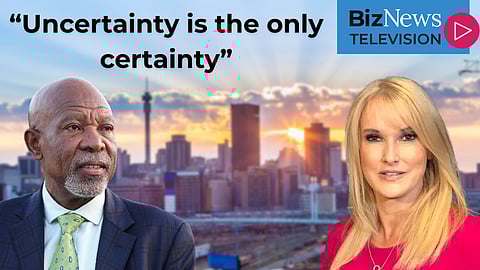
In this wide-ranging interview, Reserve Bank Governor Lesetja Kganyago speaks to Bronwyn Nielsen ahead of the impact of the Trump tariffs on Asa’s agricultural and auto sector, the push to modernise payments, and why central banks are struggling to model a future clouded by global uncertainty. Kganyago also unpacks opportunistic disinflation, interest rate scenario planning, and what’s needed to finally get South Africa’s economic “orchestra” playing in tune..Sign up for your early morning brew of the BizNews Insider to keep you up to speed with the content that matters. The newsletter will land in your inbox at 5:30am weekdays. Register here.Support South Africa’s bastion of independent journalism, offering balanced insights on investments, business, and the political economy, by joining BizNews Premium. Register here.If you prefer WhatsApp for updates, sign up to the BizNews channel here.The auditorium doors will open for BNIC#2 on 10 September 2025 in Hermanus. For more information and tickets, click here..Watch here.Listen here.BizNews Reporter.Lesetja Kganyago: Charting South Africa’s course amid global uncertaintySouth African Reserve Bank Governor Lesetja Kganyago offered a wide-ranging and candid assessment of global and domestic economic challenges in an interview with Bronwyn Nielsen on the eve of the G20 summit. With South Africa concluding its G20 presidency and the African Union now formally included in the group, Kganyago highlighted how the country had shaped an agenda relevant to African priorities - chief among them climate finance, trade integration, and payment system modernization.Kganyago emphasized the urgent need to close Africa’s climate financing gap, noting that extreme weather events have become effectively uninsurable. He questioned whether multilateral institutions like the World Bank could step in with structural solutions, as many African governments are too fiscally constrained to fill the void themselves.A second key focus, he said, is the implementation of the African Continental Free Trade Agreement. This transformative initiative creates a potential market of over a billion people - but such trade requires reliable cross-border payments. Many African payment corridors still fail to meet G20 standards on speed, cost, and transparency, making payment system reform a top priority.Addressing the imposition of US tariffs - particularly those announced by former President Donald Trump - Kganyago clarified that while central banks do not set or respond to tariffs directly, such policies present real risks. South Africa’s agricultural and auto sectors, especially in rural communities, are vulnerable, despite key mineral exports like gold and platinum being exempt.The Governor also touched on South Africa’s domestic monetary outlook, stressing that uncertainty remains the defining challenge for central banks worldwide. Global forums, like the recent European Central Bank summit, have repeatedly underscored that inflation modeling is increasingly difficult in an unpredictable geopolitical and economic environment. In response, the Reserve Bank has adopted a scenario-planning approach, presenting multiple policy pathways to reflect possible shocks.Kganyago confirmed ongoing discussions with the Treasury about potentially lowering South Africa’s inflation target - a move he believes could strengthen the rand, reduce interest rates, and boost long-term growth. However, he cautioned that such a shift must be opportunistically timed and based on rigorous analysis.He rejected the idea that modernizing the national payment system equates to deregulation. Rather, the Bank is crafting a new regulatory framework that allows non-bank fintechs to participate safely, aiming to lower transaction costs and improve efficiency.On the sluggish growth front, Kganyago defended macroeconomic policy as laying the foundation - “clearing the field” - for growth, while urging coordinated microeconomic reforms. Without these, he warned, the economic “orchestra” cannot produce the harmony needed for sustainable development.Finally, reflecting on his ceremonial appointment as Chancellor of Stellenbosch University, Kganyago described the institution as a beacon of change and excellence. Despite the global turbulence, his outlook remains rooted in policy discipline, intellectual rigor, and a firm belief in the long game of reform-driven growth.