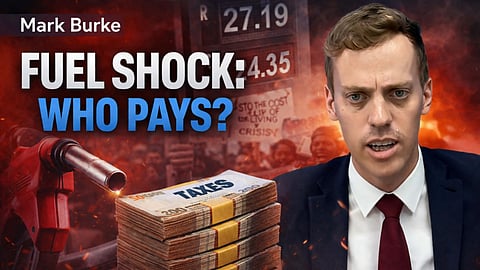
In this interview, Mark Burke unpacks the partial fuel levy relief victory, warning that deeper fiscal risks remain. He argues South Africa cannot afford higher taxes or more debt, urging government to tap inefficiencies, cut waste, and unlock idle state funds to shield consumers from further economic pain..Sign up for your early morning brew of the BizNews Insider to keep you up to speed with the content that matters. The newsletter will land in your inbox every morning on weekdays. Register here.Support South Africa's bastion of independent journalism, offering balanced insights on investments, business, and the political economy, by joining BizNews Premium. Register here.If you prefer WhatsApp for updates, sign up to the BizNews channel here..Watch here.Listen here.Edited transcript of the interview.00:00:08:08 - 00:00:34:10 Well, just the other day, Dr Mark Burke and I were talking about the threat of a fuel price increase. That was going to hit South Africa's economy in such a way that it might just kill all the green shoots that we are seeing of a recovery. He was motivating very aggressively for a three rand, 17 a litre reduction or subsidy from government. 00:00:34:12 - 00:00:58:12 And so today we hear three rand is coming through to find out how much of his motivation was listened to. Thank you, Mark. Last time we spoke you were in Parliament. You were about to go and give some questions to the minister. Has he been listening to your lobbying? 00:00:58:14 - 00:01:22:11 I think he has had to listen to both the day's pressure, as well as a larger of South African society calling out for help. There is the part of me that thinks the ANC is unable to take good faith suggestions from the DA just on face value. And so we asked for three rand 17 and he went for three rand instead. 00:01:22:13 - 00:01:51:16 But still a lot of suffering that's about to take hold in South Africa tomorrow. I wish the government could do more. And we'll have to keep finding ways as the governing coalition to do more. But under the circumstances, we'll give them the change on the three rand 17 to the three rand. And I'm sure there will be many people trying to claim victory for, you know, this slight reduction in the pain about to hit the economy. 00:01:51:18 - 00:02:10:22 But the main thing is that we've been able to alleviate some of the pain. So just to be clear, the fuel price was going up tomorrow by more than six rand—it was going to go up by more than six rand and will be closer to three rand a litre of petrol. And of course, the diesel would be quite a bit higher still, but at least three rand relief on both sides. 00:02:11:00 - 00:02:35:22 The problem, though, is that this is the average price for the month. And if you take the current price, we've got another big fuel price increase coming next month. So what are you looking at to try and reduce that shock? Because if all other things being equal, it's almost like it'll be a delayed reaction. 00:02:36:00 - 00:02:58:20 Yes. So just for the layperson out there, the way the fuel price calculation in South Africa works is on this catch-up basis. So there is movement in the price per barrel of crude, and then there's movement in the foreign currency. And then once a month we say, well, that movement has resulted in this change in the fuel price, or as frequently as once a month. 00:02:58:20 - 00:03:23:18 That doesn't, of course, always move in that way. And so what you're now describing is if the price per barrel keeps going up and the rand keeps weakening, then a month from now, we will be looking at yet another base price increase. I think it's a valid question. I think anybody telling you they can predict what will happen in the Middle East and, by implication, what will happen to the global supply of oil is probably being a bit adventurous in the analysis. 00:03:23:18 - 00:03:57:03 Nobody can tell you what will happen then, but what I feel one could say with a measure of confidence, although always applying a healthy amount of scepticism, is that this is likely more of a short-term to medium-term shock to the global economy than a permanent shock to the global economy. And I say that only because, you know, at some point, if sources of fuel from that part of the world—and Iran specifically—is not viable anymore, then the way enterprise works is it tries to find ways around it over the medium to long term. 00:03:57:05 - 00:04:19:04 And so I'm hopeful that, you know, we're not looking at a forever shock here, but that it is more short to medium term in its nature. And then back to your question now: what happens by next month? Well, the fact is of the total fuel price per litre of petrol—the simplest to explain—about six rand 32 goes towards the state coffers. 00:04:19:04 - 00:04:38:23 And the various levies that get charged, be that the general fuel levy and the Road Accident Fund levy; and three rand of that has now been offered up for a month, and potentially two months thereafter as of today from the minister's announcement. Which obviously means there's another three rand to go if absolutely needed. Well, and we'll have to then monitor and see what the base price of fuel does. 00:04:39:00 - 00:05:01:09 I will also point out that what the DA proposed—and what the ANC, within the margin of error of 5%, today announced—a three rand 17 reduction was actually a 50% reduction in the two levies, the Road Accident Fund and General Fuel Levy, which is global best practice. Australia has done it over the weekend, or maybe did it at the end of last week, and many other countries are taking measures to try and insulate their economies. 00:05:01:11 - 00:05:19:10 So we've taken a measure that's comparable to what's being done elsewhere in the world to try and absorb some of the shock on behalf of South Africans and so we have been the government, and that's good. That's good that the ANC listened on this occasion. It sucks that they took so long, as they often do, and ran it down to the wire. 00:05:19:12 - 00:05:30:01 But, and of course, it doesn't resolve the pain for South Africans. But also the pain for people all over the world. 00:05:30:03 - 00:05:59:23 Do you have any idea how it's going to be funded? Because that's the real story. A 6.5 billion rand a month subsidy effectively, which is not coming through, as you've explained—it's going to be coming from the fuel levy, and it'll be coming presumably from the Road Accident Fund as well. So do you... is that not bringing into account what you were looking at, which was the compensation fund and the SETAs, where there does appear to be quite a lot of fat? 00:06:00:01 - 00:06:20:14 So the best way to try and understand this is these fuel levies combined, the six rand 32 or 35 odd that go towards the levies. If you are a business and you're thinking about your income statement, that's the revenue side that flows to the state at the pump. And then there's the expense side, which is what that levy then get spent on. 00:06:20:16 - 00:06:49:02 Now, the general fuel levy just goes straight into the fiscus and then that funds things like policing and education and so on. And the Road Accident Fund component moves from the pump where it's extracted on the revenue side into the fiscus and straight into the Road Accident Fund. And those two things combined make up about 140 to 150 billion rand from the year, and backwards from that you can calculate at their full price what that means month on month. 00:06:49:02 - 00:07:08:20 And as you now said, in the order of 6.5 billion, if you were to slash growth by 50% is now foregone. And the question then is, if you assume that you still need to fund both those revenue cycles because there's matching expenditure—which is the case for the Road Accident Fund and there's also the case for all of the expenditure. 00:07:08:20 - 00:07:27:20 Then you almost have to ask yourself in the immediate term, how do you substitute those two forms of revenue that you've now stripped out? And what we've proposed here are four pots of money, saying there is money. If government were to become a lot more responsible. And so the first and biggest one is the Compensation Fund. 00:07:27:22 - 00:07:52:01 It's an entity that exists to provide people who lose work and their livelihood a form of compensation and, if needed, pensions. It's a very over-capitalised entity; it's a poorly run entity. It's an entity that's the subject of adverse audit findings. And it's an entity that, between its interest income as well as its contributions annually, far exceed its liabilities or its claims, if you will. 00:07:52:03 - 00:08:12:17 And so it doesn't need the surpluses that it keeps accumulating, though that contributes to its net asset basis. And it doesn't actually need to be applying and succeeding and retaining these sizeable surpluses. Just in the last year on their statements, they indicated 21.7 billion rand. 00:08:19:08 - 00:08:40:17 Represent this. It should be done. But maybe to conceptually explain it to the BizNews tribe as follows. We've now won the first stage of this, which is not extracting this revenue at the pump from South Africans. The second stage of this battle is to not increase taxes elsewhere or increase our debt, but in fact, to tap the sources of money that we've identified for Treasury. 00:08:40:17 - 00:09:05:18 And it has to be said, it's wild that we with our small team have to come up with these proposals constantly. You would imagine the Treasury's large staff go out and, you know, that the ANC minister would have been championing these sorts of efficiencies. But we will have to be firm now that this cannot come from more tax or more debt, and it has to come from something akin to these bases of funding. 00:09:05:20 - 00:09:25:11 And we need to actually do a whole assessment of the balance sheet of South Africa Incorporated and see where pots of money are sitting idle, probably ripe for looting. And so we need to cut back at those and move it over to the fiscus so that we can shield South Africans and provide more. 00:09:25:13 - 00:09:52:08 It is not letting—certainly not letting—this crisis be wasted. But if you look forward to, say, three, six months now, there are just very dire forecasts about what the unpredictable Donald Trump might do. He's threatened this morning, our time over here—not US time—to take out all of the oil producing installations that the Iranians have, in addition to desalination plants. 00:09:52:08 - 00:10:30:21 And it just sounds like it could get really bad. And if that were to occur, one would anticipate an even higher oil price. And as a consequence of that, even more potential pain for consumers in this country, because that's really what we care about: what's happening here in South Africa. Are you suggesting, then, that it's not the end of the road on the fuel taxes—that there are other parts around that a decisive government would be able to find to at least see South Africans over this hump? 00:10:30:23 - 00:10:54:11 And we all intuitively know this when we see these massive tenders being paid out for pseudo-hospitals to be built during COVID, and that never happens. At the deep level, I think we all realise that government is deeply corrupt and inefficient and that we should be a prosperous country. We should be a place that is able to tap into the resources for the benefit of South Africans. 00:10:54:13 - 00:11:12:10 And we've lost track of that at times. But it doesn't need to be that way. So absolutely, to answer the question, you know, we've just in the short exercise, we've articulated how we can fund the two levies being slashed by 50% for up to six months. And we came up with those suggestions within a week. 00:11:12:13 - 00:11:34:09 So it's a political will challenge. It's absolutely an ANC lie to believe that if we don't bring in excess revenue... and the average South African that pays taxes pays between 8 to 12 forms of taxes, between Value Added Tax and Personal Income Tax and the fuel levies and rates and charges, and the list just goes on. 00:11:34:11 - 00:11:54:20 And it's an absolute ANC lie to say, well, we have to increase those amounts, put all of them at global limits. I mean, this whole income tax in South Africa is at Scandinavian levels, and it kicks in a lot sooner than Scandinavian countries. So it's an absolute lie to say to people, no, those have to increase otherwise frontline services like policing and education and health will suffer. 00:11:54:22 - 00:12:16:18 Yeah. We need to have the political will to become more efficient. We need to tap into things like SETAs—I mean the SETAs, the surplus. There's 6.7 billion according to their latest statements, and that's just for the last year. But the running cost of the 20 plus SETAs that are, again, poorly run, subject to adverse audit findings, issues investigating them. 00:12:16:20 - 00:12:47:07 The running cost of that is close to 20 billion rand a year. And we've been saying for a while that these SETAs, which are these training authorities, could be amalgamated and scrapped in a very short space of time. And likewise, our ghost worker audit. At the moment it's run at the national and the provincial level on a Persal system—the personnel salary system—but that ghost worker audit can be expanded to the local government level. 00:12:47:07 - 00:13:07:10 The more than 250 municipalities we have, and as importantly, to the state-owned entities—the more than 700 state-owned entities we have. I mean, I don't want to go off on a tangent, but we've got some entities that exist. One of them is called the Kalahari Corporation. I can't tell you what it does, but it has a board of directors. 00:13:07:12 - 00:13:28:05 So, long story short: if the political will exists to start cutting back on all of this patronage, there's more than enough to fund it. And then if we were decisive enough to make our procurement more efficient and we said, no, no, no, we're not going to be paying for outdated ideologies, we will procure on a value basis. 00:13:28:05 - 00:13:52:10 We will only pay for things that add value. And by the way, the money that we are collecting, we are spending on things like healthcare and policing and education—there would be a lot more bang for buck. There wouldn't be, you know, up to a trillion rand that's circulated between 100 beneficiaries of the outdated policy of BEE. So we have the ability to fix these things, but it doesn't look like doing it the way the ANC has done it for 31 years. 00:13:52:10 - 00:13:57:00 It looks very different to that. It looks like running this country like a business. 00:13:57:02 - 00:14:22:12 And perhaps that quip about not wasting a good crisis is quite relevant here. Because when you're in a crisis, suddenly the political will does become more possible. And we might have that right now, getting back to the current situation though. So we've got a 6.5 billion rand subsidy, in inverted commas, that is going to be assisting South African motorists. 00:14:22:12 - 00:14:49:04 We're still going to be paying more for petrol and a lot more for diesel. But that is a result of what's happening globally. What happens if you discover that the increase or the subsidy is not being funded in the way that it should be—i.e., reduced taxes or tax take—but that it will be funded through debt, which already South Africa has a big problem with? 00:14:49:04 - 00:14:58:13 What can you do as the DA? We know you were pretty effective with VAT and you've been effective here as well. But what can you do in that instance? 00:14:58:15 - 00:15:20:02 Just to touch on the sizeable debt burden for a moment: when I was a young student in my early 20s, debt to GDP—which is just a fancy way of saying how much does the economy produce and what portion of that, if you took all of your economic output and you applied it to the debt that's outstanding. 00:15:20:04 - 00:15:42:14 How long would you sacrifice all your economic output to get rid of your debt? That's an economic term. The debt-to-GDP ratio was in the mid-20s. You know, I remember reading comparative studies at the time and thinking, what's interesting is South Africa, compared to OECD countries, has quite a manageable debt burden. And then you had the Zuma years and you had debt binges. 00:15:42:16 - 00:16:03:15 And now our debt is at 77% of our GDP. That means that if everybody sacrificed all the money they make and all the economic output of the country—if Anglo and Toyota and everybody else just handed over whatever revenue they accumulate—they'd have to do that for nine months before we would have been able to pay off our national debt. 00:16:03:15 - 00:16:21:23 That's a horrifyingly high amount of debt. But to make that more tangible for people: out of every 100 rand that your listeners and viewers pay towards tax at the moment, 22 rand is going towards servicing our debt—to paying off the credit card bill. And then every Treasury increase... they've now stabilised that this year before this latest shock. 00:16:21:23 - 00:16:41:21 But every point up to this point they've increased our debt burden, which just means the credit card bill gets bigger even though you're trying to service these interest payments. All of that to say that our debt burden is suffocating us as a nation. It's crowding out critical spending in other areas. We cannot afford to take on more debt. 00:16:41:23 - 00:17:04:02 And I don't want to go on too much of a tangent here. But likewise, we've got a real problem. The state keeps underwriting guarantees; it's the new form of taking debt. So it says, you know, if Transnet or Eskom needs this, the state will guarantee that the fund—that the state will make them whole—and it doesn't actually go onto our books in the way that the new debt would have gone onto our books. 00:17:04:04 - 00:17:26:14 So the problem is compounding. Now, back to your question. I look... which is what can we do if they're trying to debt-fund the relief that's being given at the pumps? It's unacceptable. It cannot work. And we cannot increase taxes. We cannot increase it because it is crowding out critical spending. 00:17:26:16 - 00:17:54:22 The way that you deal with budgets in a coalition is you discuss it with each other. You listen to good faith suggestions, and then, of course, it has to be voted on in Parliament. And the ANC has 39% of the seats in Parliament. And so if they propose in upcoming budget cycles to just keep bringing budgets to Parliament that increase our debt burden or try and increase the taxes, we will have to deal with it as firmly as we have dealt with this levy issue. 00:17:55:00 - 00:18:13:14 And we're not doing that to try and be obstinate. But at some point, you become an enabler if somebody keeps racking up debt with no plan to pay it off, and it is ruining the household too, you know? That just keeps going on these spending binges and kids can't afford to get to school. So we'll have to be firm on that. 00:18:13:14 - 00:18:26:14 There's no space. In our fiscal management, to start thinking about incurring more debt. It will be as painful, if not more painful to the nation, than increasing our taxes, which is equally unpalatable. 00:18:26:16 - 00:18:54:06 A bit of tough love for the ANC. Interesting. The point that you make there about government being surety or standing surety... and it's fine while those that you stand surety for are paying. But then we saw what happened with Eskom. Government stood surety and eventually ended up giving us a 250 billion rand debt as taxpayers because Eskom wasted money. Just to close off with... 00:18:54:12 - 00:19:22:11 When you look forward at the political realities of the ANC actually following those very sensible proposals that you put on the table of the Compensation Fund, the SETAs, and the ghost workers audit, I think you call it... is there a time that a partner—the biggest partner in the Government of National Unity—can actually say, hang on, we've got to do this in the national interest? 00:19:22:11 - 00:19:45:00 Are you seeing any sense that that could overcome the political negativity, perhaps, of doing something that was initiated elsewhere? 00:19:45:02 - 00:19:54:08 Pretty much, pretty much. Or just listening to common sense—to rationality—rather than saying, no, it comes from this particular person. I'm not hearing it. 00:19:54:10 - 00:20:12:14 It's unfortunate that it's progressed to the level that, you know, just because we are saying it, it's almost like if the DA really want something to happen, we should pretend like we want the exact opposite and maybe the ANC will go for it. It is unfortunate. Having said that, they have listened to us on this occasion. 00:20:12:14 - 00:20:33:03 We know more than a week ago, diesel was going to go up by almost ten rand a litre and petrol by more than six rand a litre. And nobody was doing anything about it. We stepped in, we made some noise, we added pressure. And as of today is the announcement, that's, you know, within striking distance, as we say, from our proposal—three rand versus three rand 17. 00:20:33:05 - 00:21:04:01 And so I think there's almost something adjacent to hope that the ANC might on occasion see the light. Because remember the suggestions the DA are making in instances like this and others are not purely ideological or some conspiracy to try and extract something. These are good faith suggestions that we genuinely believe will help the economy and, by implication, help every South African. 00:21:04:03 - 00:21:18:11 And because these are good faith suggestions, when they are implemented—as is the case with that, you know, as is the case with the reforms that we've insisted on to get off the global grey list—it does have an effect on the economy. It has an effect in a positive direction. 00:21:18:13 - 00:21:37:06 And you would have to hope that there are at least a couple of smart people in the ANC that see it and say, "Oh, we did this thing the DA wanted, and now things are actually a bit better than they used to be". Maybe we should do more things that the DA wanted, as opposed to this pity party: "We can't have that because then the DA would look too strong". 00:21:37:08 - 00:21:55:22 It just seems a bit juvenile to go the second route. And it does seem to me that, at times, I see the good faith market-friendly reforms we're trying to implement, and they see the value of that. But in any way, we will keep insisting on them. And if we get it right more often than they get it wrong, I think we've got a shot. 00:21:58:22 - 00:22:13:08 Dr Mark Burke is the spokesman on finance for the Democratic Alliance. I'm Alec Hogg from BizNews.com.