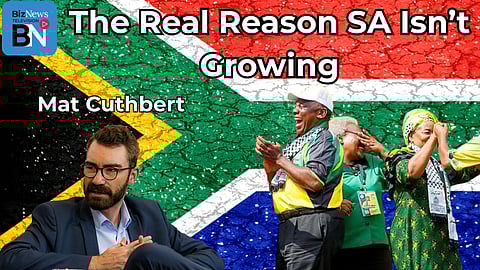
The African National Congress (ANC) has unveiled its Economic Action Plan in the wake of the Democratic Alliance’s (DA’s) Plan to Turbocharge the Economy. In this interview with BizNews, the DA's Head of Policy Mat Cuthbert speaks about the similarities and the differences. He further describes how - despite the best efforts of many of his colleagues in their departments as ministers of the DA - they have been unable to contribute towards growth and jobs in the way that they would have wanted to. “And the reason for that is because ANC ministers have acted as handbrakes on growth and failed to implement the kind of reforms that are required…” Thus he remains “highly skeptical” that his colleagues within the ANC and its partners within the GNU “have the ability to be able to implement the required reforms at the necessary speed or depth”.He calls on voters to strengthen the DA's hand in the upcoming elections “so that we are able to do more and we are able to do more quicker”. He adds: “I think that it's only a matter of time, particularly in light of next year's local government election, as well as the 2029 election, before the ANC are a thing of the past.”.Sign up for your early morning brew of the BizNews Insider to keep you up to speed with the content that matters. The newsletter will land in your inbox at 5:30am weekdays. Register here.Support South Africa’s bastion of independent journalism, offering balanced insights on investments, business, and the political economy, by joining BizNews Premium. Register here.If you prefer WhatsApp for updates, sign up to the BizNews channel here..Watch here:.Listen here:.Edited transcript of the interview.Chris Steyn (00:02.141)The African National Congress and the Democratic Alliance in the Government of National Unity are not yet on the same page when it comes to reviving the economy. We speak to the DA's Head of Policy, Mat Cuthbert. Welcome, Mat. Mat Cuthbert (00:17.966)Thank you very much, Chris. It's great to be with you this afternoon and also shout out to your listeners. Chris Steyn (00:24.881)Mat, firstly, what are the similarities between the ANC's Economic Action Plan and the DA's Plan to Turbocharge the Economy? Mat Cuthbert (00:34.872)So think it's important to start with some context. We are now a year into the Government of National Unity, more than a year, and we sit with annualised GDP growth of 0.6%. We sit with an unemployment rate of 33.2%. And despite the best efforts of many of my colleagues in the departments as ministers of the DA, they have been unable to contribute towards growth and jobs in the way that they would have wanted to. And the reason for that is because ANC ministers have acted as handbrakes on growth and failed to implement the kind of reforms that are required in order to be able to grow the economy, create jobs, and ultimately create a more prosperous society for all South Africans. And I think drawing on our turbocharge, the economy plan, which was launched over a month ago, the ANC went and looked at our homework sheet and did a bit of copying and pasting and came out with their own version of an economic action plan yesterday. Now, there are number of areas of agreement, as you alluded to, specifically around getting private sector participation in electricity as well as logistics, some of the reforms around expanding support for small, medium and micro enterprises, as well as also making sure that we have a properly constituted export orientated trade approach. In saying that, there are number of concerns that we also found in the document which was shared by President Cyril Ramaphosa, which I'm sure we'll discuss at length during the course of this interview. Chris Steyn (02:06.665)Yes, what are the biggest differences? Mat Cuthbert (02:10.968)Well, I think there is a continued defense, particularly by President Ramaphosa, who happens to be a beneficiary of this very policy, that being the Black Economic Empowerment Policy and Law, which has been implemented by the ANC over the past 50 years. And fundamentally, despite its claims to uplift the poor and to redress the injustices of the past, that policy has ultimately ended up deterring investment, has stifled economic growth and ultimately led to a vast rate of joblessness, particularly amongst Black South Africans. If you look at the national unemployment rate at 33.2%, that number is closer to around 38% for Black South Africans. And fundamentally, as Professor William Gumede from Wits School of Governance shared a couple of months back, it's in essence one trillion rand that is circulated amongst 100 politically connected individuals who have benefited off the backs of the poor. They have been the ones who have been awarded the tenders, not delivered the services, and ultimately used that to enrich themselves, their families, and ultimately be able to bankroll the ANC. And we are in fundamental disagreement with that particular continued defense, as we don't believe that it brings genuine empowerment, which the vast majority of black South Africans require, and the kind of economic opportunity that needs to be unlocked in order to be able to allow people to climb up the ladder of opportunity and live more prosperous lives of their choosing. Some of the other issues which we have a problem with in the Economic Action Plan are specifically around the protectionist measures put in place for Manganese and Chrome. If we are going to pursue a protectionist trade policy by simply slapping on tariffs and export duties on specific goods without possessing a natural strategic advantage or a comparative advantage to other economies, we're going to find ourselves in a position where we are not competitive in the international market. And we've seen in industry after industry, whether that be steel, whether that be poultry, we slap these tariffs onto specific items, hoping that we're going to somehow artificially be able to industrialise locally. And that's never been the case. There have been industries that have been supported year after year after year by national governments and its development finance institutions. And they haven't fundamentally created labour-absorbed economic growth or ultimately contributed towards the growth of our economy. Chris Steyn (04:31.529)Now it's all very well to have a plan, a new plan as the ANC now has, but are the current batch of ANC ministers capable of implementing these reforms speedily and effectively? Mat Cuthbert (04:46.542)Well, I remain highly skeptical. There's been a lot of rhetoric. There have been a number of commitments and promises that have been made, particularly since the inception of President Trump's tenure. And we've seen little in the way of implementation. We have GDP per capita that has declined over the past 12 to 13 years. We stagnate around roughly 1% growth per annum. And we don't see the kind of tangible economic change and reform that we require. So I remain highly skeptical that our colleagues within the ANC and our partners within the GNU have the ability to be able to implement the required reforms at the necessary speed or depth. There's maybe one notable exception in the case of the Minister of Transport who's gone some way in at least opening up private sector participation in transnet through the issuing of RFRs and RFQs, but we still believe that there could be greater reform, greater permission for the private sector to get involved within critical network infrastructure and we would like other members of her party to follow her example. I think fundamentally what we're dealing with is a dying organisation in our partner within the GNU, the ANC. If we look at the years of mismanaging the economy, we look at cadre deployment, we look at the corruption and we see how that correlates with the electoral performance and the fact that a number of publicly available polls have been hovering in the late 20s up to the mid-30s shows that their electoral mark is significantly weakened. And I think that it's only a matter of time, particularly in light of next year's local government election, as well as the 2029 election, before the ANC are a thing of the past. And ultimately, South Africans are looking to a party that has a track record of being able to deliver. And the only party that has that track record in provincial, local, and now national government is the Democratic Alliance. Chris Steyn (06:41.417)Now meanwhile, how has ANC policy hampered Democratic Alliance ministers to perform in the ways they would have wished? Mat Cuthbert (07:18.882)So if we look at the departments which we are in control of, if look at Home Affairs in particular, I think that Minister Schreiber has done some excellent work in reforming immigration as well as the issuing of visas. We look at the Trusted Tourist Operator Scheme and the number of reforms that we believe have the ability to bring in skills as well as much needed tourism to the South African economy. However, that only contributes somewhat towards the overall growth number. We look at the new markets which have been opened up by Minister Steenhuisen in the Agriculture portfolio. We look at some of the work in facilitating the investment into public infrastructure through our Minister of Public Works and then also the work that's been done by our Deputy Minister of Finance in making sure that we balance the budget and ultimately that we live within our means. Those are all very impactful reforms. But the sort of key levers, the structural factors that we need to address within the economy such as energy, logistics, water and the like are all within the control of the ANC ministers… And fundamentally because of the own internal lethargy within the ANC I think that they've failed to be able to implement those policies and ultimately put us in a situation as a country where we have a unified growth agenda that allows us to be able to unlock economic opportunity and ultimately to be able to get the economy to move in the right direction. I also think that there's a strong political element where the ANC haven't learned that they are sharing power and that they are not in full power. And we've seen this in a number of iterations since the inception of the GNU, the amount of times that they've threatened the DA, whether they're going to expand the GNU or whether they're going to kick the DA out of the GNU itself, and all of the double dealing that they've done with other parties behind their coalition partners' backs, particularly in relation to the budget. And I think that they haven't quite come to terms with the fact that they are no longer the holders of the monopoly of truth or of policy, for that matter, in national government. And that's why it's important that us as a party are robust when it comes to policy differences, that we try and chart a policy direction… Mat Cuthbert (09:35.011)…that is going to make it easier for South Africans to be able to find work for businesses who want to invest in the South African economy and ultimately for us to be able to live a more prosperous life. And we may be in partnership with the ANC, but that doesn't mean that we have to agree with the ANC and they somehow think that we need to agree with them. Strangely enough, in response to my statement that I put out yesterday, the very vocal Chairperson of the Communications portfolio…was going on about how the DA continuously tries to compromise and undermine the GNU. And I think she herself hasn't come around to the fact that we are fundamentally a distinct party with our own ideas, our own views, our own policies, and also our own agenda in government. And we're not going to kowtow to the ANC and simply implement the same failed policies that have failed to address the critical issues that our country faces. Chris Steyn (10:26.761)Now with ministers in the Government of National Unity essentially working against each other. What is your message going forward? Are you going to tell people just be patient? The ANC will go down. Mat Cuthbert (10:43.279)I don't think it's a case of being patient, but I think if we go on the track record of evidence that we've been able to build over our first year in government and the real tangible reforms that we've been able to implement despite the limited power that we because we all understand that this was not a fair deal that was struck at the inception of the GNU. Despite our representation within parliament and within the GNU, we have a small minority of the ministerial posts that we feel that we should be entitled to. Therefore, our power to influence things is somewhat limited, but in the limited scope in which we've had, we've been able to deliver tangible change. And the message to voters is clear, is that you need to strengthen the DA's hand in the upcoming elections so that we are able to do more and we are able to do more quicker. And fundamentally, we've seen wherever voters have lent us their support…that fundamentally we've been able to improve governance in the places where we do govern, improve the prosperity within those communities in which we serve, and ultimately contribute towards a more vibrant area in which we govern. And that's fundamentally the point that we want to get out to voters. It's about saying, the DA, the DA is the right horse to back because we are the only party that is capable of individuals able to deliver the much needed change that South Africans are so desperately after. Chris Steyn (12:07.987)Thank you. That was the DA's Head of Policy, Mat Cuthbert, speaking to BizNews. I'm Chris Steyn. Thank you, Mat.