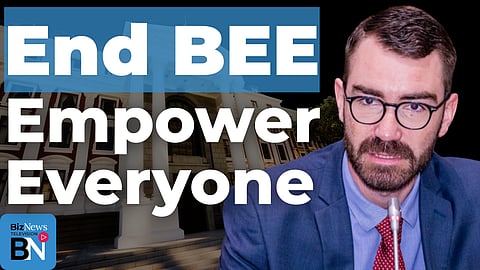
In this conversation, Alec Hogg interviews Mat Cuthbert, the DA's head of policy, discussing the contentious issue of Black Economic Empowerment (BEE) in South Africa. Cuthbert critiques the current BEE policies, arguing they have failed to uplift the majority of Black South Africans and instead benefited a small elite. He proposes an alternative approach focused on economic inclusion for all, emphasising the need for structural changes to the economy to foster growth and reduce unemployment. The discussion also touches on public sentiment towards BEE and the DA's vision for a more prosperous South Africa..Sign up for your early morning brew of the BizNews Insider to keep you up to speed with the content that matters. The newsletter will land in your inbox at 5:30am weekdays. Register here.Support South Africa’s bastion of independent journalism, offering balanced insights on investments, business, and the political economy, by joining BizNews Premium. Register here.If you prefer WhatsApp for updates, sign up to the BizNews channel here..Watch here.Listen here.BizNews Reporter.In a wide-ranging interview with Alec Hogg, Democratic Alliance (DA) MP and head of policy Mat Cuthbert made a compelling case for replacing South Africa’s Black Economic Empowerment (BEE) policy with a new, inclusive approach aimed at addressing poverty and driving economic growth.Cuthbert, a career politician who entered public office at just 22, has been instrumental in shaping the DA’s policy direction. He argues that South Africa’s current race-based empowerment policies have not only failed to uplift the majority of disadvantaged citizens but have also become a vehicle for elite enrichment and economic stagnation.“For more than a decade, our economy has grown slower than the population,” noted Hogg. “We are, on average, getting poorer.” Cuthbert agreed, stating that the economic trajectory under ANC-led policies has widened inequality, rather than narrowed it. “Despite all the empowerment policies, Black South Africans are worse off today,” he said. “Unemployment among Black South Africans sits at 36%, compared to a national average of 32%.”The DA’s alternative is the “Economic Inclusion for All” Bill, which proposes a shift from race-based empowerment to poverty-based upliftment. This, Cuthbert argues, would still disproportionately benefit black South Africans, given the socio-economic realities, but without excluding anyone based on race. “We’re focusing on poverty as a proxy for disadvantage,” he said.According to Cuthbert, BEE has entrenched a system of political insiders and outsiders, often benefitting those with ANC connections. “Just look at President Ramaphosa,” Cuthbert said. “He’s been the beneficiary of transformation deals - not a self-made billionaire, but someone who gained from patronage.” He further highlighted scandals such as the chemical toilet tender debacle in Ekurhuleni and corruption linked to state capture as evidence of how empowerment policies have been abused.The DA’s proposed model shifts focus to economic inclusion through direct investment in communities. This would include support for small businesses, infrastructure development, feeding schemes, early childhood education, and legal aid centres. “Instead of handing out board seats and shares to political elites, we want to empower communities directly,” Cuthbert explained.Critics of the DA’s stance argue that a colour-blind approach ignores the structural legacy of apartheid. But Cuthbert is quick to respond: “Race-based empowerment has failed to address that legacy. We’re not denying the past - we’re offering a policy that actually works.”When asked why the DA persists in promoting this policy despite ANC resistance, Cuthbert pointed to growing influence through the Government of National Unity (GNU), legislative pressure, and legal tools. He cited the DA’s success in blocking a proposed VAT increase as proof that they can influence policy, even in coalition.Public sentiment appears to be shifting as well. Cuthbert referenced recent polling from Ipsos and other institutions showing declining support for BEE and a growing appetite for pragmatic, results-driven governance. “South Africans just want things to work,” he said. “They care more about results than ideology.”If the DA’s economic reforms are implemented, Cuthbert envisions a South Africa, ten years from now, with a growth rate above 3%, reduced unemployment, functional infrastructure, and a society in which opportunity is accessible to all. “People want to live a life of their choosing,” he concluded. “They want jobs, services, and dignity - not empty promises.”In a country where economic transformation remains both a moral and political imperative, the DA's proposal marks a significant departure from the status quo. Whether the electorate and coalition partners are ready for such a shift remains to be seen. But if Cuthbert and the DA are right, the future may lie not in replicating the past, but in designing policy that empowers through inclusion, not exclusion.