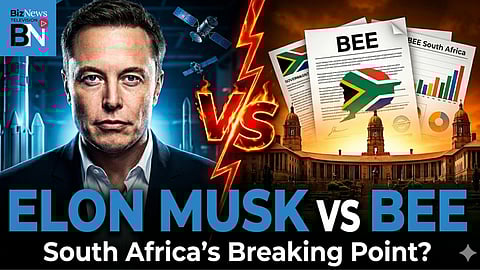
From Elon Musk’s Pretoria beginnings to global dominance, this conversation dives into power, policy, and South Africa’s economic crossroads. Solidarity’s Dirk Hermann unpacks the growing backlash against BEE, arguing it stifles jobs, fuels elite enrichment, and deters investment. With pressure mounting from markets, citizens, and international players, is reform inevitable? A sharp, thought-provoking look at race, economics, and the battle over South Africa’s future direction..Sign up for your early morning brew of the BizNews Insider to keep you up to speed with the content that matters. The newsletter will land in your inbox every morning on weekdays. Register here.Support South Africa's bastion of independent journalism, offering balanced insights on investments, business, and the political economy, by joining BizNews Premium. Register here.If you prefer WhatsApp for updates, sign up to the BizNews channel here..Watch here.Listen here.Edited transcript of the interview.Alec Hogg 00:07:22 - 00:32:17It's quite hard for us as South Africans to imagine how powerful Elon Musk is today. Here's a guy who was brought up in Pretoria, still carries a South African passport. He went to Pretoria Boys High after being bullied at Bryanston High School. Bryanston - they'll never live that one down. And he is now the richest man in the world, transforming numerous industries.00:32:19 - 01:12:10A confidant of Donald Trump, despite what the popular press tells you. And a guy who speaks his mind the way that he sees things. Also, famously, he believes in first principles thinking - in other words, break everything down to its basics and then rebuild it again. Why we're having this conversation is because Dr Dirk Hermann, who's the chief executive of Solidarity, has been pretty supportive of recent comments from Elon Musk, who, by the way, owns Twitter/X, and has got millions and millions of people who hang on his every word. And he has not really taken to heart the whole BEE story. Dirk issued a press statement this week. We're going to pick up from him. Why?01:25:06 - 01:37:05Well, good to see you, Dirk. Thanks for giving us your time. People who don't know you and don't know Solidarity, just in a nutshell, what is it that you guys are up to?Dr Dirk Hermann 01:37:09 - 02:04:11Well, of course, Solidarity is quite an old institution. We were formed in 1902, so we are part of South African history for more than a hundred years. So we could see what happened. We experience everything. We are influencing history. We are influencing the current political climate. We are influencing the relationship that we have with the United States. And we see us with one view: the benefit of South Africa. So we are a trade union, maybe a bit different than the traditional trade unions. We are a free market institution and one of your main focus, of course, is to empower people through knowledge. We believe that the route to success, of course, is through knowledge. And that's why we've built the technical college. We built a university. We have a big study fund. We built support schools, etc. So our approach, of course, is a bit different. The whole issue of black economic empowerment and employment equity - Solidarity is quite involved. We've, I think since the beginning of the debate, since 1998 when the Employment Equity Act was accepted, since 2001 when the Black Economic Empowerment Act was accepted. And we are very constant through it all, and that is that it is bad for the economy, it's bad for jobs. And we believe that government interference in ownership and specifically also in employment is bad for everyone in South Africa. And that is our constant message from the beginning.Alec Hogg 03:22:19 - 03:33:12You've been a bit of a voice in the wilderness for much of that time, but it's almost like others are listening now as well. And the support of Elon Musk-do you know the guy? Have you ever met him?Dr Dirk Hermann 03:33:17 - 04:00:13No, we haven't met him. So we don't know him. And what Elon did was to bring something that's under the surface to the front. And suddenly there is a big debate. Of course, not only Elon - there are a couple of things that happened in the past, let's say 2 or 3 years, that actually lead to a perfect storm around black economic empowerment. The first one is the real effect of black economic empowerment. It's experienced by ordinary South Africans. And that is why we can see that more and more South Africans across the spectrum reject the notion of race classification as a basis for policy making. We've seen that also in the recent research of the Institute of Race Relations. So that is the first place. I think people reject, at this stage, the policy because they feel the pain. And we can also talk about the cost of black economic empowerment. In the second place, what we see is the market rejects the black economic empowerment policy. More and more, the fact of the matter is that the free market act in the long run rejects government interference. And we see this now with black economic empowerment as well. We see how companies are less willing to implement black economic empowerment policies. Only 40% of companies in South Africa, at this stage, comply with black economic empowerment policies. Less than 50% of South African workers are covered by employment equity plans. So that's the second one: we see that the market rejects, at this stage, black economic empowerment. And then there's a third element. And the third element actually brought this whole thing together now, and that is that the international world rejects trade barriers. And we see that especially with the United States. Elon Musk articulates that. So it's actually not only Elon Musk. It's three big things: people in South Africa, the market and the international world. And that leads to tremendous pressure on the current black economic empowerment programme.06:05:11 - 06:39:20It's so interesting, the points that you make, and this - well, Professor Gomedia has also articulated it in very forceful terms. There's a little group of people who are benefiting greatly from BEE, we know that. I recall, and we both are of an age where when BEE was brought in, the questions that were being asked were around the idea that, hang on, we should be using what the Indians did, for instance, after 1947, where the empowerment went into education, the Tata Group as an example. The Tata family owned less than 2% of the company, but most of the income from that business, from their dividends, go into the broader public. But that was outright rejected. Instead, the credo was we need to bring in black people into the system and make them part of what we are, so that other black people can see them and see that the free enterprise system works. Now it sounds like a bad joke, but people did forcefully agree to that and give away a lot of shareholders’ equity during that period. What did you guys do at that point in time?07:26:13 - 07:56:03Well, like you say, at that point in time we were quite a lone voice because people felt that there's a moral obligation to address inequalities and to address imbalances of the past. And then they say how to do that. And the problem was then that the focus was on output. It was specifically on racial outputs to see how many faces away. And that was the basis of employment equity. Employment equity was measured against the outcome. We argued from the beginning that the answer for South Africa lies in input-based programmes, input race-based programmes, training, development, support systems, etc. That is a longer term, but it's the most effective way to empower a country - input-based programmes. The interesting thing is the United Nations Human Development Report and also the Committee for the Eradication of All Forms of Racial Discrimination is quite outspoken about that. The whole idea of input-based empowerment - how on earth can you empower a country in the longer term if 70% of the country's schools are actually dysfunctional? That's the real problem. So we concentrated from the beginning strongly on the input-based approach. The interesting thing is just this week, and I think most people would have read that, the research of the Institute for Race Relations was published. And the interesting thing is 75% of South Africans say that inequality in South Africa must be addressed via education and job creation. That's input-based. That is how people feel at this stage in South Africa.00:09:46:07 - 00:10:22:07Dr Dirk HermannAnd we did research on the cost of BEE, and we've published a report on that together with the Free Market Foundation. And the cost of BEE is around about 2% to 4% of GDP in South Africa. That amounts to around about 180,000 jobs. So South Africans pay for elite empowerment via 180,000 jobs. And ordinary people feel that. And that is that one element that I referred to that puts a tremendous lot of pressure on the South African BEE system.00:10:47:22 - 00:11:04:22Alec HoggSo now let's just think of this from a rational person's perspective. I mentioned the Indian option and that was rejected out of hand. You've mentioned the input, which the rest of the world - or most of the world - says if you want to empower or uplift a society, you start at the grassroots. And yet South Africa went a different route.00:11:05:00 - 00:11:37:23Dr Dirk HermannThe problem of that specific model was, of course, that everything was through that actually centralised empowerment project. And the moment that power is centralised, it leads to corruption. So the system was designed for corruption. Even the Zondo Commission makes reference to that, that black economic empowerment became a vehicle for enrichment. And the structure of elite empowerment does not lead to role model outcomes. It leads to corruption. If you look at this stage, around about 20% of a project, you can add around 20% of any project for BEE costs. And that is to finance the layers of black economic empowerment. But the problem there is it's corruption-excluded. The moment that you bring corruption in, it becomes a handout. And at the end, you pay through corruption. So the structure is designed for corruption. And that is the problem.00:13:07:22 - 00:13:33:06Dr Dirk HermannWe did not challenge the morality - the importance to actually create a strong black middle class, to address imbalances. That's not what we did. We challenged the model that related to empowerment and people's morality. Absolute belief that this is the right thing to do. That led to blindness.00:14:33:04 - 00:14:57:08Alec HoggI spent three years in the UK. Lots of reasons why we were there from 2016 to 2019, but it was quite an eye-opener to come from this racially charged society that we live in in South Africa to one where race really doesn't matter. If I must, I came there with a white skin. I spoke the way I spoke. I was a foreigner. I was not British. That was known. If there was a guy who'd had Nigerian parents and he spoke like the British did, he was a Brit. And that's the way it is. When do you think in our country we're going to be able to get to a similar situation where South Africans are no longer obsessed in the way that we have been with race?00:15:10:13 - 00:15:47:23Dr Dirk HermannMy experience at this stage is that the horizontal race relations in South Africa are quite good. And we see that in the workplace. We see that in ordinary interaction among South Africans. The relations are quite good. And again, it's just fresh in your mind - the race relations report that was published this week actually confirms that. And we experience that. If you look, for instance, at a very simple thing, by far the majority of South Africans say we don't care about the race of the President of South Africa. That is what the research shows. And we experience that. But the problem that we have in South Africa is not the horizontal race relations, it's the vertical toxic political relations. And that is the moment that we enter into very vertical kinds of political relations, then race is used as a proxy for populism. So I think we are much further down the road of working together as ordinary South Africans than we even believe, because of the toxic political divide in South Africa.00:16:49:14 - 00:17:25:18Dr Dirk HermannWhat Donald Trump’s executive order and Elon Musk did was they brought this whole thing to the front again. And they did not do it, especially not the executive order of Trump, via political reasons. They did it because of economic reasons. They said that American companies see black economic empowerment as a non-tariff trade barrier. And I want to address that. They say that, listen, if you put the tariff cost on us via black economic empowerment, we will put the tariff on you. So they had a simple economic reason for the argument, but that led of course in South Africa to a lot of political debate.00:17:35:15 - 00:18:01:23Dr Dirk HermannI grew up in the Free State. My dad was later the CEO of Global South Africa. So I actually grew up in a business world, in a business house, coal free market kind of house. And then I studied at the Potchefstroom University, and I did my master's degree on affirmative action. I did it in industrial sociology. I did it on the influence of affirmative action on alienation or entrenchment. And I did my PhD on the same topic. And then I went to America for internship.00:19:10:01 - 00:19:52:00Dr Dirk HermannWe were formed in 1902 as the Transvaal Mine Workers Association. And then our name was changed in 1914 to the Mine Workers Union. And then we changed our name in 2001 to Solidarity. And then we started to build this movement. And the movement includes at this stage AfriForum, academia, the university, the technical college, Marula Media, the media company, and Helping Hand, our social arm, etc. So at this stage it's a big movement. We have around about 600,000 people that pay every month to be part of the movement.00:21:21:17 - 00:21:45:01Dr Dirk HermannThe fact of the matter is that South Africans that went through real trauma in South Africa, especially in the farming communities, people that are attacked on farms in very brutal ways. My own uncle was very brutally murdered on the farm. And people feel we just want to get away. And for that I have respect. But we as the Solidarity movement focus on the 99% of people that will stay here, and we say we respect people if they want to leave. That's okay. One does not understand the specific circumstances, but that is not the solution.00:22:36:10 - 00:23:05:00Dr Dirk HermannWe are involved in processes where the government is involved as well. We try to create a solution for the AGOA trade agreement in America. We are quite involved in that, shifting the circumstances for a trade agreement, because that's the first thing that we must do. There are certain political asks - they call it asks of the Americans, the so-called five asks - and we are at this stage quite involved in processes to address the five asks so that we can come to a place where we can address the more difficult questions about a new trade agreement, of course, and our participation in AGOA.00:24:30:12 - 00:25:02:23Dr Dirk HermannThe principle that I just want to lay down is that there are answers beyond the state and private sector. More and more, medical care, even roads, even rail infrastructure, education, university, technical college - all of those - we can certainly build via new techniques beyond the state. And that is something that we as South Africans are actually great at in the private sector and the broad community.00:27:38:03 - 00:28:23:13Dr Dirk HermannStarlink can make a tremendous difference, especially in a country like South Africa. We have a big countryside. We have dysfunctional schools. Starlink could make a tremendous difference just in schools. The problem is, if we sit with a bunch of ideologues and the country is managed through the ideology of a specific group, then the interests of the country and the poor people in the countryside are not taken into account. Ideology is taken into account. It's a very strong ideology driven from an ideological perspective. And in the second place, of course, people want to protect specific interests so that they can enrich themselves. So that's the two things: ideology and elite enrichment that drives the process.00:29:21:04 - 00:29:54:13Dr Dirk HermannAt this stage, if a multinational wants to invest in South Africa, then they must give away ownership. And that is the big debate at this stage. Elon Musk said that, listen, I can't do business in South Africa because I'm not black. I must give away 30% of my company and I don't want to do that. And that is the basis of Donald Trump's argument that it's a trade barrier, an added cost to your company, and that is a non-tariff barrier.00:30:50:09 - 00:31:19:11Dr Dirk HermannMicrosoft, they at this stage have equity equivalence. But the problem at this stage is there's qualifying criteria. And you must argue that and government will consider that. And the problem at this stage is there's no real regulations that regulate that. What we say - and that is part of our discussions at this stage - our proposals for the South African government and the American government is taking away the criteria of the qualifications for equity equivalence.00:32:16:09 - 00:32:44:17Dr Dirk HermannSo just to close off with, if I understand you correctly, what you would support and where you think it is going to be inevitable is that when companies from abroad invest in South Africa because of our past and because of the need to uplift our society, they will have the opportunity to invest in society, to help build schools or community investment. They should not be forced to give away equity to a little group of people who are already obscenely rich and continue to just want more. Is that the way that I understand the crux of the argument that you and Solidarity have been putting forward?00:33:06:21 - 00:33:35:07Dr Dirk HermannThat's the crux of the argument. And the current legislation makes provision for that. So there must be certain regulatory changes and then it can be done, and it can be done very quickly. Within weeks, we can have a system where companies can invest in country development. And we take away that elite ownership, that enrichment element. And at this stage we hope we can be successful. That's a hard push at this stage from our side.00:35:31:08 - 00:35:59:07Dr Dirk HermannAnd that is what, when you go into the details, people just simply say, well, I'm not going to comply. And if it comes to race issues, there are so many things that you can do not to employ people beyond what the Act requires. There are self-imposed obligations that people put on themselves. And we would like companies to just stop that.00:36:27:20 - 00:36:58:03Dr Dirk HermannSolidarity started with a platform, and on this specific platform companies can register and then they can put job advertisements on our platform. But we have a condition: you can't put any race criteria in an advertisement on our platform. And we thought we would do that. More than 4,000 companies in South Africa registered on Solidarity's platform. 14,000 jobs are now advertised on our platform, and none of those jobs have race criteria.00:37:51:13 - 00:38:21:19Dr Dirk HermannIt is so difficult. The United Nations and the International Labour Organization, which of course is also an agency of the United Nations, make it very clear that any race programmes must be temporary. They are very clear on that. We've entered into agreement with the South African government under the auspices of the International Labour Organization. And in that agreement, we've agreed on the principle that it must be of a temporary nature.00:40:21:22 - 00:40:50:13Dr Dirk HermannYou are not obliged to do a BEE certificate for every other company that asks of you. But we do that, and in doing that we keep the system intact. We must see how we can put pressure on the system, within the legal parameters. There is a lot of room through which you can do it.00:40:58:11 - 00:41:04:18Alec HoggDr Dirk Hermann, the chief executive of Solidarity, and I'm Alec Hogg from BizNews.com.