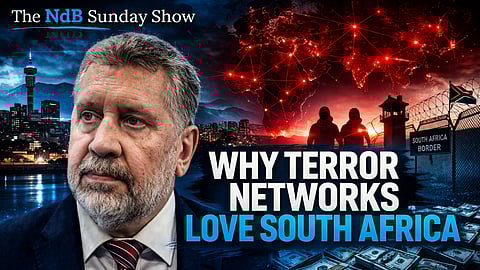
On today’s NdB Sunday Show, Chris Steyn talks to Willem Els, a consultant at the Transnational Threats and Organised Crime and the Justice and Violence Prevention Programme at the Institute for Security Studies (ISS) about why South Africa is considered to be so attractive to terror networks. Els describes how endemic corruption in “State facilities… not only within your law enforcement… but also up into a political sphere” allow terror groups to really thrive because that “facilitates not only for the terrorist groups, but also for your organised crime groups”. He also discusses the role played by the government’s foreign policy. “... it creates perceptions of political sympathy and tolerance…prompting those groups to actually come to South Africa and to operate here.” Els lists the key weaknesses being exploited by terror groups; outlines the strategies needed to fight them - and warns: “If we don't have a very good consequence management system, people are going to get away with murder and terrorists are going to think that they can also get away with murder.”.Sign up for your early morning brew of the BizNews Insider to keep you up to speed with the content that matters. The newsletter will land in your inbox every morning on weekdays. Register here.Support South Africa's bastion of independent journalism, offering balanced insights on investments, business, and the political economy, by joining BizNews Premium. Register here.If you prefer WhatsApp for updates, sign up to the BizNews channel here..Watch here:.Listen here:.Edited transcript of the interview.Chris Steyn (00:01.281)Welcome to the NdB Sunday Show with me, Chris Steyn, and Willem Els, a consultant at the Transnational Threats and Organised Crime and the Justice and Violence Prevention Programme at the Institute for Security Studies. Welcome Willem. Willem Els (00:20.45)Hi Chris, thank you. Chris Steyn (00:23.425)You're welcome. Terrorism in South Africa. Why is South Africa considered to be attractive to terror networks? Willem Els (00:35.052)Yeah, I think, know, it's been a discussion that's been ongoing for a long time. It came to the fore, especially when we had the FATF assessment of South Africa and also the sighting of some people within South Africa by the American Treasury as being funders and working to facilitate terrorism. So that actually opened up the door. But also just some background. You know, currently we have the so-called Sharia case in Johannesburg that's ongoing. We've got the Klip River case that is ongoing, on terrorism. We've got the so-called Del Vecchio case that's been on the books for several years already…. So there's been some cases. …So it's been with us. We haven't seen attacks to that matter, but we've seen that they have been here and it seems that South Africa actually opened ourselves to create an environment that is conducive for these people to thrive. But we see that recently Professor Hussein Solomon actually in one of his lectures, he really managed to capture the essence of what we are experiencing at the moment. …he mentioned that the absence of attacks does not equal the absence of the threat. And we should not be misguided. Chris Steyn (02:09.037)Are you saying that South Africa is failing? Willem Els (02:13.964)I think so. You know, the very fact that we've been Greylisted, we struggled for a long time to get removed from the Grey list and because of all the deficiencies that were identified in our structures. There are some reasons for that, why South Africa is failing. For instance, you know, we've got a very...a weak law enforcement that is supposed to actually close the gaps on these financial crimes and these people to actually thrive in the environment that has been created in South Africa. So the porous borders that we have, the weak immigration control, and also contributing to that, the weak enforcement, but also the infrastructure that we have in South Africa that is very conducive for these groups to operate, under the radar, our banking system, our transport system, our communication system, et cetera, et cetera. Those actually pave the way for these groups to exploit South Africa for logistics, but also for financing. Chris Steyn (03:28.173)So do you think that South Africa should be worried about an attack? Willem Els (03:37.71)I think as Professor Hussein mentioned, the absence of an attack doesn't mean that we don't have a problem. So I think the threat is rather more covert, the threat is rather more than kinetic. So we see that what's happening now because of what we mentioned about the conducive conditions that have been created here in South Africa, we see that these groupings, they focus at the moment on fundraising and the financial flows of them, movement of money, actually the generation of fundings. They also use South Africa for recruitment and for radicalisation support, not necessarily within South Africa, but in the region and beyond. And then also, once again, your safe haven for logistic coordination because of the weak enforcement of these legislations, etc. But also we see then, you know, because of the criminal economy that we have, we organised crime syndicates are thriving. They also thrive on the networking, the legal networking of your document fraud and your facilitation networks within the organised crime syndicates. Chris Steyn (04:53.132)What are the key weaknesses that are being exploited, Willem? Willem Els (05:00.682)I think, you know, these terrorist networks, they really are opportunistic, they do their homework, and they will move in where these conditions are conducive for them to thrive, but also where the chances of being detected is minimized. So we see that they look at your structural governance weaknesses within South Africa. In the first place, we mentioned your financial system vulnerabilities. We've got gaps still in our anti-money laundering and our terror funding controls. With the FATF, we updated our legislation and there's more money that has been allocated to the FIC, for instance, and so on. But we are not where we are supposed to be when it comes to the enforcement of these regulations. And secondly, I think what came out in the past six to eight months, know, you corruption that is endemic within your state facilities and not only within your law enforcement, but beyond, but also up into a political sphere that actually facilitate the groups to really thrive because that facilitates not only for the terrorist groups but also for your organised crime groups. The weak enforcement that facilitates and creates these opportunities for the networks to actually thrive. Then thirdly, you know, something that is also mentioned a lot and we say a lot about our porous borders, not only about the porous borders in terms of illegal immigrants coming in, but also the illicit goods and the money flows that are coming in and out. That is a big challenge. We have to look at your easy movement of people, goods, and your illicit finances that are coming from there. And then very important, what we also mentioned quite a few times in the past, our intelligence fraternity is really in limbo…. Willem Els (06:55.668)…and you know it's fragmented and it is really not functioning the way it is supposed to function. And these people, they really thrive and they exploit that in order to come up with their strategies. Chris Steyn (07:10.582)Does South Africa's foreign policy play a role? Willem Els (07:16.48)Yeah, I think, you know, our foreign policy, of course, it will play a role because at the end of the day, it sends out a message. And Prof. Solomon actually suggests that your foreign policy can have unintended consequences, even though it might not be intended by government and by the policymakers. As it is at the moment, it opens the door. So we see that South Africa's global political alignment and the problematic stances, you know, might send the wrong message to some of these groups. And also it will increase the visibility of these groups on our horizon coming in here. And then also it creates perceptions of political sympathy and tolerance, you know, prompting those groups to actually come to South Africa and to operate here..Read more:.The NdB Sunday Show — Jonathan Deal: Mkhwanazi, Masemola, The Big 5 - and the silence of the GNU….Chris Steyn (08:09.356)What needs to change urgently, Willem? Willem Els (08:16.044)Yeah, you know, there's a lot of things that we have to do. And I think we have to look at the multi-layered approach there. You know, there's something that can be done immediately. Then there are your short-term, medium-term and long-term responses. And it's very important, it must not only be multi-layered, it should actually be multi-dimensional and also multi-stakeholders that you have to bring in in order to deal with it. So if you look at your immediate priorities, first of all, we spoke about our financial systems, we spoke about our intelligence and our money laundering enforcement. Since we've been removed from the Gray list, South Africa is on a maintenance plan where we still have to demonstrate and we still have to improve. And I think it's an ideal opportunity for South Africa to bolt on what has been put in place with the FATF assessment and then we have to actually start to enforce. You know South Africa is very good when it comes to legislation, when it comes to policies and drafting of all of that and putting it in place - we demonstrated that because those were one of the first boxes that we ticked with the FATF assessment - challenge actually come with the enforcement of it and the implementation of those legislations and all those policies. So that is where we have to start. Then of course, you know, it's easier said than done, but our border security needs to be strengthened, because that is our first line of defense when it comes to this. And your challenge there is, you know, we've got very long maritime borders. We've got land borders that stretch several thousand of kilometers. But also we have corruption. Now, it doesn't matter if you have 200 or 500 enforcement agents at one small little border post. If corruption crept in and it compromised that area, that border post... Willem Els (10:20.298)…is porous and these things will come through. So we will have to look at how we're to strengthen that and how we're going to curb corruption when it comes to that. And then also, South Africa has got a history of inter-agency intelligence that is not what it is supposed to be. I know we've got NICOC and where they are really trying to bring things together. But the moment you get to intelligence, you know, the one with the most intelligence is the king. And so what's happening is that these agencies are not at liberty to always share everything and that can create some gaps. So we have to find a way to strengthen that mechanism and that we can bring in our intelligence and coordinate it. But because then you can start to proactively. Then we also need some strategic shifts. Your threat of terrorism in the past was...fairly standalone. But we saw in recent times that the interaction and the nexus between your terror organisations and your organised crime syndicates, that ecosystem, has now merged. They are feeding off each other and they are using each other. So it's not a standalone issue anymore. So while we have the SADC Transnational Organised Crime Strategy that is being implemented at the moment. We also are busy drafting our South African NationalTransnational Organised Crime strategy. We have to bring in the counterterrorism part and we have to see that we're not overlooking while they are feeding from each other and how they are benefiting from each other. Because if you just focus on the one, your chances are good that you might miss out on the rest. And then also, you know, it's about investment. We see that that is one of the big things now with the Budget and how much money must go to the military, how much to the police, et cetera, et cetera. But we see that our intelligence-led policing is actually what we need to do. There are two things. You need your intelligence-led policing and then you need your evidence-based policing. And they are feeding off each other because the only way that you can work proactively is if you've got those in place. Willem Els (12:40.43)So that is on a medium and a long term strategy. But also, South Africa is not an island. We are in a region, there are 16 countries within SADC. And if we do not bolt on that regional capacity and get all the partners involved, we are going to fight this one alone and then we're not going to win it. So I think the critical message that we have here is that, you know, South Africa...we are not a target at the moment, but we are part of the global terrorism network environment. And if South Africa does not close those gaps that we identified and that are there, it risks remaining a safe operating space for your global terror networks - even though we don't have attacks at the moment. Chris Steyn (13:30.604)Can this government realistically fix it, Willem? Willem Els (13:39.662)Chris, I think, yes, but as with everything else, you know, it starts with political law. We saw so many things in the past that went wrong, and that is where the political influence was there. The political interference was there. It's coming out in the commissions now. So we will have to, in the first place, demonstrate the political will in order to do that. Then we will have to actually minimize the political interference in the operation of your organisations that have to fight this. And then we have to come up with a strategy of consequence management. If we don't have consequences for what people are doing, and it's not only for this, it is from the smallest crime up to the most heinous crimes. If we don't have a very good consequence management system, people are going to get away with murder and terrorists are going to think that they can also get away with murder. So yes, we can fix it. It's not going to happen overnight, but we need a holistic, multi, multi-agency, multi-stakeholder strategy that will include everything else, but will be guided by un-intrusive political leadership. Chris Steyn (15:01.942)Thank you. That was Willem Els, consultant at the Transnational Threats and Organised Crime and the Justice and Violence Prevention Programme at the Institute for Security Studies. With me, Chris Steyn, on the NdB Sunday Show. Thank you, Willem. Willem Els (15:20.706)Thank you, Chris