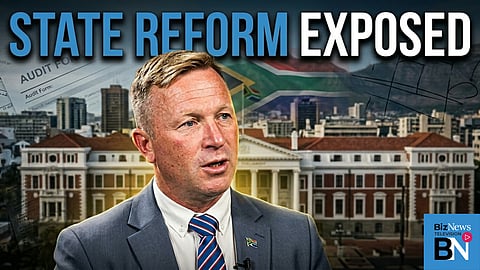
DA spokesperson Jan de Villiers unpacks one of South Africa’s most significant governance reforms since 1994, aimed at building a merit-based, professional public service. He explains how stricter rules, independent oversight, and lifestyle audits could curb corruption, restore accountability, and improve service delivery - while highlighting the political and practical challenges of making reform stick..Sign up for your early morning brew of the BizNews Insider to keep you up to speed with the content that matters. The newsletter will land in your inbox at 5:30am weekdays. Register here.Support South Africa’s bastion of independent journalism, offering balanced insights on investments, business, and the political economy, by joining BizNews Premium. Register here.If you prefer WhatsApp for updates, sign up to the BizNews channel here..Watch here.Listen here.Edited transcript of the interview.Irakli Rekhviashvili 00:08:13 - 00:35:12So there’s a particular kind of politician. South Africa doesn’t get enough exposure to the ones who do the quiet technical work of fixing the state. Jan de Villiers is one of them, the Stellenbosch man. He’s been in Parliament since 2019 and today chairs the Portfolio Committee on Public Service and Administration, the body that just drove through one of the most consequential governance reforms this country has seen since 1994. He’s also one of the DA’s national spokespersons.00:35:14 - 00:41:07Yeah. Welcome to BizNews.Jan de Villiers 00:41:11 - 00:45:21Thank you so much, Irakli. I am really honoured to be here. I really look forward to the interview.Irakli Rekhviashvili 00:46:00 - 00:55:21Thank you so much. I mean, you chair the Committee on Public Service and Administration and serve as a national spokesperson at the same time. How do you manage that?Jan de Villiers 00:55:22 - 02:03:04Yeah, so I must say the two roles don’t really clash at all. And I think what most people don’t always know about politicians is we often, basically all the time, have two hats on. So we are representatives where we do all constituency work and we work on elections.And my national spokesperson role is very much in that box. It’s part of my party work, if I could call it that.And then we all have, or those of us who are lucky to be public representatives, we have government work. I’m a Member of Parliament and the chairperson of a parliamentary committee, Public Service and Administration.But in just the same way that Jordan Hill-Lewis, who’s our new leader, is the mayor of Cape Town, but he’s also now a de facto leader. Those are also the two hats that he wears. Or on a local level, somebody can be a councillor in a local municipality, but they can be the DA chairperson of the local DA branch or whatever the case might be.So it’s kind of normal for us. But yeah, it is two roles and we make it work together.And I’ve found my spokesperson job is very much more off-the-clock, interesting hours, early interviews, late interviews over weekends. My Parliament work as a chairperson is very structured. We have Wednesday mornings, like clockwork, committee meetings. So I can always be well prepared for it. It’s a much more structured environment.Irakli Rekhviashvili 02:33:20 - 02:47:08That’s great. The Public Service Amendment Act has recently been signed, and your committee drove it through Parliament. Can you perhaps in plain language for our viewers explain what it actually means for everyday South Africans?Jan 02:47:10 - 04:17:03So I think I would like to touch on two aspects. When we entered the Government of National Unity, we received minister and deputy minister positions, but we also received chairperson positions in Parliament.The committees in Parliament are often referred to as the engine room of Parliament. It’s where we do oversight over departments and where we legislate.A bill would originate from Cabinet. The Minister of Public Service and Administration would draft the bill, take it through Cabinet, and then it would reach our committee. We would review it, send it for public participation, and then send a recommendation to the National Assembly. It may go to the National Council of Provinces, and ultimately ends up on the President’s desk to sign off.So legislation takes a long time.When we received our chairperson positions, we said legislation should not be held up in committees. We wanted to bring urgency back to Parliament.That’s why I’m happy that in my committee all legislation has been speedily processed, and this piece of legislation has now been signed off by the President.One of the reasons I’m happy is that the DA has always advocated for a professional, merit-based public service. This is now captured in the Government of National Unity’s statement of intent.The public service - often called the civil service - is about 1.2 million people. Government is the largest employer in the country.What we’ve seen in the past ten years of state capture is that if you capture the administration, you can enable corruption, especially through supply chain management and senior appointments.What you do to stop that is ensure a professional public service based on merit, with no political affiliation. This legislation makes it much tougher for public servants to be politically active while serving.It also strengthens the independence of Director-General appointments. Previously, a minister could appoint a Director-General without proper selection processes, which enables patronage networks.If you get someone at the top who is not there on merit, the result is state capture and corruption.You cannot fix the economy, hospitals, policing, or anything else without a professional public service. That is why I am passionate about this reform.Irakli Rekhviashvili 09:03:06 - 10:16:04You mentioned independent bodies and lifestyle audits. The SIU needs a presidential proclamation to be properly empowered, and that sits with the President. How will accountability be enforced within this legislation?Jan 09:05:06 - 10:16:04Lifestyle audits are a tool used mainly in the last three or four years. They assess whether public servants’ lifestyles match their declared income.You can either use independent auditors or the Special Investigating Unit (SIU).There are two ways to use the SIU: through secondment or through a presidential proclamation. The proclamation gives stronger powers and access to information.If seconded, they rely on voluntary cooperation, which is not always reliable if corruption is involved.So we believe there should be a presidential proclamation for all departments and senior officials to undergo SIU lifestyle audits.Irakli Rekhviashvili 13:59:19 - 14:24:18Is it a conflict, given reliance on presidential proclamation?Jan 13:59:19 - 14:57:15The challenge is cost. Lifestyle audits are expensive, and departments often do not have budgets for this.There needs to be coordination between National Treasury, the Presidency, and Public Service and Administration to make this more affordable and effective.Also, enforcement is difficult when only one person is audited without access to spouses or family members, which creates loopholes.So legislative strengthening may still be required.Irakli Rekhviashvili 15:58:17 - 17:42:16Why is standardisation still an issue across provinces after four years?Jan 15:58:17 - 17:42:16It is because there were no established standards at the start. Departments were told to implement lifestyle audits but given flexibility in how to do so.For example, some used external firms, others used SIU, and some used internal ethics officers.In one province, ethics officers conducted audits internally and reported no red flags, which is unlikely.This shows that audits cannot be done internally. They must be independent and external to be credible.Irakli Rekhviashvili 18:27:15 - 19:16:19On the GNU, the DA leader is staying outside Cabinet. Is that a strength or a gap?Jan 18:27:15 - 20:01:09At this stage, it is a strength. It allows him to continue as Mayor of Cape Town while leading the party.He will still attend caucus meetings and participate in decision-making.The DA is decentralised and operates on trust and strong relationships, which already exist across leadership structures.Irakli Rekhviashvili 22:10:10 - 23:15:17What kind of parliamentary leader does the DA need?Jan 22:10:10 - 23:15:17Nominations open next week, followed by an internal caucus vote using a secure digital system.The parliamentary leader is responsible for caucus strategy and works closely with the Chief Whip.The process is democratic and transparent.Irakli Rekhviashvili 24:32:22 - 25:41:06What is the dynamic between the parliamentary leader and Chief Whip?Jan 24:32:22 - 25:41:06The parliamentary leader sets strategy and direction.The Chief Whip ensures execution and discipline.One leads; the other implements.Irakli Rekhviashvili 27:42:14 - 29:05:00What must the DA do to reach a governing majority by 2029?Jan 27:42:14 - 29:05:00We must move from around 20–23% to about 30%.We have proven we can deliver, but we must also connect emotionally with voters.People must feel that the DA cares, not only that it performs well.Irakli Rekhviashvili 34:10:02 - 36:06:18What is one key message for the business community?Jan 34:10:02 - 36:34:15South Africa must grow the economy to reduce unemployment.Without growth, we cannot fix inequality or create opportunity.Government must remove barriers, improve service delivery, and ensure functioning infrastructure.Only then can people reach their full potential in an open opportunity society.Irakli Rekhviashvili 38:18:07 - 38:23:22Thank you so much for your time. This is BizNews.Jan 38:22:22 - 38:23:22Pleasure. Thank you.