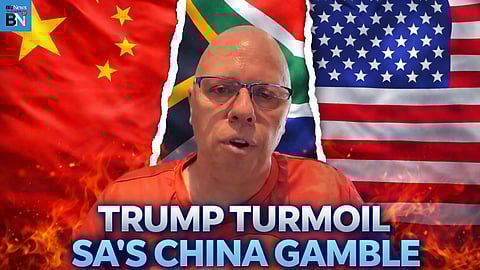
Is Pretoria’s rushed China framework a strategic masterstroke or political posturing amid rising US tensions? Trade expert Donald MacKay warns the economics don’t add up and the risks could outlast Trump..Sign up for your early morning brew of the BizNews Insider to keep you up to speed with the content that matters. The newsletter will land in your inbox at 5:30am weekdays. Register here.Support South Africa’s bastion of independent journalism, offering balanced insights on investments, business, and the political economy, by joining BizNews Premium. Register here.If you prefer WhatsApp for updates, sign up to the BizNews channel here..Watch here.Listen here.BizNews Reporter.South Africa has a habit of holding talks about talks. It is a national sport. But when those talks involve the world’s two largest economic powers, the stakes rise dramatically.In a frank discussion with Alec Hogg, trade expert Donald MacKay questioned the logic behind South Africa’s newly announced trade framework with China. On paper, it sounds ambitious. In practice, he says, it raises more questions than answers.The agreement itself is remarkably thin. It runs short, speaks in broad aspirations, and contains little in the way of operational detail. MacKay’s verdict is blunt. He sees plenty of political signalling, but very little economic substance.China is reportedly offering to remove duties on South African exports. That sounds generous. But when MacKay ran the numbers, the supposed windfall quickly shrank. China would forfeit billions in duties under current trade patterns. South Africa would forfeit almost nothing. The imbalance is so large that it prompts the obvious question: why would Beijing agree to this unless something else is at play?On the South African side, the gains appear limited. The country’s major exports to China, platinum and iron ore among them, already face low duties. Removing those duties will not meaningfully expand volumes. On manufactured goods, the reality is harsher. South Africa cannot compete with China on price or scale.Agriculture could benefit. Citrus and certain approved products already enter the Chinese market. But here the problem is not tariffs. It is non-tariff barriers. China’s sanitary and phytosanitary approval processes are notoriously slow. New agricultural products must clear regulatory hurdles one by one. Removing tariffs without addressing these barriers changes little.MacKay’s broader concern is procedural. Trade agreements are complex instruments. They take years to negotiate properly. They require modelling, industry consultation and careful sequencing. Yet this framework is being accelerated on a political timeline. A meaningful agreement by next month, he says, is simply not feasible.The suspicion is that economics may not be the real driver. South Africa’s deteriorating relationship with the United States looms large in the background. If this deal is meant to signal independence from Washington or to demonstrate alternative alliances, it may succeed symbolically. Economically, MacKay sees no replacement effect. China is not a substitute for the United States in South Africa’s trade structure. The composition of trade differs too greatly.There is also the question of long term consequences. Donald Trump will not remain US president forever. Trade agreements, however, have a habit of outlasting administrations. Locking in commitments to address a short term diplomatic rift could create constraints years down the line.MacKay’s critique extends beyond Pretoria. He believes Trump’s approach to global trade and security has injected deep uncertainty into the international system. Uncertainty is poison to investment. It alters strategic calculations not just in Washington and Beijing, but across Europe and Asia.He points to NATO tensions and the ambiguity around Taiwan as examples. If US security guarantees appear unreliable, other nations will respond. Some may accelerate nuclear programmes. Others may test geopolitical boundaries. The real damage of Trump’s policies, he argues, may only become visible after he leaves office.Against that backdrop, South Africa’s pivot toward China looks less like strategic diversification and more like reactive diplomacy. That does not mean engagement with China is wrong. It means the country must understand precisely what it is trading away and what it is gaining.MacKay is not reflexively anti-China. Nor is he defending Washington’s current posture. His message is more pragmatic. Trade agreements must increase GDP. They must create measurable economic benefit. They must be rooted in data rather than political theatre.South Africa’s history with trade deals is not inspiring. The country has signed numerous agreements over the years. Many are underutilised. Businesses often do not understand how to leverage them. Negotiations consume time and public resources without delivering clear economic uplift.This is why MacKay calls for transparency. If there is a compelling economic rationale for the China framework, government should present the modelling. Show the projected export gains. Detail the sectors that will benefit. Clarify the safeguards against import surges. Without that, scepticism is inevitable.The irony is that South Africa represents a tiny fraction of US trade. It does not carry enough weight to force Washington’s hand. Nor does it possess the leverage to shape Beijing’s grand strategy. That makes strategic discipline even more important.Trade, in the end, is not about grandstanding. It is about long term competitiveness, regulatory certainty and incremental gains that compound over time.MacKay’s warning is simple. Do not make permanent commitments to solve temporary political irritations. Do not confuse symbolism with substance. And above all, do not assume that aligning with one superpower shields you from the consequences of alienating another.