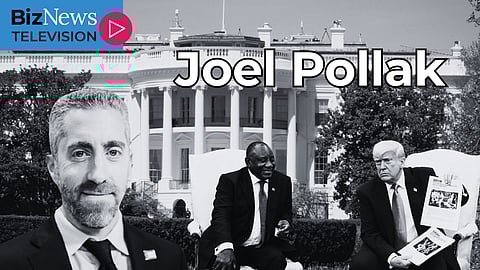
Trump Administration insider Joel Pollak shares how the US side reviewed last week’s Oval Office smackdown - and it doesn’t bode well for SA’s immediate future on trade or international relations. Pollak, once tipped as a likely US Ambassador to SA, provides perspective on the Ramaphosa camp’s clumsy spinning of a “successful” meeting - revealing the unvarnished truth with BizNews editor Alec Hogg..Sign up for your early morning brew of the BizNews Insider to keep you up to speed with the content that matters. The newsletter will land in your inbox at 5:30am weekdays. Register here.Support South Africa’s bastion of independent journalism, offering balanced insights on investments, business, and the political economy, by joining BizNews Premium. Register here.If you prefer WhatsApp for updates, sign up to the BizNews channel here.The auditorium doors will open for BNIC#2 on 10 September 2025 in Hermanus. For more information and tickets, click here..Watch here:.Listen here:.BizNews Reporter.When President Cyril Ramaphosa touched down in Washington for his much-anticipated Oval Office meeting with Donald Trump, expectations ran high - both in Pretoria and among South Africans disillusioned with 17 years of economic decline. Instead, the event unfolded as a geopolitical reality check, with Washington emerging victorious and Pretoria returning empty-handed, according to US political commentator Joel Pollak.In a wide-ranging interview with BizNews founder Alec Hogg, Pollak, a senior editor at Breitbart and seasoned Washington insider, offered a candid assessment of what really happened behind the scenes. His analysis paints a stark contrast to the triumphant spin coming out of South Africa’s government and mainstream media.“The White House is satisfied they achieved what they wanted… a public victory over a South African government that was intransigent,” Pollak said. “South Africa came for a fight and got one - and lost.”Not a negotiation, but a performanceFrom Pollak’s account, the South African delegation, far from being prepared to negotiate, came to Washington with the sole purpose of posturing for a domestic audience. Their goal? To publicly correct Trump’s “misinformation” on issues such as farm murders and land reform - a strategy Pollak describes as naïve and provocative.“You don’t come to the White House to lecture the President of the United States,” Pollak warned. “That’s not how diplomacy works - especially not with Trump.”Pollak claims the meeting had been reduced to a political theatre from the outset. Ramaphosa’s team, he suggests, staged their own “ambush” by including white South African figures like John Steenhuisen to rebuff allegations of white genocide - an issue Trump has highlighted in the past.But the plan backfired.Trump, well-briefed and unfazed, countered with video evidence of Julius Malema’s incendiary remarks, illustrating the exact rhetoric the US finds troubling. “Malema has become Afrikaners’ best PR agent,” Pollak quipped. “The US government isn’t investigating AfriForum, but it should be asking why South Africa isn’t investigating Malema.”Empty hands and missed opportunitiesPollak notes that no real diplomatic progress was made. There were no proposals from the South African side - no trade deals, no concessions, and no substantial foreign policy discussions. The only “achievement” was a vague suggestion that Trump might attend the G20 summit - something Pollak characterizes as a diplomatic sleight of hand meant to create leverage.“Ramaphosa returned with nothing,” he emphasized. “No aid. No new trade terms. No progress on AGOA. Just a photo op.”What could have been a platform for strategic compromise and renewal of bilateral relations became a zero-sum game. Even critical economic opportunities - such as the inclusion of Elon Musk’s Starlink to address digital inequality - were apparently never mentioned in the actual talks..Read more:.Feisty Joel Pollak - defending Afrikaner refugees, urging Western Cape to promote its exceptionalism.Domestic weakness on global displayAccording to Pollak, Ramaphosa’s lack of engagement stemmed from political paralysis at home. “He may simply be a weak president,” Pollak said. “He can’t compromise because he’s beholden to hardliners in the ANC and fearful of alienating the EFF or factions within his own party.”Pollak pointed to Ramaphosa’s post-meeting defense of Julius Malema’s “Kill the Boer” chant as a profound error, calling it “a terrible signal to the world.”“Trump made it clear he wanted something done about it. Ramaphosa came home and essentially defended it,” said Pollak. “He’s now equated himself with Malema - and that damages South Africa’s global standing.”No Washington friends, no favorsUnlike the Ukraine delegation weeks earlier, which included a swath of US cabinet officials and generated new strategic commitments, the South Africa meeting was almost entirely one-sided. Trump alone led the meeting. “There was no appetite to build anything,” Pollak explained. “The US came to send a message, not to partner.”When asked about the looming 30% tariffs on South African goods, Pollak was blunt: “That threat is real. If Pretoria doesn't shift gears, it will face consequences.”Even symbolic gestures like praising Trump’s peace efforts or referencing Zelensky’s visit fell flat. “They offered nothing tangible. No concessions, no strategic alignment, not even a shared vision,” he said. “Contrast that with the UK trade deal - London offered something, however small. Ramaphosa couldn’t even manage that.”Business, not politics, may save relationsLooking ahead, Pollak believes any hope for salvaging US-South Africa relations lies outside of government. “If things improve, it’ll be thanks to business leaders and private actors - people building transnational ties from the ground up,” he said.Starlink is a potential model: an idea born in the business community, slowly gaining political traction. But more such initiatives are urgently needed.“Pretoria has made itself a cautionary tale,” Pollak concluded. “Unless it changes course - and quickly - it risks diplomatic isolation, economic penalties, and deepening public distrust.”In the end, the Trump-Ramaphosa summit may be remembered not as a triumph, but as a warning shot: performative diplomacy has a cost. And South Africa, once a poster child for democratic aspiration, now finds itself relegated to the wings of global influence - unprepared, unpersuasive, and increasingly, unimportant.