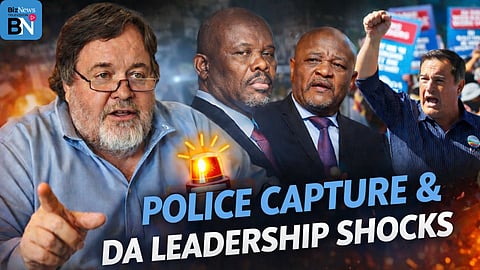
More and more shocking testimony of police and political capture is being heard at the Madlanga Commission of Inquiry and Parliament's Ad Hoc Committee. In his latest interview with Chris Steyn, policy and political expert Professor Theo Venter dissects the evidence of Witness F and other recent testimony. “I think this is an interesting spin on the investigation that's emerging over the last three or four evidences that we received that politicians would use organised crime, and let's use Cat Matlala as the example, to carry political messages to the police…or use somebody like Brown Mogotsi almost as a facilitator of the message and thereby not go directly into the police. And I think it's the Brian Mogotsi-Senzo Mchunu relationship that opened that of worms for the first time.” Professor Venter looks at the implications for suspended Deputy National Commissioner General Shadrack Sibiya and former Police Minister Senzo Mchunu who is on special leave. He also shares all the names that have crossed his desk for the next leader of the Democratic Alliance (DA)..Sign up for your early morning brew of the BizNews Insider to keep you up to speed with the content that matters. The newsletter will land in your inbox at 5:30am weekdays. Register here.Support South Africa’s bastion of independent journalism, offering balanced insights on investments, business, and the political economy, by joining BizNews Premium. Register here.If you prefer WhatsApp for updates, sign up to the BizNews channel here..Watch here.Listen here.Edited transcript of the interview.Chris Steyn (00:01.916)More and more shocking testimony of police and political capture is being heard at the Madlanga Commission of Inquiry and Parliament's Ad Hoc Committee. I speak to policy and political expert, Professor Theo Venter. Welcome, Professor. Theo Venter (00:23.586)Pleasure having you. Chris Steyn (00:26.098)Shall we start with the testimony of witness F? Your thoughts. Theo Venter (00:32.46)Yes, I think witness F is the most recent, apart from the court case, which was dealt with early in the morning, which I'm very glad. maybe just in general saying that early when this year started, I thought, okay, we are going to ease into 2026. And then Donald Trump, of course, made it much more interesting in the beginning two, three days. And ever since that, it hasn't stopped from Donald Trump to John Steenhuisen to both the Ad Hoc and the Madlanga. But you're quite right. I think the juicy pieces, if I can call it that, in the big puzzle are now being filled in by both of these investigative bodies. Chris Steyn (01:23.656)And what of sorry, what of witness F’s testimony stands out for you? Theo Venter (01:33.731)What stands out is part of the triangle that is emerging in organised crime that you must have access to a security company, you must have access to a taxi organisation for you to distribute your product, be it drugs, be it whatever. And it seems to me Witness F was playing in that game where the big taxi boss was on the one hand very important in all his dealings and he was like the conduit to Sebiya on the other hand and then the whole question of firearms was involved in that. And then lastly, the thing that the Madlanga Commission is really supposed to investigate: clearly some political interference and some political pressure put on police officers or members of Crime Intelligence to deal with individuals that irritate them or that they don't like. So yes, his testimony has been quite significant, although he came to the commission very hesitantly and his lawyer tried his best to put brakes on the commission. I think the Commission passed this test with a very, very high margin. Chris Steyn (02:59.666)What does the latest testimony mean for suspended Deputy National Commissioner General Shadrack Sibiya? Theo Venter (03:08.79)I think it means that he will stay suspended. It's interesting that his name is not mentioned in the Presidential Order to the Commissioner of Police and the Minister of Police to be investigated. And that was curious. I thought his name would also be up there, but it is not there. So in other words, I think the case against him, or at least what we hear, is of such a nature that...his name isn't there and Senzo Mchunu’s name also isn't there, but I guess that's for political reasons and the president said that Senzo Mchunu is the burden for him to carry, whatever that means in politics, I'm not so sure. But I think the Shadrack Sibiya case is absolutely fairly clear. I think he will be called again to do some testimony towards the end. But I think it's clear that he was a major, major kingpin in the linkage of those three entities that I spoke about. And you have your security company because that provides the firearms and the protection you need and the blue lights you need, whether it's legal or illegal or whatever. You need the taxi industry to convey or to carry or to transport. And then, of course, you need access to the product and that was where Major General Senono's evidence a week or so ago was also crucial. It's hanging in the air but somehow drugs disappeared and it seems to me the investigative people were very cynical about the explanations provided by Senono. Chris Steyn (04:58.312)That cryptic remark of President Cyril Ramaphosa about Mr. Mchunu…but surely he cannot protect him with everything that is emerging. Theo Venter (05:08.812)Yeah, I agree with that. I think even when testimony started and when the Minister was in front of the Ad Hoc, the lack of clarity on his answers and the searching for a justification of what he did. In other words, why would you at the end of December change the structure of the police on your own when the work of a Police Minister is to give guidance, to help with policy and to set direction? It is not to administratively design of organisational charts. That's not your work. That's the work of the Commissioner of Police and not even the Commissioner of Police will do that. He will have specialised people in his HR division doing those things because it's fairly important when you do… But if you develop an organisational chart. It's not only doing a little picture of who reports to whom, but there are things like levels and salary scales and responsibilities. There's a whole package around each and every post when you develop something like an organisational chart. And sitting alone in your rondavel at the end of the year is absolutely the wrong place to do that. So the Minister wasn’t convincing and then Madlanga took him and that was even worse. So I think politically, he has had his chips, if I can use the word that we use so often in high school. How the ANC is going to deal with it, I think that is in part going to play out in the ANC's own leadership struggle towards the next year, year and a half. Theo Venter (07:15.502)And I think they can look a little bit at the DA going through a similar kind of thing now when suddenly certain things emerge and people must not make themselves available and other people come through the ranks and so on. My guess is that the best way for Senzo Mchunu to get out of the way is to take retirement. He's old enough, and there will be a pension of some kind through Parliament. He's long enough there, was long enough in government and maybe fulfill a job in the Luthuli House as an ANC party operative. But as a political appointee, I think he can't be appointed anymore. Chris Steyn (08:05.394)Do you think General Sibiya's name was not on that list because there is already probably an investigation into him judging by the raid on his house?.Read more:.The NdB Sunday Show: Prof. Theo Venter - Cat’s Metro Capture, Gigaba’s fall, Trump’s G20 boycott - and the GNU’s unity breakthrough….Theo Venter (08:16.172)Yes, I think that's one of the reasons. And when you do an investigation, like the Commissioner of Police was now instructed through the Minister, that means you must now investigate and you must gather intelligence and you must gather information and you go through that whole process of how you investigate the case. I think with Sibiya, they have the opinion that they've got enough. And remember, one of the… instructions of the Madlanga Commission, not necessarily the Ad Hoc. The Ad Hoc …Committee, must provide Parliament with a way forward. And I think that is going to play out in the Police Act, or how legislation will be changed. The Madlanga Commission, its recommendations will play out in the Presidency, where its interim report already had a result, but what that will do if you look carefully at what the instructions were, is they must recommend whether certain people must stay in their positions, whether they are appointable, and whether they're in the right position. And I think in those recommendations,I think Sibiya is not going to get a of a clear answer. I think they will recommend that maybe it's time for him to go. Chris Steyn (09:43.93)If General Mkhwanazi did not call that shock press conference, do you think General Sibiya would eventually have become National Police Commissioner and Mr. Mchunu might even have become the next President of the African National Congress? Theo Venter (10:01.356)Yeah, that's an interesting scenario that you're talking about because there is criticism on on Mkhwanazi himself and we've seen some pushback through the evidence led by McBride and one or two others and of course Paul O'Sullivan is still running around; they haven't cornered him yet and I'm sure he's going to give some pushback and I think the recommendations would include a reference to how Mkhwanazi did it because it was unconventional - and if you take the Mkhwanazi example and you see how it spilled over into the Defense Force where the Chief of the Navy are now talking closely and he's saying things about his political overseers which I think is militarily uncalled for, the Chief of the Health Services did the same, and the Iran participation, the naval exercises, it tells you that there's a big problem at the top structure of the Defense Force and I think they took a leave from what happened in the police. And I think one of the recommendations would be, if I can describe it in the following way, that politicians must get out of administration - and the administration, meaning the generals or the commissioners, must get out of politics. And what we've seen in these investigations is that those two are too closely intertwined. And the untangling of that is really astonishing if you see how deep it goes, where paper bags would deliver the newest evidence, how Ozempic, the wonder drug nowadays, how that was delivered to certain police officers, jet skis, boats, weddings. It's just incredible how this... And social events, social parties. For me, as a political analyst, it was interesting every time when I saw on TV or personally when I attended as an analyst, Theo Venter (12:22.582)…that police officers are at the ANC's annual Elective Conference. They shouldn't be there unless they're protecting the politicians, but they can't be there participating. And they were there, and the same with the military. And I think if these two investigative bodies can do anything, it's to take those things a little bit further out of reach and so that we get a better governed police, a better governed Defense Force. I know this interview is not about the Defense Force, but it's about the security structures in general and that politicians know where their limitations are. Chris Steyn (13:04.476)Wasn't it the African National Congress SG Fikile Mbalula, who warned police generals after General Mkhwanazi's press conference that they should remember that the ANC appoints them? Theo Venter (13:16.952)Yeah, but he's not innocent in this whole thing. If you read the evidence and if you listen carefully, he was involved in several instances as Minister of Police and in other roles that he played where he has placed some pressure on police officers, sometimes indirectly. And I think this is an interesting spin on the investigation that's emerging over the last three or four evidences that we received that politicians would use organised crime, and let's use Cat Matlala as the example, to carry political messages to the police. And it's not necessarily, or use somebody like Brown Mogotsi almost as a facilitator of the message and thereby not go directly into the police. And I think it's the Brian Mogotsi-Senzo Mchunu relationship that opened that of worms for the first time. Chris Steyn (14:28.53)What do you think of Brian Mogotsi and forensic investigator Paul O’Sullivan's way of avoiding the Ad Hoc committee by citing personal security concerns? Theo Venter (14:43.322)Well, first, Brian Mogotsi. There was no such security concerns when he was at the Madlanga Commission. There was only a lot of sweat and a lot of water drinking. So he was very much on his nerves. Now that was, let's call it, Investigation Chapter One, before the end of last year. They have now learned what they must do: they can't go there and intimidate a commission or BS the commission, if I can call it by its name, because that's what they're trying to do. And I think we must give the three commissioners at Madlanga a very, very high score in terms of their decisiveness and how they apply the law….They’re doing very well - and I think Judge Madlanga in his soft approach is as sharp as a blade in doing these kind of things. Parliament of course is a different kettle of fish. There your questions are all over the place and it is intertwined with political statements and questions - and very often I think especially on the Action SA and the EFF and MKP parliamentary representatives very often go, is there for the statement they're making rather than a question. Other people like Cameron and Breytenbach, they're closer to the point. So you must distinguish between those kind of things. I think they're not going to get far. And Carrim, the guy that was now in front of commission tomorrow at Madlanga, he failed with his interdict against the commission. You know, when you ask for an interdict and it is denied with cost, it means the judge wasn't impressed with the reasons that you provided. Theo Venter (16:50.07)…you will go to the Commission and you'll talk to them. And the interesting part of Witness F was that his lawyer tried everything in the book, from coming late to being hungry to being this to being that, to make it difficult for the Commission, but the Commission just continued on like a steam train. And eventually, he started speaking despite the bricks that his lawyer tried to put in place of his testimony. Chris Steyn (17:26.216)Do think he was hesitant because he feared for his safety; look, a previous witness was killed? Theo Venter (17:35.311)That definitely has mattered because you're quite right. There was, I think it was Mr. D that got hit. Yes, A, B, C, D, E, F…that created, even the commission is very concerned about that. Now, even if you address the commission anonymously, people would know who you are, people in the police would know who you are. The network of crime cartels would know. There is definitely security challenges which I think we must take serious. But I mean, this is a dangerous job and everybody that participated know this. And I'm sure through this commission, more and more people will come forward with smaller but very much the same kind of situation. What we see here is this fascinating story of Armandt Swart being killed and then rifles and cartridges found in a bus near, I think it's Bramley, while the shooting was in Vereeniging and then they put it together and then this whole thing emerged and then of course, KT Molefe was also involved and I think it was yesterday or the day before when evidence was brought by a captain from Forensics..Read more:.Prof Theo Venter - 2026: Trump, the ANC, the GNU, AfriForum and Solidarity….Theo Venter (19:15.414)That was also not very convincing. Some of the mistakes he made, I was listening very carefully. I tried to give him the advantage that maybe some of these things were done... just as an ordinary mistake. But the longer I think about it, the clearer I can see that if you fear an investigation, if you've got a hold on two people at the Forensics Lab, then that is something. And his excuse, which the judge didn't find very humorous, that they're chasing numbers, in other words, quantity rather than quality, that didn't go off very well and I'm sure that will be one of the recommendations in the Madlanga report. Chris Steyn (20:10.76)Are there any other points from these inquiries that you would like to highlight? Theo Venter (20:16.834)Well, I think the most important thing that I would like to highlight is that we have seen for the first time that I can remember that the President acted on an interim report, the Madlanga interim report. That to me is a positive signal. And then secondly, I think there is slowly but surely a recognition that the problem that we are looking at, in Afrikaans I will call it the rotness, the place where all these things started, is Crime Intelligence. And some of my co-commentators also refer to it as Crime Incorporated, not Crime Intelligence. That there is a problem and more oversight and looking at how this is done is very, important. And the second part is we must do something about the investigative capability of the police, detectives to call it simply, and there's just not enough of them and very important cases are being stacked onto 200 or 300 and no single individual can deal with that. And I think more bobbies on the street is maybe something that we can do but that's not going to solve problems and that's not going to bring good cases to court. So this whole criminal system is under pressure due to the police's inability to get a good detective system going and of course Sibiya was the head of it. Chris Steyn (22:08.008)Before I let you go, the resignation yesterday of Democratic Alliance leader John Steenhuisen…your thoughts? Theo Venter (22:18.52)Two weeks ago, I was asked the same question and I said, in terms of what I know, there's only one candidate for the Federal Congress of the DA in April, 11 and 12 April, and that will be Steenhuisen. Geordin Hill Lewis already indicated that he will not stand because he wouldn't oppose his good friend John Steenhuisen, and they are good friends. But then slowly but surely messages came through and by Monday people were asking me is John going or is he not going? And then it became clear that it is the combination of three or so issues that kind of flowed together that forced his hand. The one being the accusations made by Dion George. Whatever it is, it's still fairly confidential nobody really knows what it is that he shared with the DA but it's being investigated. And the second thing of course is I would say two approaches in the DA. The one saying that the participation in the GNU is fine but we must be more aggressive. The other approach is no no let’s let's ease our way in and see where we can get those two things. And I think John is more towards, let's ease ourselves in. Helen Zille, think is more towards guys, we must strengthen our backs and we must be a little bit more aggressive. That started playing out in the party. And I think lastly, the Food and Mouth disease and the reaction of the farming community, a very, very aggressive reaction all over the place. And it seems to me that if I can call it that, I think his reading of the room temperature was wrong. The problem was much bigger. Theo Venter (24:23.63)But here I must give John Steenhuisen a little reprieve. He inherited Onderstepoort. He inherited a department that undert… was already not doing what they had to do. And for him to turn that around in one and a half years is just not enough. So yeah, but I think eventually he paid the price. The fact that he stays on as party leader until April, but that he will now focus more on the departmental work, I think that's good for agriculture. I know there's a few voices in agriculture like SAAI and like…Sakeliga and things and groups like that, Transvaal Agricultural Union and Free State Agri, they're not happy with that. But if you look at the numbers and you look at Agri-SA, they're happy. They haven't said a word in this whole debate. But it is these small guys that was all over the place. I think there is a large majority that feels leave John Steenhuisen where he is at least now. He can focus on an epidemic in agriculture that is comparable to COVID in South Africa in 2020, 2021. And we can all still remember who was the most hated figure in COVID. That was of course Nkosazana Dlamini-Zuma, because she signed all those stupid regulations. And I think John Steenuisen finds himself in very much the same thing. But, the positive of what I see is that new leaders, especially younger ones, the names that I've seen, may come through the DA structures. And I think the DA being recognised generally as the party with the most diverse support among all racial groups in the country, they may utilise this coming Federal Conference… Theo Venter (26:34.584)…to even expand on the diversity of their national or their federal leadership. And that I think is a positive. Chris Steyn (26:43.848)Okay, so which names have come across your desk as the next leader? Theo Venter (26:48.574)Well, I thing Geordin Hill Lewis, is a front runner because his name was already mentioned earlier. I've seen the name of Alan Winde as premier of the Western Cape. I'm not so sure that he has the gravitas, the energy for what the DA demands. I've seen the name of Solly Malatsi, our Minister of Communication. I've seen the name… Siviwe Gwarube's name was mentioned. So those are the names. We mustn't forget one of our best performing DA ministers of agriculture, Ivan Meyer, in the Western Cape. And the reason why I'm mentioning Ivan specifically is that in the last by-elections, excluding the latest two, which the DA took by-election from the ANC, but in previous by-elections, the Patriotic Alliance under Gayton McKenzie took some significant votes from the DA. And I think the DA must very, very closely check their position in the so-called Coloured community of South Africa. Chris Steyn (28:12.826)Indeed. Thank you. That was political and policy specialist Professor Theo Venter speaking to me, Chris Steyn at BizNews. Thank you, Professor. Theo Venter (28:23.821)Thanks Chris and cheers.