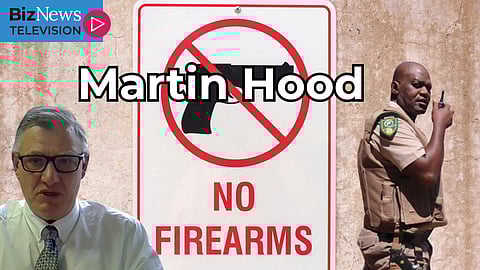
Proposed amendments to South African Private Security Industry Regulatory Authority (PSIRA) regulations will “basically control the possession of firearms everywhere” - and will “constrain the ability of the security industry to respond to potentially dangerous situations”. This is the warning from attorney Martin Hood who is concerned that there's “some terminology in these proposals that are ideological - and I think that they've overstepped the mark, and there's going to be consequences for them that may be very difficult for them to deal with”. Hood says the government's view of the private security industry as a threat is “completely unjustified…The private security industry is not going to be the spearhead of a revolution in this country. It actually stopped that in July of 2021.” He urges the public to lodge objections to the proposed amendments, and adds: “the view of the industry is that these proposals are unlawful.…the industry and broader society may have no option but to take them to court because the consequence of them coming into effect in the way that they are will be an adverse consequence on the ability of all of us to protect ourselves and our assets”..Sign up for your early morning brew of the BizNews Insider to keep you up to speed with the content that matters. The newsletter will land in your inbox at 5:30am weekdays. Register here..Support South Africa’s bastion of independent journalism, offering balanced insights on investments, business, and the political economy, by joining BizNews Premium. Register here..If you prefer WhatsApp for updates, sign up to the BizNews channel here. .Watch here:.Listen here:.Edited transcript of the interview.Chris Steyn (00:02.374)Will half a million private security guards effectively be disarmed if proposed amendments to private security regulations are implemented? We speak to attorney Martin Hood. Welcome, Martin. Martin Hood (00:16.046)Hello, thanks for having me. Chris Steyn (00:18.832)You're welcome. Please take us through the most significant proposed amendments. Martin Hood (00:25.614)The regulations as a whole are very poorly thought out and they are very poorly presented. But I think what's of most interest to people in general, not the security industry, are the restrictions on the carrying of firearms in what the regulator terms public places, but which actually aren't public places. Because many of the places specified such as shopping malls, restaurants, and hospitals are actually privately owned, but the regulator is saying that these are public spaces and you can't take firearms there. And then the regulator goes even further and says in a later regulation that he, an administrative official, can prohibit the issuing of a firearm of a particular type to a security officer for the rendering of a security service in terms of not only to the company and the security officer, but the area. So what the regulator is proposing to do is basically control the possession of firearms everywhere. And it's clear that the intent of these regulations is to stop the possession of firearms in public spaces. And that, unfortunately, is where they are most frequently needed. And a simple example, which is not a public space, but it has public has access to it as a shopping centre. We all know that there are guards at shopping centres and they have access to armed reaction services. And there are, for example, cash deliveries because shopping centres have ATMs and they have banks. So when you want to deliver cash, you have to have firearms because of the risk of robbery. Now all of a sudden, the cash and transit companies are not allowed to take firearms into a shopping centre. But there's an even more fundamental problem with these proposals because if you look at what really is a public space, it would be a public road. So if you look at the one phrase in particular that the regulator has decided to add to this, it talks about or any other public establishment, sorry, any other similar public establishment. So the regulator really is saying that you can't have firearms in public. So the transportation of firearms on a public road… Martin Hood (02:50.946)…may well contravene this regulation. If you look at the structure of these regulations and the two in particular that I've read, they emasculate the ability of the security industry to possess firearms. That is not a security industry issue. It's much broader than that because private security renders services to its clients. So it's a contract. But by definition, that security touches many members of the public indirectly as well as directly. I've given the example of a shopping centre, a restaurant is another example. Schools are another good example. This is what I'm about to say is another example of how poorly the regulator, the PSIRA, Private Security Industry Regulator, has considered these proposals because public, private security at schools is regarded as an essential service. It's proclaimed as an essential service. Yet, one of the places where the possession of firearms is prohibited is in a school. So you've got a conflict of different laws. Now there's a very good reason why you have private security at schools. We're talking about the safety of children. We also need to see these proposals in the context of an increase in kidnapping in this country, unfortunately. And then another example is in churches. There was an example a few days ago in KwaZulu-Natal where a pastor was held up and kidnapped at gunpoint from his church. Now, what these proposals say is, well, sorry, you can't have security there anyway. The ambit of these proposals touched the retail industry because private security protects the retail industry in general. So we're talking not just shopping centres, we're talking about commercial centres. It affects business in general because business parks have guards that have access to firearms. In fact, some business parks have armed security physically present, but most have armed reaction. It affects rural security because first responders generally in rural areas are your private security. And one of the submissions I'm going to make is from a farmer… Martin Hood (05:08.706)…who called this private security company to come and arrest the poacher. The private security company had to first go to the police station to collect the policeman, to come to the farm, to arrest the poacher, to take them back to the police station because the police station didn't have vehicles. There are so many examples. The mining industry is very concerned about this because they have massive areas that contain essential infrastructure. And I use this word essential infrastructure because it's a legal term, it's in legislation. And that is proclaimed as protectable and it includes public and private infrastructure. So mining houses have to protect infrastructure to support the operations. We're talking about electrical cables, water supply. Everything that you can possibly conceive of in terms of a public service infrastructure is protected by private security. And the last example I want to give is ports in South Africa. All of our ports are protected by private security. Now, some of what I've mentioned are national key points, which is other legislation which dictates that there must be private security. And we're talking national legislation versus regulation. And someone hasn't done their homework yet. The conflicts in legislation are manifest. Chris Steyn (06:34.14)So if these regulations are implemented, what will the impact be on the fight against crime? Martin Hood (06:42.478)It will constrain the ability of the security industry to respond to potentially dangerous situations. Any employer has got an obligation to equip their employee properly and it's unreasonable to expect an employee to place himself in a dangerous situation where they're not given the correct tools to deal with it. So there will be massive limits on the armed reaction industry, first of all. We all know that criminals take advantage of weakness. So as soon as there's a weakening of the security, there will be an increase in crime. And I think it's also important that with that increase in crime will come an increase in insurance costs because insurers will be then obligated to cover higher losses. And I want to give a very specific example. The car tracking industry recovers thousands of vehicles a month through the use of car tracking devices. Many of those cars are hijacked. Criminals have guns. The tracking companies are not going to send unarmed guards into a situation where they know that a vehicle has been hijacked to recover it. So the vehicle recoveries will go down. The cost of insurance will go up. The more one thinks about it, the economic impact of this is so potentially adverse. The tourism industry, if we...have the perception worse than it already is that we're not a safe destination for tourists, then tourists won't come here. Chris Steyn (08:19.782)What will be the ramifications for ordinary citizens if in the worst case scenario the only people with firearms out there are criminals and cops? Martin Hood (08:30.04)Well, that's an interesting question because on the one hand, many people rely on private security and they don't go and buy their own form of protection like a firearm. And I think obviously if the security industry can't provide that on protection, then people are going to have to make a decision, potentially, do I go and purchase a firearm myself because if I can't be protected by somebody else, I must do it myself. So again, we're looking at potential unintended consequences here. It may be that there will be an increase in demand for people to go and arm themselves. And that probably is something that the government has already thought through, and it may be a consequence that they might not like, but it may be an inevitable consequence. Chris Steyn (09:16.666)What is the thinking behind these proposed amendments? I know there is an attempt to deal with rogue elements in the security industry, but what other thinking is behind this? Martin Hood (09:22.146)Well, you can look at a number of different labels. Martin Hood (09:32.226)First of all, think there's sufficient legislation that's not properly enforced to deal with rogue elements. The regulator has given some examples of why they need more powers, and with respect to the regulator, he doesn't know the law because the examples that he gave are covered by the current legislation. What does concern me is that there's some terminology in these proposals that are ideological. And I'm referring specifically to high caliber firearms, which is a phrase that comes from organisations that want to remove firearms. There is no such thing as a high caliber firearm. But this phrase has come from somewhere. And what is interesting is that these proposals mirror to a great extent 2021 proposals to amend the Firearms Control Act that came from the Secretariat of Police. And I know that these proposals here came from the Secretariat of Police. So it seems that someone is driving a gun control agenda here in the form of better regulation. And unfortunately, I think they've missed the mark. And I think that they've overstepped the mark, and there's going to be consequences for them that may be very difficult for them to deal with. Chris Steyn (10:51.132)Could there be political reasons? Martin Hood (10:55.086)Well, as soon as you talk about ideology, I think it does become political. We have a government that has expressed very strong anti-firearm sentiments, as it is entitled to do. And there may be a time and a place for better restrictions on firearms. But the first step is to actually get your law enforcement agencies in order, and that is the police, the National Prosecuting Authority, and our courts; justice as well. And I work with all of those entities and I can tell you, unfortunately, that their capacity is just getting worse and worse. Then you must enforce existing laws and see how successful that is because there is no point in making more laws when you can't enforce them. All it does is it forces the law-abiding people to jump through more hoops and it just creates more opportunities for the criminals to do what they're already Chris Steyn (00:02.424)Do you think the government sees the private security industry as a threat? Martin Hood (00:07.612)They do, but it's completely unjustified. The private security industry is not going to be the spearhead of a revolution in this country. It actually stopped that in July of 2021. But for the security industry, the effect of the riots would have been far, far worse. The police were very slow to respond. And we all saw private security at shopping centres stopping the riots. We saw private security in the middle of the riots trying to stop it. So no way. That's a complete misconception on the part of government. And what we also need to bear in mind is on a ground level, every single reputable security service provider has to and does work hand in hand with the police. They provide a tremendous amount of resources to the police. They work with the police in operations. They provide vehicles. They support police stations even. Not one of the service providers that's come to me has anything bad to say about the police on ground level, where they work with them. This is why these proposals seem so wrong, because they don't take into account what happens on the ground. Chris Steyn (11:53.533)Well, meanwhile, the trade in illegal firearms is rampant as ever. You and I can go and buy an AK47 this afternoon if we feel like it. Martin Hood (12:03.074)Well, again, what's interesting is there's been a spike in cash and transit robberies in the last three months. I've got the data. And because I work in the industry, I see a lot of material that's not necessarily publicly available. But what you do see, even in some of these public videos, is the use of automatic firearms. And those come from one of two places. They come from the police or the army, or they come from the illegal trade. They're not available to civilians. So again, we've got to ask ourselves these basic questions. Where are they coming from and why? Before you start regulating us, get your own house in order, go. Chris Steyn (12:43.516)Now what can be done to fight the implementation of these regulations, or to at least get the proposals amended? Martin Hood (12:47.704)That's a very critical question because I think the response has been very strong, a negative response. And whether this government likes it or not, and bearing in mind now that it's a coalition government as well, the feeling of the public, the response of the public is critical. And if you have a situation where there is a very broad rejection by the public, then you have to go and rethink. And that's where public participation becomes important because the public have a voice and it's something that many of us don't really understand or exercise, but you have a voice. And there is a way to lodge an objection and ironically in the government gazette itself, the email address that was given was incorrect. So that just goes to the level of competence of what we're dealing with. You can send an objection to regulations@psira.co.za and PSIRA spelled P-S-I-R-A regulations@psira.co.za Do it now please! Chris Steyn (13:56.604)Is it possible for legal action to be launched if necessary? Martin Hood (14:03.96)That's always a question that people get asked, ask a lawyer if he's going to go to court. The first process obviously is engagement. And we need to try and use reason and fact to sit down with the regulator and government to say this is not a good idea. Obviously, the view of the industry is that these proposals are unlawful. They're not properly formulated, they give excessive powers where that power is not legally permitted. So the many legal arguments that say there could be a legal challenge. And I think fundamentally, to answer your question, the industry and broader society may have no option but to take them to court because the consequence of them coming into effect in the way that they are will be an adverse consequence on the ability of all of us to protect ourselves and our assets. Chris Steyn (15:07.91)Thank you. That was attorney Martin Hood speaking to BizNews and I am Chris Steyn. Thank you, Martin.