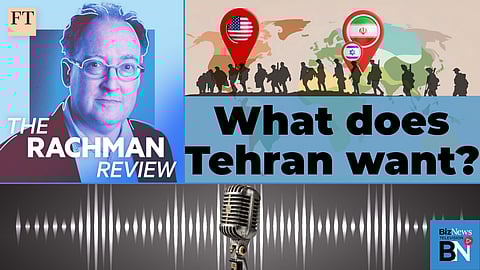
The Financial Times' Gideon Rachman discusses possible negotiated solutions to the Iran war with Suzanne Maloney of the Brookings Institution. What do Tehran's leaders want and how long can they hold out for a winning settlement that will ease the country’s economic pain? What are the stakes for Trump and the global economy? And what role, if any, can Gulf countries play in curbing the regime’s power to blight progress in the region? Clip: Fox News © 2026 The Financial Times Ltd..Sign up for your early morning brew of the BizNews Insider to keep you up to speed with the content that matters. The newsletter will land in your inbox every morning on weekdays. Register here.Support South Africa's bastion of independent journalism, offering balanced insights on investments, business, and the political economy, by joining BizNews Premium. Register here.If you prefer WhatsApp for updates, sign up to the BizNews channel here..Watch here.Listen here.Transcript of the Rachman Review episode.Hello, and welcome to The Rachman Review. I’m Gideon Rachman, chief foreign affairs commentator of the Financial Times. This week, we’re looking at the latest on the conflict between the US, Iran and Israel. My guest is Suzanne Maloney, director of the Foreign Policy program at the Brookings Institution in Washington, an author of several books on Iran.The US has announced a blockade of Iran and the global economic damage is mounting. But President Trump has made it clear he wants diplomacy to start again. But how about the Iranians? What do they want and what might a peace settlement look like?[MUSIC PLAYING]JD Vance voice clipI wouldn’t just say that things went wrong. I also think things went right. We made a lot of progress, but we also made very clear — and I think this is part of the progress we made — what the terms where the United States could make some accommodation, what terms we were flexible on and what things we absolutely needed to see in order for the President of the United States to feel like he was getting a good deal.Gideon RachmanThat was vice-president JD Vance speaking after the failure of peace talks between Iran and the US in Islamabad. Shortly afterwards, America announced a naval blockade of Iran, and then a bit later they said that they would like talks to resume. When I visited Suzanne Maloney at her office in Washington DC, I began the conversation by asking her how she thinks Iran is currently viewing the conflict.Suzanne MaloneyI think from the start, the Iranians understood that this was an existential moment for the regime, and so they have responded with a very clear and deliberate plan to try to ensure that the regime survived. But also over time, I think their goal has been to come out of this war stronger and with some sense of deterrence against the United States and Israel.They don’t want to see a repetition of what has now been two rounds of conflict between the parties. So I think if they were to assess where they are today, it is very much having achieved that goal, like keeping the regime intact, gaining to some extent the upper hand by the control of the Strait of Hormuz, and to some extent also dictating the shape and the pace of diplomacy.Gideon RachmanAnd we’ll get on to what the diplomacy might look like in a second, but I mean, it’s striking that you say not only do they want to emerge from this conflict stronger despite all the bombing that’s happened and the killing of the top leadership, but you think it’s quite likely, and if it is the President Trump, they’ll constantly say they’ve been devastated, they barely exist anymore.But you actually think it is plausible that, despite the pummeling they’ve taken, they’ll come out ahead.Suzanne MaloneyYes, and I don’t think that was inevitable at the start of this conflict. You know, certainly in the opening hours when the initial strikes were evident and the president released a video that essentially called on Iranians to cease their government.I think it could have gone in any number of directions, but it’s also been clear from those early moments that the Iranians had a plan that they were prepared for this. Unlike the June, 2025 conflict, in which I think they were to some extent caught off guard by the decision to launch the strikes, even as negotiations appeared to be still viable this time around, they had a strategy and they were ready to implement on it almost from the very beginning.And so we saw the kind of early strikes against their neighbours. Again, that shouldn’t have been a surprise, but it appears to have been the United States and that those strikes were targeting soft targets in the beginning and then clearly directed at economic and energy infrastructure. Iranians have always said that if they can’t export their oil, that nobody else from the region and will be able to export their oil, and I think most of us understood that they were prepared to deliver on that.How effective they could be at a time where they were being bombarded by two militarily, technologically, economically superior adversaries was always in question. And there, I think we’re gonna take a lot of takeaways from this war in terms of the new way of war, just as many have been doing from the conflict in Ukraine, about how a weaker adversary can actually take advantage of ingenuity, of opportunity and really seize the advantage. And that’s what I think the Iranians did, even within the first week of the war.And while they continue to suffer pretty severe damage to their infrastructure, you know, the toll from this war will only be really fully understood in the months after the conflict ends. I think the regime itself, by holding, by sending the delegation that they sent to Islamabad — a very high-level, capable delegation — and continuing to retaliate in ways that are not wild and unfocused, but very deliberate and targeted and also measured in terms of how they’re using their residual resources.I think we see the capabilities of this system that were definitely underestimated.Gideon RachmanAnd President Trump, you know, announced a blockade, but then very quickly followed through just today, we’re talking on Tuesday, by saying, well, he’d like talks to resume. From the Iranian point of view, do you think they’re keen to talk and what are their major asks?Suzanne MaloneyWell, it’s been interesting that the first round of talks was 21 hours. That’s a pretty epic negotiating session. It sounds as though they were trying to achieve a lot in that very first session. But the gaps, while significant, are not insurmountable. The Iranians do not want to give up their enrichment programme. The United States would like a permanent cessation of the enrichment.Iranians are not enriching at this point in time for the first time in about 20 years, and so they’re prepared to extend that for some period of time, not indefinitely. Whether that gap can be bridged,I do think that it’s possible, but you know, the administration needs to tow a fairly tough line because they came into this with such gargantuan ambitions of changing the regime. They’re not going to achieve that. They now have new goals that they have to achieve in terms of reopening the strait, and so they need to be able to show that they can deliver on something.And the nuclear programme is going to be a continuing concern. This is the way the general public thinks of Iran is really just a nuclear issue, even though it’s far more complicated. And the larger question is the residual highly enriched uranium, some of which is buried ostensibly near Isfahan, some of which may have been dispersed before the prior conflict. And I think that is a very critical issue for the administration to get some headway on in terms of what the disposition of it is, the access to the wider infrastructure of Iran’s nuclear programme heavily destroyed.But there’s a lot that was built up since President Trump walked away from the deal in 2018. And it’s not clear to me that we have an entire accounting of every advanced centrifuge, as well as the highly enriched uranium. All that has to be dealt with.Gideon RachmanSo that’s the nuclear issue. And you say that they’re quite far apart, but you reckon they could somehow find something in the middle.But the issue that’s really only emerged because of the war, which is the closure of the Strait of Hormuz. Iran seems to me to be pretty adamant that it wants to be able to toll it in the way that Egypt controls the Suez Canal. And the US has said repeatedly that’s unacceptable. And I think most countries around the world would be reluctant to see that happen.How do you think that’s gonna come out?Suzanne MaloneyI think that right now, that is probably the hardest issue for the two sides to bridge because this is what has enabled the Iranians to persevere. This is what is giving them the leverage that they have today. And if they see it entirely in the course of these negotiations, they will be the weaker party at the end of this war and that is not what the regime wants.I don’t know what the formula that could enable this to move forward. Perhaps some kind of a temporary arrangement in which there is a modest fee applied to passage through the strait that benefits postwar reconstruction on both sides of the Gulf. That’s a proposition that I think is at least tenable to other parties, but you know, we really have to come down away from the $2mn a tanker that the Iranians appear to have been extorting.The other formula I’ve heard is $1 a barrel of oil, and in fact, I was called to big people in the energy industry said, yeah, we could do that. I mean, you know, it’s 1 per cent we’d barely notice. But I guess what might work for an oil industry executive would not work for Iran’s neighbours or the US.Suzanne MaloneyWell, and of course, there’s a lot of other commodities that pass through the Gulf. And how do you address the empty tankers that are going in? And it’s a complicated scenario, and I think one of the difficulties here is we don’t have an obvious precedent.My colleague, Aslı Aydıntaşbaş, had a wonderful piece in the New York Times describing the Montreux Convention as a potential model. It’s not an exact one, but . . .Gideon RachmanWhat did that do?Suzanne MaloneyThis really addressed a different strategic waterway and brought the international communities to a set of agreements around protecting freedom of navigation.Gideon RachmanThat’s the Bosphorus, yeah?Suzanne MaloneyYeah. I don’t think that that’s . . . it’s not entirely applicable to this sort of scenario, and obviously it would take time to negotiate something like this, but I think that we are in a set of circumstances in which the Iranians had the ability to endure this current crisis without as much pain as the international community is going to be facing, if in fact, they don’t reopen the strait, and so this is the leverage that they have. That time is on their side, both in terms of the economic pain, the political fallout for the president and his party facing midterm elections. And of course, if we saw a resumption of the conflict, there’s also the question of munitions and interceptors in there too.They have been very careful in ensuring that they can continue the war and potentially for longer than we will be able to supply our partners and allies in the region with what they need to intercept some of the ballistic missiles and Iranian drones that have been causing the damage.So from Tehran’s side, every day that this continues, they gain some advantage. And from the international community side, every day that this continues, the economic fallout is potentially far worse.Yeah, well, in fact, I wrote a column saying time is on Iran’s side. And that is kind of my view. But in a second, I want to just press you on the counter-arguments because there are counter-arguments.But before we get on to that, let’s stick with the negotiations for a moment. So we’ve talked about the nuclear issue, we’ve talked about the Strait of Hormuz issue. Any other big dossier on the table that they’re gonna have to solve?Suzanne MaloneyWell, I mean, the United States would like to have something in which the Iranians commit to an end to support for their proxy militias around the region, like an end to the Iranian ballistic missile programme. I think those things are going to be very hard to extract at the negotiating table. TheIranians would like to see some kind of reparations, formal reparations. I think that too would be inconceivable for the United States and Israel, although one could imagine that whatever formulas worked out around the strait is essentially a proxy for some kind of reparation payment.Gideon RachmanWhat about sanctions? Because Iran is saying it wants sanctions lifted. Might the US do that?Suzanne MaloneyThat’s the other piece. I think Iran believes it’s going to come out of this crisis in a stronger strategic position, but they also need to address the dire straits of their economic conditions that drove people to come to the streets in January in such large numbers, and in some way may have given rise to the presidency ambitions with this war of regime change.And they’re gonna have even higher burdens when the war ends in terms of reconstruction, not just of the military infrastructure, but the civilian infrastructure that’s been hit. And so this question of blocked assets is going to be a very critically important one. They were trying to demand that payment before the opening of the Islamabad talks.Don’t believe they received that, but I imagine that will remain on the table. You know, given how idiosyncratic the current administration is, you could imagine a world in which the president sees some potential advantage for American companies in a postwar Iran that is a formulated appeal to women in Venezuela.Gideon RachmanAlso, they could say, sure, I’ll lift sanctions if you give us all the contracts.Yes, this could be something completely unthinkable in any normal administration. But at least it is an avenue that I imagine the Iranians might try to exercise because they have a pretty good read on the president.Gideon RachmanAnd how do you think Israel will be thinking about all this? Because some of these prospects that you raise, presumably, the idea of Iran emerging strengthened from this is kind of anathema to them. And of course, they’re crucial players. They helped to persuade Trump to go to war in the first place. They are fighting alongside the Americans. In the past, they’ve shown a willingness to defy the Americans and keep fighting when Washington would rather prefer them not to.So what do you make of that Israeli component to it or . . .Suzanne MaloneyWell, to add to everything that you just described in terms of the Israeli position, I think there’s also the question of Lebanon and the extent to which are demanding an end to all the conflicts in the region, including and especially Lebanon. And that is a place where I think we will continue to probably disagree.I don’t see any prospect of a near-term resolution of the situation in Lebanon, although there have been talks here in Washington, unprecedented talks in some respects, in terms of bringing theLebanese and Israeli ambassadors together. And so I think the Israeli security doctrine will not change as a result of this war because ultimately, they’ve not achieved their objectives, and they will continue to be prepared to take actions that are both riskier and potentially costlier than the United States will be prepared to take.They do not have the same degree of sensitivity to the wider economic fallout of this war, or even the wider diplomatic fallout for Israel standing in the region and the world as a result of this war.And at the same time, you know, what we’ve seen is that the president was successful in persuading the Israelis to end the June war on his timeline. And if he comes to the decision that the Israelis need to wind down their activities, or if he is unprepared to provide the level of support that has been necessary for the Israelis to undertake some of the missions that they’ve undertaken in this war, I think the Israelis will respect that.Gideon RachmanAre you saying essentially that if the US really wants to enforce its will, they can just stop giving Israel munitions and at some point, that leaves the Israelis little option?I could not imagine that Washington would exercise a sort of power over Israel’s access to munitions and interceptors. I do think that the degree of co-ordination and logistical support that the US has been providing to Israeli bombing rates on Iran has been unprecedented in some respects, and that, in and of itself, if the president wanted those rates to end, but they could end and they have obviously during the course of the ceasefire.So Israelis have other ways and they have exquisite intelligence assets in Iran. They’ve been able to demonstrate their reach, not just in this conflict, but in the course of the post-October 7th efforts to degrade Iranian proxies, both inside Iran in terms of hits against leadership of Hamas, but also in the wider region.Gideon RachmanComing back to Iran, the picture you paint and the one kind of infers is that they’re doing quite well, but one of the reasons that I think President Trump and Netanyahu felt this was a good moment to strike was these internal protests that you referred to, and that hasn’t resurged, but presumably that remains a bit of an Achilles heel for this regime.Suzanne MaloneyRegime is deeply unpopular and it doesn’t really have a way to mitigate the issues that have detracted from its ability to govern its own people. You know, the economy was the driving force, but really, this has been a building resentment against a system that has lost its legitimacy, that is deeply unpopular and highly repressive.And so while there is still a committed base of support within the Islamic republic for whatever revolutionary, theocratic state might be still sustainable. There is really a deep and abiding dissatisfaction that they will not be able to address without some kind of an improvement in both the economic conditions, but also in terms of Iran’s place in the world and Iranians’ access to the outside world.Remember, of course, the Iranians have been cut off from the internet throughout this entire conflict, at an unprecedented level.Gideon RachmanAt the behest of the regime itself.Suzanne MaloneyYes. They have built a system in which they can essentially shut off the connection to international information. And they have imposed that during the protest back in January and once again as soon as the war began.And that is intolerable, I think, for Iranians. And you know, we don’t know what the postwar situation will look like for the regime. That’s certainly in the minds of the leadership. But remember, the people who are in charge now in Tehran are people who have lived through worse in some respects, lived through the post-revolutionary period in which Iran was still racked by instability, economic disruption and internal conflict. And then, of course, the invasion by Saddam Hussein, which appeared to be very successful in its early years. Iranians fought back. They obviously didn’t achieve all of their war aims in that conflict.And I think one of the challenges today is at what point did they decide that they have succeeded sufficiently to enable them to survive this current conflict and begin to look for and plan for the postwar period? They didn’t make that calculation very astutely during the Iran-Iraq war; they carried on with the war, essentially, six years passed, the useful life of the war.They ended evicting the Iraqi troops, they turned down reparation offers from the Gulf. I think this leadership is going to try to maximise what they can get and minimise the extent to which they end the war in a weakened position.Gideon RachmanAnd do we yet have a sense of who’s in charge in Tehran in the sense of, has anything changed?I mean, obviously, Khamenei was assassinated at the beginning of the war, symbolically replaced by his son, another Khamenei in charge. But you know, there had to be a lot of churn at the top of the leadership. Is it behaving any differently or the new faces showing up? Any sense of change?Suzanne MaloneyThere has been some change in the personalities, and I think there has been a shift in the balance of power away from the formal clerical rule that had always been front and centre around the Islamic republic, particularly the supreme leader, because while Mojtaba Khamenei has been named successors to his father, he has not been seen in public. He has only issued formal statements several times. He is apparently communicating behind the scenes. He’s assumed to be grievously wounded, potentially disfigured, and so it’s not clear what kind of a public-facing role he’s going to have is gonna be very interesting to watch.But even without that factor, I think the front-facing public officials at this point in time are almost entirely from the security bureaucracy and the revolutionary parts. It was notable that in the negotiations in Islamabad, Abbas Araghchi, the foreign minister who has deep in extensive experience, especially around the nuclear file and especially around the negotiations with the west, was accompanied by not just his bounty of deputy foreign ministers who also have similar experience, but also by Mohammad Bagher Ghalibaf, who is the speaker of the parliament, but really comes from a background in the revolutionary guard. Having also led the internal security bureaucracy, the law enforcement forces, as well as the revolutionary guard’s construction conglomerate that was established after the Iran-Iraq war to lead the reconstruction, has really become one of those powerful economic factors in the country.And so Ghalibaf, at least in that negotiation, is clearly the lead player, but he’s also surrounded by other military officials with long experience, long and fairly ugly experience. Ahmad Vahidi, the new head of Revolutionary Guard, who is well known to have played a role in terrorist attacks around the world. In previous roles, you know, this is a very hardened and ideological anti-American and radical leadership in Tehran. That may not sound all that different from what preceded it, but I think it’ll be very interesting to see how the dynamics evolve in the post-conflict period. To what extent the formal institutions of the state matter at any point in time, whether it’s the parliament or the presidency, and to what extent this is almost a kind of military coup, to some extent, with the veneer of a theocracy.Gideon RachmanHmm. I mean, we’re talking as we should about what Iran might look after this war, but in some sense, maybe we’re getting ahead of ourselves because obviously the negotiations, if and when they restart, have a long way to go. So just to conclude, obviously, it’s inherently unpredictable, particularly when Donald Trump is president of the United States. But do you think that negotiations could end this conflict fairly rapidly, or do you think we’re gonna be in a kind of long stop-start? Bits of war, bits of talking going on for quite a while.Suzanne MaloneyI think that the only way to end the war is through negotiations. There’s not gonna be a conclusive victory on the battlefield by either side, and so really we’re left to a diplomatic process.I don’t think a diplomatic process is going to be quick or neat. You know, we know from the history of US-Iran negotiations, none of them have been particularly straightforward or short in terms of timeframe. Whether it was the efforts to try to resolve the hostage crisis or the efforts to try to negotiate a nuclear deal, they were long and winding roads.I assume this one is going to be probably with additional bursts of conflict, but I think the president has a trip to Beijing coming up. He wants to be able to put this issue in the rear-view mirror to some extent, particularly after the remarks of Chairman Xi in recent days. He wants to have a good summit and it’s going to be very difficult if the war is still raging at that point.Gideon RachmanAnd yeah, you say it could be a long and winding road, and previous negotiations took months, years. The JCPOA was going on forever and ever, but we didn’t have that time or, because meanwhile, the economic damage of the closure of the Strait of Hormuz mounts and mounts. So, in that sense, is there added pressure to complete it? Although you said earlier, Iran at least feels that it can play along.Suzanne MaloneyIran believes that time is on its side, but I think they also understand they can’t overplay their hand, that there’s a shelf life to the set of circumstances. They will also read, I think, the remarks from Beijing. Some degree of impatience with this issue.Gideon RachmanWhat did the Chinese say?Suzanne MaloneyEssentially, it was a criticism of the United States in terms of the meeting between Xi and Emirati leaders. But I think it’s also an indication, and we see this even in the pressure apparently exerted by Beijing on Tehran to join the talks in Islamabad last weekend, that the Chinese would like to see an end to this conflict because it will have a huge blast zone in terms of the way that it plays out for the global economy, on agriculture, on technology, on everything that involves shipping. And China has built this economy on its global engagement, and they will feel the fallout from this despite the fact that they obviously weren’t part of precipitating it.Gideon RachmanRight. And wouldn’t it be ironic if a conflict that the United States and Iran are involved in is ended partly through pressure from China?Suzanne MaloneyIt would be an interesting list of fate that Chinese have sought to expand their strategic profile in the Gulf, and I think that this war will certainly accelerate that process. They have rarely played the role of most meaningful actor in terms of driving toward a resolution of any conflicts. And so if, in fact, the Chinese assumed a more prominent role, this would be a watershed moment.Gideon RachmanYeah. I did say earlier, we should consider the counter-arguments that, you know, actually, maybe we’re getting this wrong. And some people, when I wrote Iran has time on its side, said no, you know, the Iranian economy’s in a terrible shape. The blockade will bring it to its knees. They’ve been devastated. You know, don’t panic now, America can still win this thing. What do you say to that?Suzanne MaloneyI understand those arguments, and I think that there’s a lot of truth to them. The Iranians are not the 10-foot-tall giant that they are trying to project, and they will have to deal at the end of this war, I think with some pretty serious issues at home.However, I think they can leverage the time advantage at this point, and they also haven’t used all of the arrows in their quiver. The Houthis have been fairly quiet. The routes of exports for Saudi oil, about 7mn barrels a day, getting out through Yanbu. The Iranians or the Houthis could complicate that very quickly and they could also do further damage to energy infrastructure that would delay returning some of those exports through the strait if, in fact, we can reopen it.So I think this is the real challenge, the ton question, because every day that this conflict continues, it gives the Iranians slightly more advantage and it hurts the wider international community more, you know. They’re preferred to wait that out and I think it’s very clear that the president is not. I think it’s very clear that the international community could not withstand additional weeks or even months that it would take to mount a military operation to enable the United States to reopen the strait through force.That’s not really an option. And so this is why I come back to the idea that we have to negotiate a way out, and that, unfortunately, does give Iran some advantage.Gideon RachmanFinal question, then: what are the Gulf neighbours thinking? I mean, they’ve kind of had a golden era for the last 10 years. UAE is this global hub, Mohammed bin Salman has an incredibly ambitious vision for Saudi Arabia. Everyone’s paying court to him. If there’s a piece somehow, are they back on track or do you think their model is damaged long-term?Suzanne MaloneyI think they’re gonna be dealing with the fallout of this war well after the end of the war itself. I think that investors, tourists, you know, the sports industry and some of the other places in whichthe Gulf was beginning to reimagine, not just its economies, but its societies and its political model, will be damped in the short term and it will very much depend on what things look like in Iran.The stability of Iran now becomes an existential issue for the Gulf States as well. And I think, you know, we had seen this kind of pivot in the way the Saudis were approaching Iran. They had sought to co-opt the Iranians.I don’t see a pivot away from the United States in terms of their relationship, but it’s gonna be very clear to them that they can’t afford a giant sucking wound to their north that is incentivised to extort access to their economies as a means of trying to manage its own crisis. They could be part of a solution here in terms of targeted sanctions, really, that enable some Gulf investment in Iran.You could imagine these very unusual and non-traditional ways of trying to ensure that there is some vision of a shared prosperity. Because the takeaway from this conflict is that the longstanding Iranian posture that if we can’t export oil, no one can export their oil, has been expanded to the general prosperity and stability of the region that the Iranians are prepared to target their neighbours in order to ensure their own survival.That, unfortunately, means that their neighbours are invested in the survival of this regime.Gideon RachmanThat’s so interesting because some of the voices on social media, you hear coming out of the UAE, some of the louder voices, they’re very, you’ve gotta finish the job. We can’t live in the shadow of a more powerful, radicalised Iran, but you are implying that that’s exactly what they’re gonna have to do.Suzanne MaloneyI think it is exactly what they’re gonna have to do, and I think they do feel very strongly that that should be intolerable. But the reality is that we’ve been at war for six weeks now, that we haven’t seen an ability to end the regime itself, and that the regime has figured out a canny way to hold the global economy hostage in order to ensure its own survival. And that’s just the reality of the situation.I think some of this could have been anticipated and prepared for, and that’s one of the takeaways from, I think, the current set of circumstances that the president understood his options. He may not have understood the implications of the options that he was considering, and when it goes wrong, it goes really wrong.[MUSIC PLAYING]Gideon RachmanThat was Suzanne Maloney of the Brookings Institution in Washington, ending this edition of The Rachman Review. Thanks for listening. And please join me again next week..© 2026 The Financial Times Ltd.