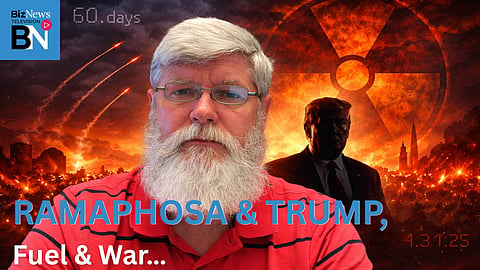
South Africa's foreign relations are under renewed pressure. At the same time, the country is being hit with the fall-out from the Iran war. In his latest interview with Chris Steyn, US intelligence analyst, retired Colonel Chris Wyatt dissects the rhetoric flying between Washington and South Africa over its exclusion from the G7 Summit in France. He also slams the war talk between Trump and Iran. “The rhetoric from both sides, from the theocracy in Tehran and from the government here in Washington, that's not helpful.”He analyses rumours surrounding Kharg Island and boots on the ground ahead of the two-month mark when Trump will have to get approval from Congress to continue with the war. And he comments on the fuel supply crisis hitting South Africa as a consequence of the war and news that a tanker might be heading to South Africa. “But if you keep...poking the bear and he starts paying attention and being poked in the backside or in the ribs, they may turn around the Seventh fleet to intercept that tanker and they won't get those millions of barrels of oil coming to South Africa.”.Sign up for your early morning brew of the BizNews Insider to keep you up to speed with the content that matters. The newsletter will land in your inbox every morning on weekdays. Register here.Support South Africa's bastion of independent journalism, offering balanced insights on investments, business, and the political economy, by joining BizNews Premium. Register here.If you prefer WhatsApp for updates, sign up to the BizNews channel here..Watch here.Listen here.Edited transcript of the interview.Chris Steyn (00:01.563)South Africa's foreign relations are under renewed pressure. At the same time, the country is being hit with the fall-out from the Iran war. With me is US Intelligence Analyst, retired Colonel Chris Wyatt. Welcome, Chris. Colonel Chris Wyatt (00:18.38)Hey Chris, good morning, well good evening for you. It's still early morning here in Nevada, in Las Vegas, this Sin City. I hope you're doing well. Certainly doing better than U.S-South African relations, I imagine. Chris Steyn (00:30.449)Washington has denied blocking South Africa's invitation to the G7. What do you think? Colonel Chris Wyatt (00:39.438)Well, it's interesting to see this come out. And in my view, a government that talks a lot about others spreading disinformation is very good at disinformation campaigns. Vincent Magwenya came out and made a claim that France backed off because the U.S. threatened France. Well, anyone who knows U.S.-French relations knows that that seems highly implausible. Emmanuel Macron especially doesn't do anything the United States asks or tells him to do. And France doesn't do anything America tells it to do, whether it's in NATO or it's in the European Union or its bilateral relations. The French have always been stickly and prickly when it comes to relations. Of course, remember, they famously withdrew from the command structure of NATO back in the 1960s because Charles de Gaulle had a bear up his backside. And he made an intentional effort to destroy the American economy by convincing countries around the world to exchange the dollars in their banks for gold, which is a reason we're no longer the gold standard, because France made a run on gold and they drained the U.S. Treasury of its gold reserves and nearly caused a dollar to collapse as a currency, something the BRICS nations would aspire to do but don't have the ability to accomplish. So it seems implausible. And within an hour of that report coming out of News24, I'd already done an analysis of that and said, no, it's not possible. I had not talked to any government officials about this. But what seems clear is that the South African government wants to play the role of martyr here, the role of victim, and play this up. So what's interesting is after this came out, I did my report. And then a short while after that, Ramaphosa was interviewed and he said, no, no, no, we're not part of the G7. It's not surprising. We're not going. Not an issue. Then he goes to an ANC party conference and he turns the story around completely and says, we will not be bullied by countries that are Right Wing and attacking, you know, the global order and we're high and mighty and moral and we defend these countries. And the whole thing is just utter nonsense. It's poppycock, it's balderdash. I have to say that it's becoming more and more obvious when the government of South Africa wants to spread this disinformation. The French themselves have clearly stated publicly that they were not pressured by the United States. That's from the French. In addition to that, the United States government came out and said, no, we didn't pressure France anything. It's French soil…. So I'm not really sure what's going on there, why they believe that the US is pressured. It sounds to me like the entire story is made up. Or perhaps the South Africans have been hoodwinked… Colonel Chris Wyatt (03:00.584)…by some French officials who are trying to lay the blame on America for their own actions. That seems to be a possibility too. But rather than go meet with Brent Bozell or contact the embassy in Washington and ask the embassy in Washington to get a meeting with Marco Rubio and see if the US had anything to do with this, no, Vincent Magwenya and the South African government proudly and happily come out and trot out rumours and innuendo. Look, there's nothing for the US to gain or care about them going or not going to the G7 Summit. I don't know why they would go. They're not a G7 member, but apparently Kenya has been invited in their absence. But that's France's prerogative. It's taking place in France. They're a G7 member, and they're welcome to do it. But this is just nonsense coming from the government of South Africa. One of two things, Chris, either the government of South Africa is very gullible and stupid, which seems possible, or it's a disinformation campaign. And I think maybe it's a little of both. Even the likes of President Ramaphosa have continued to run around and call the U.S. Refugee Program for South Africans an Afrikaner policy. There's no such policy. The Refugee Programme, for instance, and it's been known since the 10th of February, 2025, posted on your embassy's website. It's still there...it is for those of Afrikaner ethnicity and racial minorities. And if you don't believe that, Hey, I encourage the officials at DIRCO to come watch my videos where I've interviewed South Africans who are Indian, Coloured and black, as well as white, and those who are English speakers, not just Afrikaners. Anyway, that was a long answer, Chris, but I think it's a disinformation campaign. Chris Steyn (04:44.036)Thank you, Chris. Meanwhile, US President Donald Trump has threatened to obliterate Iran's energy infrastructure if a deal is not struck soon. Colonel Chris Wyatt (04:57.168)Yeah, I saw that. That's a little bit disturbing. This is...I hope it's just a bunch of bravado. I really don't think it helps the situation. The rhetoric from both sides, from the theocracy in Tehran and from the regime in Washington...well, I've called my government regime. Look at that. No, but from the government here in Washington, that's not helpful. I seriously doubt we would obliterate Kharg Island. That would have a very serious economic long-term impact on Europe, on Japan, on South Korea, and on China. And the impact of that will have a ripple effect across the global economy, of course, because all of us have foolishly outsourced our manufacturing to the Chinese communist. So, regardless of whether we like it or not, we all around the world depend on China making cheap and expensive garbage and good products, too. So this is, I think, a bit of hyperbole. And I hope that's the case. The smarter move would have been long ago to send in, as we talked about previously, to send in Delta Force and or the SEALs, capture the island and reinforce it with the Ranger Battalion and then just take possession of it and stop Iran's oil exports. That would have crippled the country. Not really sure why we didn't do that. From an operational standpoint, it seems to me like a major failure. From a strategic standpoint, it's also a bit of a failure. It's comical to see some of these experts come on. I saw a retired general officer from the National Guard who was on one of the US channels here in the States, formerly MSNBC, last night, talking about the troops that are coming into the region. And he said, well, they'll have to fly in now because the Iranians control the straits. I'm not really sure what that general officer in the National Guard did in his career, but we had 250,000 coalition troops that were in the 2003 Iraq conflict. They were almost all flown into the region. And I participated in the 1990, 91 Desert Storm operation. We had 650,000 troops who all flew in. We don't go on many ships, only a handful of people come on ships. I don't know what this guy's talking about, but the bottom line is that this is a very dangerous rhetoric and I hope that it's just hyperbole from President Trump. Destruction of that facility would be very seriously bad news for the global economy and for the long term. It would have a major impact. I mean, these countries around the world are desperately dependent on Iranian oil. Now, South Africa is not one of them. South Africa gets a lot of its oil from Nigeria, but the US is not one. We get virtually no oil from the Middle East. But these other countries, without that oil, their economies will freeze up. Chris Steyn (07:27.994)Chris, Iran has called Trump's demands excessive. What do you think? Colonel Chris Wyatt (07:35.608)Well, from Iran’s perspective, I suspect they would. He wants unconditional surrender. That seems a pretty serious condition. He hasn't talked about that recently. But I think Iran also has ludicrous expectations, too. They now have a new demand. They say they're willing to talk peace, but they... Colonel Chris Wyatt (07:54.296)They say they're willing to talk peace, but the problem with this story is that now they're demanding that they have exclusive rights to the Strait of Hormuz. Sorry that there's other countries there on the other side of the body of water which have rights to that in their exclusive economic zone. We cannot give those rights or claims to Iran, and even if we could, we would never do that. That's a foolish move. The Iranians are being outrageous. I think it's maybe a consequence of...the head of the government has been snapped off and many of the key leadership positions are gone, and the people in charge really don't have experience or aren't bright enough to understand that that's not a real negotiating position. Demanding that you have sovereignty over the Strait of Hormuz, absolutely unacceptable, not gonna be tolerated. And again, we don't even have the authority to do that. I mean, even if we said, sure, it's yours, it's not like that makes it theirs. They'd have to have an agreement between nations and that's...they're the ones being unreasonable, and it's costing their economy and their ability to threaten their neighbours. And you notice that the Gulf states and the other states and regions aren't screaming or squawking loudly about the U.S. and Israel ending this campaign. Isn't that strange? Despite the fact that missiles have been raining down on their cities and some of their citizens have been killed, their hotels have been attacked, desalination plans, oil infrastructure, despite all of that, these countries are not screaming for the United States and Israel to stop this campaign. Why is that? Because Iran is a genuine, credible threat to everyone in the region to global peace, and these countries know it, and they're willing to pay the price while Israel and the United States bear the brunt of the burden of taking out this theocracy and its ability to threaten and harm its neighbours. So there you have it. I think that Iran is the one with unreasonable expectations. Trump's unconditional surrender, that's an unfortunate thing. It didn't really give the Iranians a glide path to peace or to end the conflict, and he hasn't said much about it. So, perhaps he keeps talking about the Iranians or agreeing they want peace. I don't really know what Trump's up to. But the bottom line here, from my perspective, is that this talk of destroying Kharg Island and this talk of unreasonable expectations from both sides is probably just rhetoric. Perhaps they are speaking behind the scenes. The Pakistanis have said they're trying to play a middle role here in good faith. I think the Egyptians are also trying to work with this. But hopefully, this will end soon. But like I said, the 60-day point, if Trump hasn't wrapped this up, he's going to need Congressional approval to continue. Chris Steyn (10:12.26)Do you think he will get Congressional approval to continue the war? Colonel Chris Wyatt (10:16.991)If you want me to put on my Siener van Rensburg hat right now. Okay. Yeah, that's a tough one. I would normally say it would be an issue, but the Democrats are looking for a hill to die on. And they thought that hill to die on was the Department of Homeland Security and not funding that organisation. But what they did is they angered millions of Americans by forcing them to spend three to four, six hours waiting to go through security at airports. And it has backfired on them. Despite the fake media reports that Americans are up in arms about Iraq, about Iran, a lot more Americans are more concerned about the fact that it took them four hours to wait in line to fly to Las Vegas this weekend or get back home to New York. That's a bigger issue for many Americans. And this is a hill that the Democrats would probably be willing to die on because they are just that opposed to Trump. They have Trump Derangement Syndrome. Whether what Trump is doing is right or wrong, what's fascinating is that every single president since 1979, when Iran declared war on the United States and attacked our embassy and imprisoned our diplomats for 444 days…Ever since they started this war 47 years ago, every single president, Carter, Reagan, Bush, Clinton, Bush, Obama, Trump, and Biden, and now Trump again, every single one of them said Iran is a threat to global security. They can't have nuclear weapons, but it took 47 years for one president to actually take action. So I think that this is just something that was long overdue, unfortunately. And I would hope that civilian casualties are kept to a minimum as this war progresses, but hopefully it'll end soon. We are now five weeks into it. My prediction initially was six weeks, as you recall, but that was before the Unconditional Surrender. So I adjusted it to the 60 days because I don't think you'd get unconditional surrender in six weeks. So we'll see what happens forward, but that's where I think we're at. You know, it's interesting. There's a lot of noise being made in the US and international press. About 50,000 US troops are in the Gulf. True, true. President Trump has sent an additional 2,500 Marines plus 2,500 sailors to the region, and the 2,000 soldiers from the 82nd Airborne were put on alert to fly into the region. But we're only talking about 10,000 more troops than you'd normally find in the Gulf region. The U.S. has troops stationed in many countries in the region. That includes Bahrain, Saudi Arabia, Iraq, Syria, Jordan, Qatar, UAE, and Kuwait. So let's not get all crazy here. 10,000 additional troops compared to 250,000 in 2003 and 650,000 in 1991 is hardly a major escalation of troop presence in the region. Colonel Chris Wyatt (12:43.951)So I think that a lot of this is done for posturing. But if Trump was going to take Charg Island, I think the time has passed. Now it's going to be painful and probably resulting in casualties… Chris Steyn (12:56.726)Meanwhile, Chris, South Africa is facing fuel shortages, queues and fuel price hikes that most people would probably not be able to afford. Colonel Chris Wyatt (13:09.318)I've seen a couple analysts say that they expect the price of petrol to hit 40 rand a liter in South Africa. Now, that's a shocker. That's going to be painful. I think the bigger concern in the short term is because South Africa lacks a couple of things. Because of the corrupt nature of the government in South Africa, the National Strategic Reserve was sold off to a BEE tender, and it's actually the government that pays them to maintain it. But the oil no longer belongs to the South Africans or to the government. I don't know what's going on with that, but it's supposedly 8 million barrels. But 8 million barrels won't last very long for South Africa, Chris. South Africa consumes 612,000 barrels of petroleum every single day, every single day. So eight million, even if it was all devoted to petrol, isn't gonna last long. But remember, that's devoted to lubricants and medicines and plastics and all sorts of things. So it's not even gonna last that long. That's a bit of a concern. I understand supposedly that I've heard… claims that an oil tanker has gone through the Straits and it's headed to South Africa. I don't know if that's true. I haven't been able to confirm that. But the way that Ramaphosa keeps, you know, he's getting a bigger, bigger stick and poking the bear, trying to force the United States to respond and take action. I think this must be an election ploy in advance of this elections to make the ANC a victim. Look, the Americans have attacked us, rally around the ANC flag. We brought you liberation. That's another fairy tale they didn't. But I think that he's poking the bear. I said last night that, you know, that tanker might be heading to South Africa. But if you keep...poking the bear and he starts paying attention and being poked in the backside or in the ribs, they may turn around the Seventh fleet to intercept that tanker and they won't get those millions of barrels of oil coming to South Africa. My point is that South Africa is almost entirely dependent on oil imports. People want to talk about Sasol and its coal to liquefaction process, but its capability is greatly degraded. Sasol has been misused and neglected for years and can't reach its maximum capacity of fuel conversion. So it can't meet the need. I think the amount they can produce per day is maybe 150,000 barrels. Plus, you've got about 5,000 barrels that are dug out of the ground somewhere. Not much. The rest has to come in from abroad. As I said early on, this disruption of oil supply is going to affect South Africa. And unless a couple tankers show up out of nowhere, very soon South Africans will be in a very difficult situation. And there will be fewer cars on the road, not because of potholes, which are everywhere, but because there's no petrol. Chris Steyn (15:32.632)On that somber note, Chris, I'm going to let you go. I know you don't do the usual Vegas stuff, but I'm sure you will find something virtuous to get up to. That was US intelligence analyst, retired Colonel Chris Wyatt on BizNews with me, Christine. Thank you, Chris. Colonel Chris Wyatt (15:55.957)Well, thank you very much, Chris. I appreciate it. Now, I don't get up to the shenanigans in Vegas. I'm just here visiting South African refugees, all of whom are doing quite well here in Las Vegas. No major complaints here. But hey, Chris, always bet on black. I'll go to the blackjack tables and put a chip down for you.