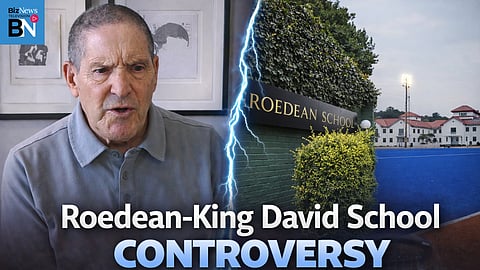
A cancelled tennis fixture between Roedean and King David has ignited a far bigger debate. In this hard-hitting conversation, David Shapiro argues the incident crossed a dangerous line, warning that antisemitism is resurfacing in subtle but troubling ways. From elite schools to corporate boardrooms, he questions the silence - and what it means for South Africa’s moral leadership..Sign up for your early morning brew of the BizNews Insider to keep you up to speed with the content that matters. The newsletter will land in your inbox at 5:30am weekdays. Register here.Support South Africa’s bastion of independent journalism, offering balanced insights on investments, business, and the political economy, by joining BizNews Premium. Register here.If you prefer WhatsApp for updates, sign up to the BizNews channel here..Watch here:.Listen here:.BizNews Reporter.In a week meant to focus on markets and momentum, the conversation with David Shapiro took a sharp turn into the uncomfortable terrain of identity, leadership and social fracture. What began as a routine follow up to a previous interview became something far more personal, and far more urgent.The trigger was a school tennis match that never properly happened.A scheduled fixture between King David, a Jewish day school, and Roedean was abruptly cancelled amid reports that some parents at Roedean objected to their daughters playing against a Jewish school. The explanations shifted. Security concerns were cited. Communication faltered. The King David team arrived to find no proper welcome and no match. For Shapiro, that was the line that had been crossed.“I have never seen this before,” he said. “We’ve always had our debates, our politics, our arguments. But this was the first time I felt something overt. You’re now preventing school children from completing a tennis match.”For a man who has spent decades analysing markets rather than moral disputes, the reaction was striking. Shapiro is not known for party political commentary. He has long insisted on separating economics from ideology, focusing instead on growth, capital flows and opportunity. Yet this episode unsettled him deeply.To understand why, he reached back into history.South Africa’s Jewish community, he noted, has lived through periods of prejudice, but in the democratic era has largely felt secure. Even after the horrors of October 7 and Israel’s war in Gaza, daily life in Johannesburg’s Jewish neighbourhoods continued without barricades or visible fear. Families still walked to synagogue. Children still attended school. Business carried on.“This was different,” he said. “It was a simple act of saying, we don’t want to play against you because you’re Jewish.”For Shapiro, the danger lies not in a single cancelled match but in the precedent it sets. If one school can capitulate to pressure from a small group of parents, what stops others from doing the same. What message does that send to the children involved. And how quickly can social discomfort turn into social exclusion.He was blunt about what he believes is required.“Leadership,” he said. “You need strong leadership that says this is who we are, this is our ethos, these are our values. We are going to play the match.”Instead, he argues, weakness created confusion. In any institution, whether corporate or educational, there must be red lines. Clients, shareholders or parents cannot dictate decisions that undermine the core values of the organisation. When leaders fail to draw that boundary, trust erodes.Shapiro also expressed surprise at the relative silence from prominent voices in business and civil society. Many leaders, he noted, have deep ties to both schools and to the broader community. In his view, this was a moment to speak clearly.“I’m surprised more people didn’t stand up,” he said. “If you don’t highlight it and stop it, then it can develop.”His concern is not alarmist. He is not predicting mass unrest or an exodus. But he does worry about a slow shift in tone, a growing comfort with exclusion justified by geopolitics. He points out that antisemitism globally surged not only after Israel’s military response in Gaza, but immediately after the October 7 attacks by Hamas.“The hatred didn’t start with the bombing,” he said. “It started when Hamas invaded Israel. That’s when it became acceptable for some people to be openly hostile.”That hostility, he believes, has found expression in social media and public discourse in ways that would have been unthinkable a decade ago. The risk is not state policy but social permission. When a community of 50,000 exists within a country of 50 million, it cannot rely on numbers. It relies on constitutional values and societal goodwill.And here Shapiro broadened the conversation.South Africa, he argues, is at a crossroads economically. The global economy is being reshaped by artificial intelligence, data infrastructure and technological investment. The United States and China are pouring billions into new capacity. South Africa, by contrast, risks marginalisation if it drifts into ideological isolation.“We are not building this economy for the good of the people,” he said. “We are isolating ourselves.”He invoked advice from his late friend Jack Shapiro, known as Gypsy Jack, who once told him that in a pub you should always buy the biggest man a drink. If trouble comes, he will stand by you. For Shapiro, the metaphor applies to geopolitics. Align with growth, align with strength, and secure your future.Yet alignment begins at home. It begins with schools that stand firm on principle, with parliamentary committees that treat whistleblowers with respect rather than hostility, and with leaders who understand that values are not negotiable when they protect children.As the dust settles, Roedean has reportedly apologised and leadership changes may follow. Shapiro hopes the tennis match will simply be replayed and completed as it should have been in the first place.“These girls just wanted to play tennis,” he said. “That’s all they wanted.”For a country grappling with economic stagnation and social strain, the lesson may be larger than sport. When ordinary civic interactions become battlegrounds for global grievances, the damage runs deeper than a cancelled fixture. It chips away at the quiet confidence that holds a diverse society together.And for David Shapiro, that is reason enough to speak out.