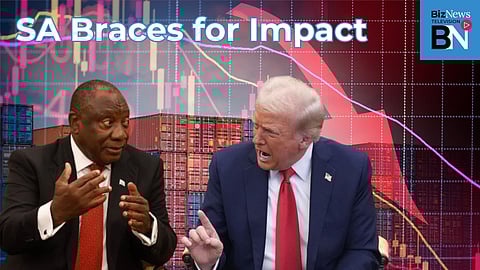
Economist Dawie Roodt warns that looming US tariffs on South African exports are politically driven and could significantly damage the country's fragile economy. In a BizNews interview with Bronwyn Nielsen, he criticises government inaction, highlights geopolitical risks, and calls for urgent reform. With economic growth stagnating, Roodt stresses the need for a new political direction and smarter international alignment..Sign up for your early morning brew of the BizNews Insider to keep you up to speed with the content that matters. The newsletter will land in your inbox at 5:30am weekdays. Register here.Support South Africa’s bastion of independent journalism, offering balanced insights on investments, business, and the political economy, by joining BizNews Premium. Register here.If you prefer WhatsApp for updates, sign up to the BizNews channel here..Watch here.Listen here.BizNews Reporter .In a candid and sobering interview, Dawie Roodt, chief economist at the Efficient Group, laid out the potential implications for South Africa amid rising geopolitical tensions with the United States. With new tariffs looming and political uncertainty mounting at home, the country's economic outlook is increasingly fragile.The conversation, hosted by BizNews’ Alec Hogg, centred on the anticipated imposition of 30% tariffs on South African exports to the US. Roodt, drawing on decades of experience analysing government policy, expressed scepticism over Pretoria’s claims that efforts had been made to mitigate the fallout.“I think the Democratic Alliance is probably closer to the truth than the ANC themselves,” Roodt said. “The government typically waits until the last minute, then scrambles for a solution. I suspect that's what's happening now.”The tariffs, introduced under the Trump administration’s increasingly confrontational foreign policy, are believed to be more political than economic in nature. Roodt was quick to emphasise that South Africa’s economic insignificance to the US - contributing just 0.3% to global GDP - means the tariffs serve a broader political agenda.“This cannot be about economics,” Roodt argued. “It’s about politics - pressuring South Africa to rethink its ties with nations like Russia and Iran. We are not equals here. Trump is the strongest bully on the playground, and whether you like it or not, you will be bullied.”The potential economic cost of the tariffs is not insignificant. Roodt estimated that a worst-case scenario could result in a 0.2% reduction in GDP growth and the loss of up to 100,000 jobs. While this may appear marginal in global terms, it is substantial for a country barely scraping 1% growth annually.“The economy is not growing due to ANC mismanagement,” Roodt stated bluntly. “If we were growing at 5% or 6%, the impact would be minor. But with projected growth at 0.8%, a 0.2% hit is massive.”Amid this backdrop of economic fragility, interest rate policy becomes even more significant. The US Federal Reserve recently held rates steady despite pressure from Donald Trump. Roodt applauded this decision, both for economic prudence and the reinforcement of the Fed’s independence.As for South Africa, he believes there is room for a 50-basis point cut in interest rates, given that inflation is well within target. However, two major uncertainties could stall any such move: the unclear impact of US tariffs and the Finance Minister’s pending decision on potentially lowering the inflation target.“If the Minister reduces the target, the Reserve Bank can then safely cut interest rates,” said Roodt. “But we need clarity on tariffs first.”Looking at the broader global picture, Roodt painted a vision of an international trade order undergoing seismic changes. He acknowledged that while Trump’s policies may be disruptive, they are forcing the world to reconsider long-held assumptions.“Free trade is always good, and Trump is wrong there. But he’s right to question why the US carries so many of the world’s costs - military, economic, and aid,” he explained.Domestically, political shifts are also underway. The government’s unity agreement is beginning to show strain, with the firing of the Higher Education Minister suggesting that the DA’s pressure is yielding results. Yet Roodt remains deeply critical of the entire political structure.“What we have today is a horrible government that survives because of a marriage of convenience between the ANC and the DA,” he said. “The public has lost faith in leadership. We need a new political dispensation - there’s no doubt in my mind.”As the country waits to see the full impact of impending tariffs, Roodt’s analysis offers a stark reminder: South Africa’s international alliances, domestic leadership, and economic direction are all being tested in unprecedented ways.