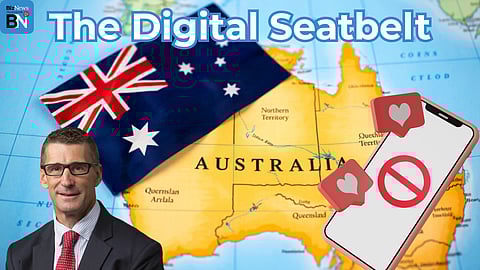
Security expert Rory Steyn reacts to Australia’s groundbreaking move to ban under-16s from social media, explains why tech firms must be held responsible, and argues that protecting teenagers now is as essential as seatbelts once were for road safety.Sign up for your early morning brew of the BizNews Insider to keep you up to speed with the content that matters. The newsletter will land in your inbox at 5:30am weekdays. Register here.Support South Africa’s bastion of independent journalism, offering balanced insights on investments, business, and the political economy, by joining BizNews Premium. Register here.If you prefer WhatsApp for updates, sign up to the BizNews channel here..Watch here.Listen here.BizNews Reporter.Former Nelson Mandela bodyguard and security specialist Rory Steyn says Australia’s decision to ban under-16s from social media could become one of the most important child protection measures of the modern digital age.Speaking to BizNews from Brisbane just hours after the announcement took effect, Steyn described the move as “world-leading” and applauded the Australian government for shifting the burden onto technology platforms rather than parents or schools.“From midnight last night, under-16s are no longer allowed access to social media,” he said. “And crucially, the responsibility is now on the tech companies. If they fail to enforce it, they face fines of up to $50 million.”Major platforms including Instagram, TikTok and WeChat fall under the ban. Authorities estimate that more than 350,000 Instagram accounts and over 210,000 TikTok accounts are being deactivated immediately as the policy is rolled out.Steyn says the legislation is not driven by political opportunism, but by grassroots advocacy led by grieving parents and community organisations.“There’s a group called Let Them Be Kids,” he explained. “It was started by parents whose children died by suicide or were harmed by online stalking, cyberbullying and social media pressure. This movement has been led by the people, not politicians.”A father and grandfather himself, Steyn described the generational contrast with poignancy.“My youngest once said to me, you and your brother come from a golden generation because you never had to grow up with social media,” he recalled. “That really stuck with me.”He acknowledges critics who argue teenagers will find workarounds through VPNs and offshore accounts. However, Steyn believes enforcement will only become tighter.“This is only step one. The next phase is strict regulation with real teeth. The onus stays on the tech companies.”From free speech activists to Silicon Valley giants, opposition is expected. Yet Steyn draws a parallel with landmark safety legislation of the past.“When governments forced car manufacturers to put seatbelts into vehicles, people screamed about overreach,” he said. “Now no one questions seatbelts. You won’t buy a car without them. This is the same principle.”Australia already leads the world on preventative health measures, from mandatory sun protection policies in schools to national sunscreen campaigns. For Steyn, extending that protection into the digital realm makes complete sense.“The principle here is simple,” he said. “Teen safety before tech profit.”International attention is moving quickly. The UK, Europe and Canada are watching closely to see how Australia’s ban performs in practice. If online harm drops measurably, similar legislation could emerge elsewhere.One early projected benefit stands out. Australian officials estimate the average teenager could gain an extra 90 minutes of sleep per night once removed from late-night scrolling culture.“From a mental and physical health perspective, that alone is extraordinary,” Steyn noted.Despite calling Australia a “nanny state” in the past, Steyn says this intervention is fully justified.“In this case, they’ve got it right,” he said. “We have a duty to protect our teens. They are vulnerable, emotionally exposed and too often targeted.”As the world watches the Australian experiment unfold, the central question remains simple: will this become the digital equivalent of the seatbelt moment for youth safety worldwide?