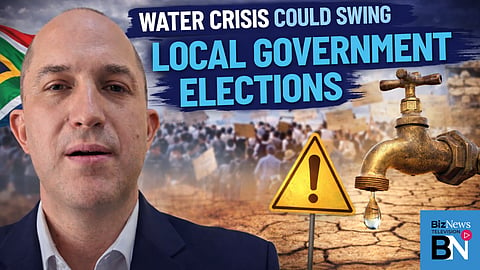
From loadshedding electricity to load shifting water…The water supply crisis in many parts of South Africa against the background of the threat of global water bankruptcy - and the upcoming Local Government Elections is the topic of Chris Steyn’s interview with Stephen Moore, the Democratic Alliance's spokesperson on Water and Sanitation. He describes how protests by long suffering residents have “really actually have galvanised” national government. “So we're seeing a response to the protests, which is which is key. But the honest truth is if nothing happens again, the next summer we're going to have this exact same thing…If we start having water outages in September, October, this issue is going to be the issue of the election.” Moore urges for budgets to be put in place “that are going to fix this, that are going to enable teams to handle this and start turning things around”. Meanwhile, the urges the public to keep up the pressure “because in an election year, maybe we can convince people that the unsexy infrastructure maintenance is the most important thing”..Sign up for your early morning brew of the BizNews Insider to keep you up to speed with the content that matters. The newsletter will land in your inbox at 5:30am weekdays. Register here.Support South Africa’s bastion of independent journalism, offering balanced insights on investments, business, and the political economy, by joining BizNews Premium. Register here.If you prefer WhatsApp for updates, sign up to the BizNews channel here..Watch here.Listen here.Edited transcript of the interview.Chris Steyn (00:01.958)From load shedding electricity to load shifting water. I speak to Stephen Moore, the Democratic Alliance's spokesperson on Water and Sanitation. Welcome Stephen. Steve (00:15.892)Thanks Chris and thanks for having me. Chris Steyn (00:18.896)You're welcome. Please tell us what is the latest on the water crisis, particularly in Gauteng. Steve (00:26.622)I you're opening the door for a huge conversation with the water crisis because it's all over the country and Knysna and KZN and the Northern Cape. But let's focus on, on Gauteng because I think that's the hot button issue at the moment. At the moment we've seen and it's, I have to be careful not to call it water shedding because the terminology being used is water shifting. So Gauteng has basically announced the Gauteng province, the deputy president that in order to balance the available supply in the Rand water system, which supplies Gauteng, parts of the Northwest, parts of Mpumalanga and the Free State, we always talk about Gauteng, but it actually supplies four provinces. They no longer have enough supply for all of the demand. So they're now shifting supply around to try and cover areas. And that's a difficult position to be in because we've seen areas without water for days, weeks. And in the case of one town out in Mpumalanga on the same supply system, over a month now without a drop of water. Chris Steyn (01:32.348)What did you make of President Cyril Ramaphosa's remarks on water during his State of the Nation address? Steve (01:39.37)I was glad to hear so much about water. In the last few State of the Nation addresses, we've got very short shrift, just talking about some inflated big numbers to make it sound like a lot is happening. I think there was real recognition by the president that there is a crisis. It's not just a Gauteng crisis or a Rand Water crisis. It's definitely a national crisis. I was in Knysna a few weeks ago where where it is well publicised… almost hitting Day Zero… their dams drying up. So I'm glad he's spoken it. I'm glad he's given the priority. But Chris, words are something we've heard before. You know, we've now shifted from the deputy president who's heading up the Water Task Team to now the president himself is going to head up a task team. That's great. As long as he has the time to actually do something with it, because I’m to this day, not entirely sure what the deputy president did with the task team. I'm not sure what difference he made to Gauteng because these water outages were completely anticipated. They were to be expected by anyone who understood the system and understood the trends that we were looking at. And I didn't see any preventative action. So great. I'm glad it got the attention it did, but time will tell whether it gets the money attention, the actual time attention, the physical attention on the ground by ministers and the president himself. Chris Steyn (03:08.826)Now we have yet another committee, a National Water Crisis Committee. What do you think that is going to achieve considering that warnings of a water supply crisis going back over decades were not taken particularly seriously? Steve (03:23.228)I, Chris, I'm not sure what they're going to achieve, to be honest with you. Again, this is now the president's committee as opposed to the deputy president's committee. And it's not like there aren't a half a dozen other bodies who have this type of responsibility. I'm always very hesitant about creating other sets of oversight, especially when the challenges are known. The challenges aren't at some level that we need to discover, have a dialogue on, have a committee to investigate. It's the massive non-revenue of water in so many municipalities. Joburg is a good example. Their non-revenue water is between 44 and 48 percent, depending on whose report you believe, which report you read. And to put that into a scale, just the losses, just the physical losses…so those are leaks. For Joburg, it means over 400 million liters of drinkable water are lost to leaks alone. That's not all the water they lose to non-revenue water. That number is closer to 700, 800 mega litres a day. So million liters a day, but to lose over 400 million drinkable litres a day to leaks is is terrible - and I mean obviously Joburg's the big number but I got a stat two days ago from Mogali City and then non-revenue water… Mogali City for those who don't know Gauteng well is a is a smaller municipality on the west of Gauteng…theit non-revenue water is at 80% which means that 80% of the water they buy from Rand Water they don't get paid for and is lost in all sorts of various ways, but also largely to leaks. Chris Steyn (04:55.164)Now, let's say there is political will to deal with this crisis. What is financially and logistically possible? Steve (05:06.288)So there's various levels. At a local level, you know, I hesitate to say this, but it's possible to say that the current mayor has allowed Joburg Water to put in place a good plan. So there's a good plan in place, which is great. But a plan without financial backing won't go anywhere. That's the reality here. Words don't move worlds, money does. And we need to see major shifting in the budget, not minor shifting. There has been some shifting, but it's still less than half of what they need on an annual basis for the next 10 years in order to catch up. And remember, the longer you don't put the money in, the more the system decays and that number ticks up. So from a Joburg perspective, they needed to tighten their belts in other areas. It's what we did in government when we were in Johannesburg. We tightened our belt. We gave other departments a bit less so we could pump more money into City Power and Joburg water. And that's why when we were in charge of Joburg Water, the number of leaks went down everywhere…Only a little bit, I think it went from 48,000 to 47,000 one year and 47,000 to 46,000. But going down, getting better is a lot better than the over 100,000 leaks that are currently happening in the city since it's been under different control. But beyond the municipality, Chris, and I think this is important, is that there are levers in other areas. This is a disaster and I think it needs to be treated as such. There's the ability to shift money around at a provincial and national level…it It was done for it's a eThekwini and when they had the floods, but it was done not for beautification, it was done because they had a water and sanitation disaster. Does that sound familiar? they had a water and sanitation disaster. So they got i think one point seven billion rand of disaster funding to help fix it’s eThekwini. Now that type of money spread across particularly Tshwane which is an accelerating disaster…also because of its size. But Tshwane is a disaster because of how fast the infrastructure is decaying due to neglect or other influences. So those are the two primary ones which need a lot of attention. And there's various grants. I don't want to prescribe it because if I say they should use the Municipal Infrastructure Grant, then they'll say, no, no, no, that's not what it's for. But it has been used for that type of thing beforehand. There's the Water Services Infrastructure Grant from the Department of Water and Sanitation that can also be shifted. Steve (07:30.652)There's various bits and pieces that aren't normally intended for this, but have been used for it in the past. And Chris, Joburg is too big to fail. It's our economic hub. Because if Joburg isn't working, Gauteng isn't working. And to be blunt, Joburg gets the media attention, but Ekurhuleni is feeling this pain. Massive industrial centre. Tshwane the capital of the country, is feeling this pain. And the smaller municipalities, they don't get any of the love, but I promise you they are getting it even worse because Rand Water and everyone know they don't get the attention. So national government, provincial government needs to actually put some money to this attention. Carefully ring-fenced. You know, disaster funding… people look at it and they start getting very excited, Chris, because there's, we've seen with the COVID funding how many problematic things came out of that. But if you ring-fence it correctly, if you release it in tranches which are carefully monitored, there's the ability to make a big difference in a short time. And using the Pareto principle of the 80-20 rule of 80% of the water lost is probably through 20% of the problems. If we can get some money in now to do some emergency fixing now, and Joburg Water knows where these things are. Joburg Water have a really good technical team behind them. Their managing director… is, I believe, a top-notch MD for the organisation. Give them the resources, Chris. And I really believe we can start to turn this around, although the full solution is years away and priority for years. Chris Steyn (09:05.82)Do you think that service delivery in Gauteng is salvageable? Steve (09:13.474)Yes, I have to. I'm a Joburg resident myself. I have a two year old daughter and I often get asked the question as a parliamentarian, don't you want to move to Cape Town? And you know, I love what my party is doing in Cape Town. You know, there's always challenges, but they're doing some great work here. But I love Joburg. I was elected as a parliamentarian for Gauteng, regional rep for Gauteng. I don't want to go anywhere else in the entire world. This is, you know, Joburg is where I want to be. So we need to fix it. And I worked in the administration years ago. So before I was a member of parliament, I worked for Tshwane. Before that, I worked for Joburg in the water and electricity space. And I can tell you, I know this can be fixed. Not easily, not overnight. In fact, in a five year term, you'll still have problems with the best team. Give Helen Zille a five year term and there will still be problems at the end of it. But Chris, there'll be a lot less problems. There'll be fewer issues to tackle and every issue that gets solved means more money that isn't being spent on emergency repairs, more money that goes into general service delivery, and five years in with concerted effort, not only will be water and electricity be under control, but the general city will just see a huge change, like happened with Cape Town in her first term there. Chris Steyn (10:32.698)On top of this, the United Nations has warned that the world is entering an era of global water bankruptcy. How is that going to blow back and aggravate the crisis here? Steve (10:48.533)I was very interesting. We actually attended a international conference at the end of last year as part of the Water and Sanitation Portfolio Committee in Parliament and a lot of areas around the world, first world country, third world countries, the global north, the global south are facing these pressures. Ethiopia, as ever, is absolutely in a dire state. And the core issue is when your population rises and you haven't adequately prepared with infrastructure or else you're reaching the stage where you cannot cope with that population anymore with the traditional water sources, you need to have made a plan. Otherwise, demand is going to increase above supply, not due to a manmade reason like we're experiencing in Gauteng, but purely there's only so much water going around. So then you need to start looking at more advanced technologies, water reuse. And desalination, although desalination is not the magic bullet that people hope it is, it's very expensive. And in our fiscally constrained economy, I'm sure you know, Chris, like you don't want to go for the most expensive option. You want to fix the easy solvable bits, get the infrastructure working properly, stop losing billions of rands worth of water to the ground. And then you can start worrying about that. But in the long term, we're going into a drier year ahead . And we are seeing global temperatures rise and in a water scarce country like ours, we are, we are decades behind where we should be in order to be fully prepared as, it gets drier and hotter. Um, and so the longer, as I said, the longer it takes for, people to really start taking this seriously and investing in the future. And that's always a challenge with infrastructure. The future isn't sexy now. It doesn't help me in my election come November this year when the local election comes because the pipes are still being laid, the plants are still being built, the refurbishments are still being done. You know, you want a shiny, a shiny ribbon that I can cut with a golden scissors. But the harsh reality is you need someone who's going to go, I understand it's not sexy, but we need to do it anyway. We need to find the money to do it anyway, because that's the only way you get longevity. And I'll say even in the United States with all of its billions, they have this problem because infrastructure… Steve (13:07.073)…is not an obvious thing for politicians to want to invest in, but it's an intrinsic part that maintenance, that regular maintenance and upgrading of infrastructure is part of our policy at least. And it needs to be. It's the only way we're going to cope with what you're talking about. Chris Steyn (13:24.38)Lastly, long suffering citizens are to use that quaint South African word, gatvol. And we are seeing protesta. This is an election year. What are you predicting unless these problems are being dealt with in a visible and effective manner? Steve (13:47.2)I probably shouldn't say this, Chris, because it's a possible Manna from Heaven for my party. But obviously, the ANC, you can see that they are very concerned. And that's what I'm so grateful for the protests. I understand that my water goes out. I have a two-year-old daughter. And you must know when you're the DA's Water Guy and you don't have water at home, your wife is understanding, but there's still the pressure. So the protests really actually have galvanised national government. When the president does the speech he did in the SONA, when the Minister of Water and Sanitation, even though she went in and out and didn't stay very long, she did supposedly fly and spend some time in Gauteng, the Minister of COGTA, I see anything with him in it, but he was supposedly also sent to Gauteng. I know the deputy minister… is on the ground working on the issue. So we're seeing a response to the protests, which is which is key. But… …the honest truth is if nothing happens again, the next summer we're going to have this exact same thing. And we were very fortunate this year. We had a cool and wet spring into summer. December was particularly cold and wet. Otherwise this would have started a month earlier. But September, October, if we get a dry year, which is possible, it's a La Nina year in terms of weather patterns, which for our area means drier, inland South Africa means drier. If we start having water outages in September, October, this issue is going to be the issue of the election. And I say this because I, like I say, I probably shouldn't, but I say it because I'm also a resident of Joburg of Gauteng. And I want people to wake up now, start putting the budgets together now, because now's the time you have to start working in your budgets for the next year. Let's put in place the budgets that are going to fix this, that are going to enable teams to handle this and start turning things around. So keep the pressure up is what I'd like to say to people, because in an election year, maybe we can convince people that the unsexy infrastructure maintenance is the most important thing. Watering your tap is the most important thing that they need to deal with. Chris Steyn (15:55.024)Thank you. That was Stephen Moore, the Democratic Alliance's spokesperson on Water and Sanitation, speaking to BizNews about the water crisis, not only in Gauteng but across the country. Thank you very much. I'm Chris Steyn for BizNews.