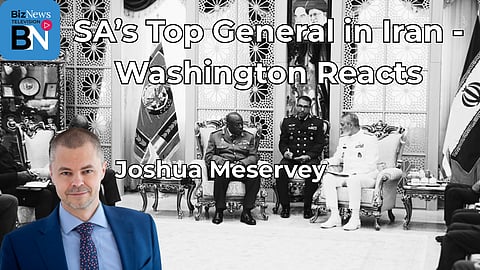
Washington’s patience with Pretoria is wearing thin. Senior fellow Joshua Meservey of the Hudson Institute warns that the head of South Africa’s defence force, General Rudzani Maphwanya, may have dealt a fresh blow to US–SA relations with his recent trip to Iran and remarks in solidarity with its regime. In conversation with Alec Hogg, Meservey unpacks why the incident - whether sanctioned or not - will deepen mistrust, complicate trade negotiations, and feed growing US frustration over Pretoria’s political choices..Sign up for your early morning brew of the BizNews Insider to keep you up to speed with the content that matters. The newsletter will land in your inbox at 5:30am weekdays. Register here.Support South Africa’s bastion of independent journalism, offering balanced insights on investments, business, and the political economy, by joining BizNews Premium. Register here.If you prefer WhatsApp for updates, sign up to the BizNews channel here..Watch here:.Listen here:.Highlights from the interview.When news broke that General Rudzani Maphwanya, the chief of South Africa’s National Defence Force, had travelled to Iran and delivered remarks in open solidarity with its leadership, many South Africans were left bewildered. The trip - and its messaging - was not only politically charged but, according to the presidency, unauthorised.For Washington, the episode was another confirmation of a pattern: warm rhetoric about “resetting” relations with the US, followed by actions that do the opposite. Speaking to BizNews, Joshua Meservey, a senior fellow at the Hudson Institute, described the reaction in American policy circles as a mixture of exasperation and resignation. “People in Washington almost just shake their head,” he said. “They’re not even particularly surprised anymore.”The tariff shadowThis incident comes at a delicate time. South Africa is lobbying to ease the 30% tariff the US imposed - the highest in sub-Saharan Africa. That rate, Meservey explained, isn’t just about trade disputes; it reflects political misalignment with US foreign policy priorities.Under former President Donald Trump’s tariff framework, “reciprocal tariffs” can be increased when a country’s policies undermine American national security interests. For the US, South Africa’s close ties with countries like Iran, and its positions on conflicts such as Israel–Hamas, fall squarely into that category.Even if Pretoria presents a strong trade and investment package, Meservey doubts it will meaningfully shift the tariff rate. “Making some concessions on pork or chicken is not going to move the needle,” he said. “The core problem here is political.”The military parallel that mattersTo understand the gravity of Maphwanya’s move, Meservey drew a US comparison: “It would be like the chairman of the Joint Chiefs of Staff going to a geopolitical flashpoint and taking sides, without clearance from the president.” In the American system, such an act would be career-ending.By contrast, Pretoria’s response has been to distance itself procedurally - saying the trip was not authorised - without condemning the substance of Maphwanya’s remarks. That nuance is not lost on Washington. “They’re not condemning that he aligned with Iran,” Meservey noted. “They’re condemning that it caused bureaucratic embarrassment.”The optics are troubling for another reason: President Cyril Ramaphosa has previously dismissed a deputy trade minister for travelling to the US without permission. If Maphwanya’s trip was indeed unsanctioned, Meservey said, “for consistency’s sake alone, he must fire him.”A record that hauntsMaphwanya’s tenure has already drawn criticism. He was in charge during the July 2021 unrest in KwaZulu-Natal, when the army’s absence in the first days allowed looting and violence to spiral before community groups pushed back. Now, his high-profile appearance in Tehran is viewed as another lapse - one with international consequences.The BEE factorUS frustration with Pretoria isn’t confined to foreign policy. Black Economic Empowerment (BEE) laws, Meservey argued, are a “huge non-tariff trade barrier” for American companies. The Economist recently joined a chorus of critics, arguing that the policy has entrenched inequality while enriching a small elite.Meservey said Washington takes note. “Whether or not you agree with the reasoning behind BEE, it imposes immense cost and difficulty on doing business in South Africa. We don’t demand that of South African firms entering our market.”He doubts the ANC can abandon BEE, not only for ideological reasons but because it is one of the few pillars the party can still claim as part of its liberation legacy. “If they abandoned core components of this supposed struggle, they might have to confront the fact that they have failed spectacularly in governing this country.”The Jackson billLooming in the background is Representative Ronny Jackson’s bill in the US Congress, which could formalise punitive measures against Pretoria. Having cleared committee stage, the bill now awaits a full House vote. Meservey said the Iran trip could bolster its momentum when Congress returns from recess.The road aheadFor Pretoria, the choices are all bad. If the presidency’s claim is accurate, Ramaphosa risks looking weak for not firing his top general. If the trip was authorised, it confirms a deliberate alignment with a regime that Washington views as a state sponsor of terrorism. Either way, the fallout further damages South Africa’s credibility.Meservey’s bottom line: “The best case scenario for Pretoria is that the president doesn’t have control over his own defence forces. And that’s still a terrible signal to the United States and to the West.”In an era where diplomatic missteps can have swift economic consequences, General Maphwanya’s visit to Tehran may prove to be one of Pretoria’s most costly own goals yet.